How to Prepare for an Apocalypse: A Beginner’s Plan
Turn a vague intention to prepare into a practical sequence: use what you own, close the most important gaps and check that your plans work for your actual life.
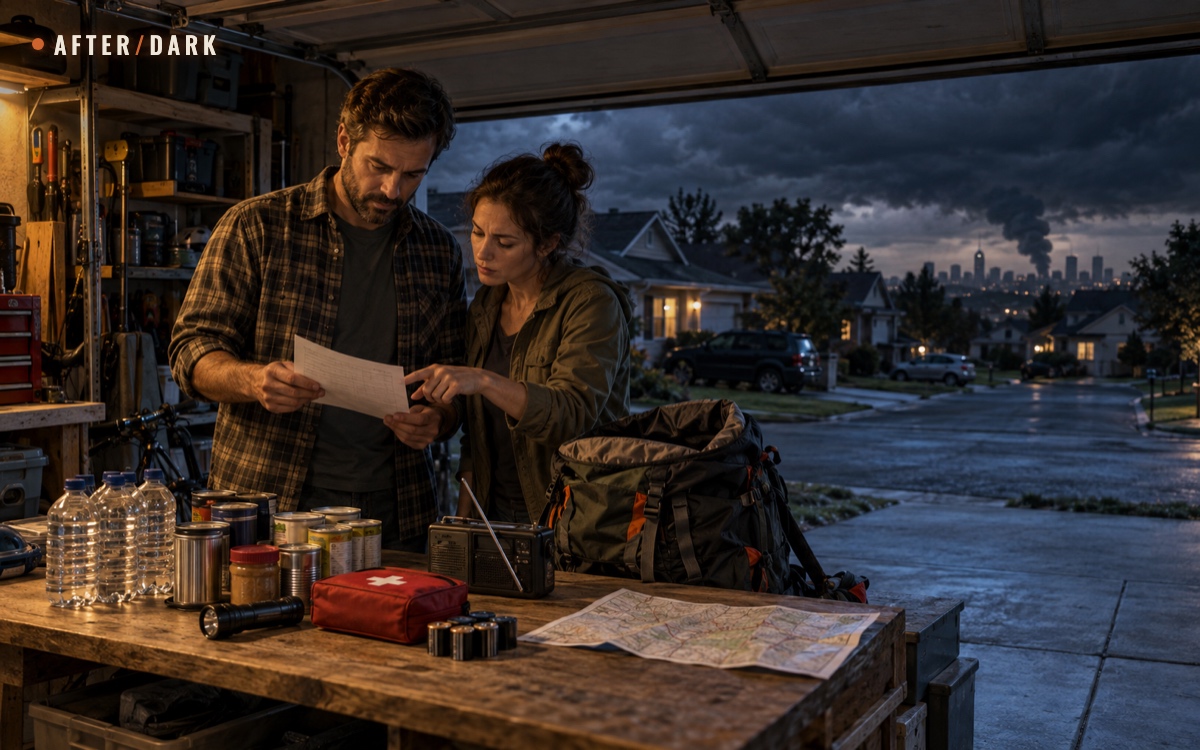
Short answer
Key takeaways
- Start with your actual routines and existing possessions; a missing arrangement can matter as much as a missing item.
- Build supplies around tasks you can complete, including opening food, powering devices and reaching what you have stored.
- Use the next available money or preparation session to address an important unmet need before expanding a category already covered.
- Include being away from home, travelling without a car and helping people who cannot follow the plan independently.
- Test a small part of the plan, record what failed and correct it before buying a larger setup.
Preparing for an apocalypse starts with a practical question: what would you need to keep doing if the services around you stopped working? You still need water, meals, somewhere suitable to stay, information and a way to reach the people who depend on you. Start there, using the resources already within reach.
This is a beginner’s preparation plan for a prolonged disruption. It takes you from an unorganized collection of ordinary possessions to a written set of priorities, usable supplies and arrangements you have checked. You can begin without a dedicated kit, a large budget, your own house or a car.
By the end, you should know what is covered, what remains unresolved and what to do next. During an actual emergency, follow local protective instructions; this advance-planning sequence does not determine when a particular place is safe to occupy.
Start with your real life, before choosing equipment
Take a sheet of paper and describe an ordinary weekday. Include where you wake up, how you travel, who spends time elsewhere and which activities depend on a service you do not control. A night-shift worker, a parent making school pickups and someone living alone will need different arrangements even if they buy identical equipment.
Think through the consequences of being unable to get home, losing utilities or having to leave. This keeps the exercise connected to decisions you can prepare for. For each relevant interruption, write the first practical difficulty it creates: “the only way to heat our meals is electric,” “our contacts are on one phone,” or “the person with the car works across town.”
Then check your local authority’s information about hazards, alerts and evacuation arrangements. NIST recommends starting with the risks specific to your area. Save the responsible organization and its official contact details. You are looking for requirements that change your plan, such as where to receive warnings or how to arrange transport assistance.
Starting circumstances that change your first preparation task.
| Your starting point | Begin with | A useful first result |
|---|---|---|
| No emergency kit and little spare money | Identify usable possessions and complete the free tasks below | A short list of genuinely missing items and arrangements |
| Some supplies, but no shared plan | Check who can find and use them | Supplies with known locations and an agreed purpose |
| Small rental or shared home | Check storage, access and building responsibilities | A setup you can maintain within the space you control |
| Much of the day away from home | Map the places and people you would need to contact | Essentials and information available without returning home first |
| No car, or help needed to travel | Discuss actual transport and assistance options | A departure arrangement with a backup and named contacts |
Finish this first page with the people included in your plan. Count regular visitors or dependants only when you have actually agreed to provide for them. Note pets separately. If someone divides their time between two homes, identify what must be available at each address rather than assuming everything will travel with them.
Complete a first preparation session without shopping
Set aside one manageable session to find things and make decisions. The UK’s preparedness guidance recommends checking existing possessions and building gradually. A cupboard, an everyday bag and a notebook are enough to start organizing what you have.
Work through these actions:
- Locate the useful items. Find drinking water, food you can eat without cooking, lights, batteries, chargers, suitable clothing, bags and basic hygiene supplies. Check whether each item is usable now. Put broken, empty or incompatible items on the gap list.
- Find essential information. Write down important contacts and addresses, including someone outside your immediate area. Locate identification, relevant booking or insurance information and the documents you would need to take with you. Keep private details protected rather than displayed openly.
- Check access. Find your keys and inspect the normal routes out. Stored boxes must not obstruct doors or windows used for escape; USFA’s escape-planning guidance specifically requires these routes to remain clear. Report building problems to the responsible person.
- Ask one unresolved question. Confirm a possible place to stay, ask about a school’s collection procedure or find out whether a friend can actually provide a lift. Record the answer and any conditions.
- Choose your next action. Write a specific task, who will do it and when you will return to it. “Find the right cable for the power bank” is actionable; “buy survival equipment” is too broad.
Keep the inventory simple: item, usable quantity, location and next check. Do not move every useful object into a sealed box if that makes daily life harder. A light can remain beside a bed while its location is recorded in the plan.
Without reliable internet, start with paper contacts, existing supplies and conversations. Ask your local authority, building office or community organization where to obtain printed preparedness information. Leave unanswered questions clearly marked until you can confirm them. A blank space labelled “transport not arranged” is more useful than a ride you have silently assumed someone will provide.
Build a starting reserve you can actually use
Choose a first stage you can complete, then extend it. Official recommendations vary: the American Red Cross lists three days of supplies for evacuation and two weeks for home. Use the applicable local advice and your household’s requirements to set your target. An initial three-day stage is a practical organizing step, not a promise that services will recover by then.
For each category below, ask whether you can perform the whole task. Having a device without its power source, or food without a way to open it, leaves the job unfinished.
Drinking water and access to the reserve
Water is a useful first calculation because the amount is visible and storage takes space. The CDC recommends at least one gallon, about 3.8 litres, per person per day for three days, with a two-week supply if possible. That baseline covers drinking and other uses; hot conditions and pets can increase the amount required.
For two people over three days, the calculation is 2 × 3 × 1 gallon = 6 gallons, about 23 litres. This is an application of that daily baseline, not a separate official household target. Subtract only water that is already suitable, available and part of the reserve.
Unopened commercially bottled water is the simplest starting option. Follow its storage and date instructions. For water you fill yourself, use suitable food-grade containers and the cleaning and rotation procedure in our emergency water-storage guide.
Choose containers the people using them can handle. Check where you will open and pour from each one, and whether someone else can access the supply while you are away. Decide which smaller bottles can travel with you. A large stored reserve and the water you can carry serve different purposes.
Meals that fit the available tools
Write down the meals you already eat that can be assembled without refrigeration or cooking. Choose shelf-stable products according to their labels, include the opener or utensil they require, and check whether an opened package creates leftovers needing refrigeration. Smaller portions may be more workable than a cheaper oversized container.
New Zealand Civil Defence includes long-lasting food that does not need cooking in its household supplies guidance. Use that principle to make your initial menu straightforward. List breakfast, lunch, dinner and any ordinary extras for each planned day; account for everyone’s established food requirements without assuming the same products suit the whole household.
Try one planned meal during normal conditions. Open it with the equipment you intend to keep, serve it with the intended utensils and notice what preparation or washing you overlooked. Record what was actually needed. This is also the time to discover that nobody likes a product you were considering buying in bulk.
Once that small menu works, use the 30-day food and water planning guide to calculate a larger reserve. The food-storage guide covers packaging, conditions and rotation. These are later extensions of a working starting supply.
Light, device power and usable information
Turn on the lights you already own. Check the correct batteries, charging leads and controls, and place a working light where it can be reached when room lighting fails. Include the user who may need to operate it: a small switch or stiff battery compartment can change which device belongs in which location.
Connect the power bank to the actual phone with the actual cable. Confirm charging begins, then write down where the cable stays. Keep device instructions available offline. When comparing additional equipment, consider how it will be replenished or recharged after its first use; several rechargeable devices may all depend on the same outlet.
Identify a local source of official updates and a way to receive it without your home internet. If you have a radio, tune to a relevant station, check reception where you plan to use it and record the frequency. A broadcast receiver supplies information; it does not establish two-way contact with your family. Plan those conversations separately.
An expensive power system can wait until you know the loads it needs to support, where it can be used and whether it is compatible. Start by making the devices you already own function together. Our backup-power guide for phones, lights and radios helps with that narrower calculation.
Clothing, hygiene and the ability to remain somewhere
Review ordinary clothing and bedding for your climate. Put suitable footwear, layers and rain protection within reach. Ask what changes when heating, cooling, water or the toilet stops working. These questions may reveal a missing household arrangement as well as a missing item.
Check soap, toilet paper, menstrual products where needed, waste bags and the containers used for normal washing and cleaning. Include the water these routines require when planning the reserve. If the household toilet depends on disrupted services, use the emergency toilet guide to choose a fallback compatible with local instructions.
Write down what would make your current accommodation unsuitable and whom you could contact about an alternative. Someone in a hot upper-floor apartment and someone in a cold detached house face different limitations. Obtain building-specific information from the manager or responsible service provider; a supply kit cannot resolve every limitation of the place where it is stored.
The home-preparation guide goes further into household systems and layout. At this stage, identify the unanswered questions and the supplies you need to make the first part of your plan workable.
Choose your next preparation or purchase
Use a task-based priority list. For each proposed item, finish this sentence: “This lets us do ___ when ___ is unavailable.” Then check whether something you already own can do that job.
A useful order is to resolve an important need with no workable answer, complete the missing parts of an existing setup, and then extend how long that setup can support you. This is an editorial planning method, not a universal ranking of dangers. An urgent local warning or a constraint affecting someone’s ability to leave takes precedence over routine shopping.
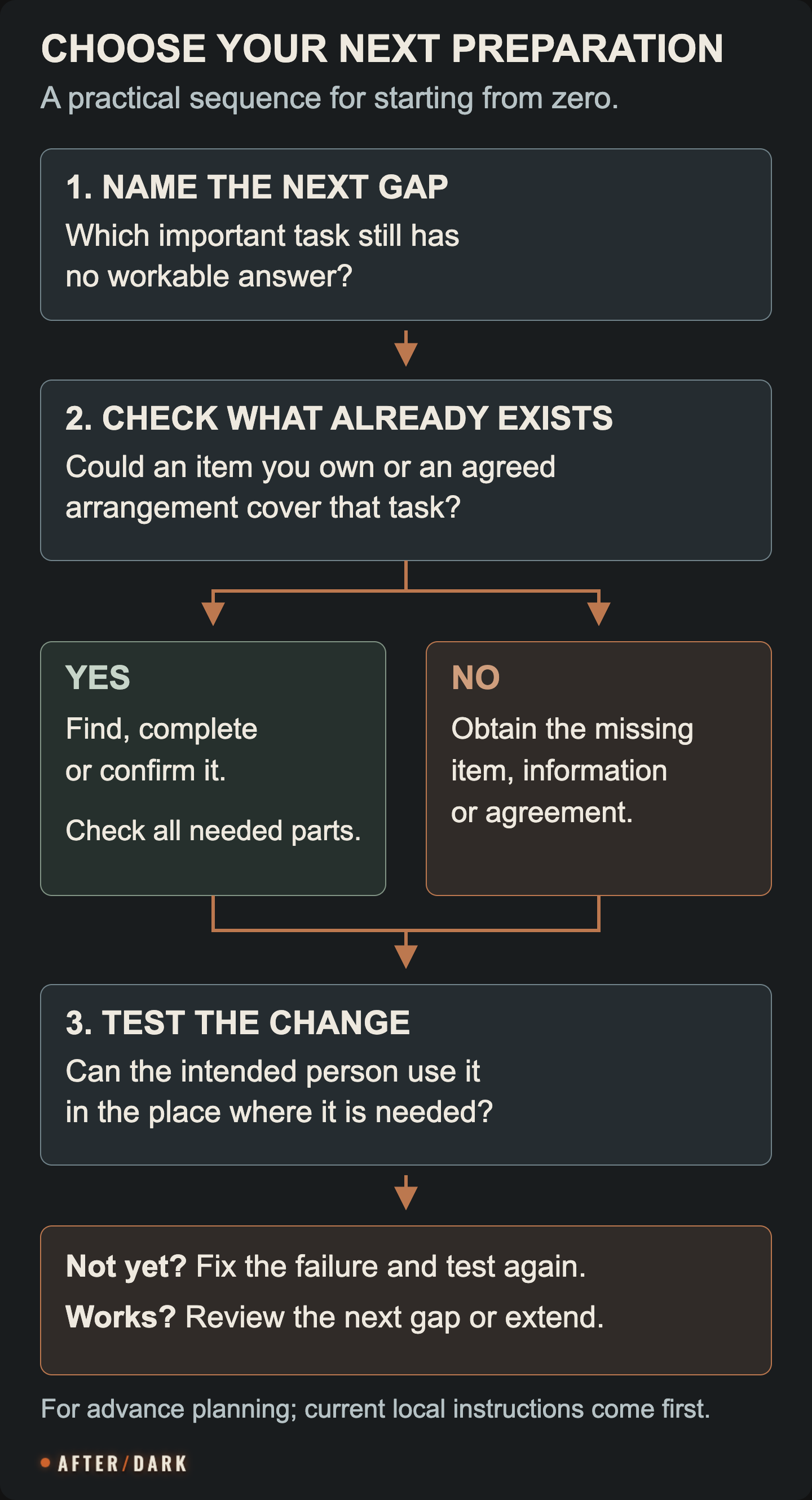
Before buying, check the whole cost of using the item. A radio may need a battery type you do not keep. A large container may need suitable storage and a way to pour. A discounted multipack may include food that requires more cooking resources than your menu allows. Put those requirements on the same line as the purchase.
Separate purchases from agreements. “No confirmed person to collect the child” and “no portable light” are both gaps, but only one is solved in a shop. Give each task a next action and a completion condition: a confirmed collection arrangement, a tested light, or a counted quantity of accessible water.
Example: two adults with one small shopping allowance
Suppose two adults find enough suitable food for their first three days, two working lights, blankets and a daypack. Their water reserve is incomplete, the power bank’s cable is missing and their only radio has not been tested. They were considering buying a larger backpack.
They first test the radio with the correct batteries they already own. They find that it works. One person checks existing cables; none fits the power bank. They count the water shortfall and measure the shelf available for it. These checks turn three vague concerns into two specific purchases and one completed task.
Their next shopping trip can now focus on suitable water and the missing cable, within the allowance they have chosen. The existing daypack remains usable while they test what must travel. A larger backpack moves to a later list, where they can assess it against the load they actually need to carry.
If the water shortfall cannot be closed in one trip, they record the current amount honestly and schedule the next addition. They also complete free contact and destination arrangements in the meantime. This example illustrates sequencing; it is not a fixed shopping order for every household.
When money or space is tight
Use a repeatable purchase amount you can manage alongside ordinary expenses. Add familiar consumables gradually and use them in normal rotation. Avoid tying up all available money in supplies while leaving no practical way to pay for transport or accommodation. Choose any cash reserve around your own anticipated essential purchases and storage arrangements, rather than copying someone else’s amount.
For limited space, measure the locations before purchasing containers. Prefer manageable units that fit without obstructing movement. Keep an inventory of separate storage spots so a small reserve spread between cupboards remains countable. Label food clearly in a shared home, and agree which supplies belong to everyone.
When you cannot buy something essential, identify the specific shortfall and investigate available local support or a confirmed arrangement with someone you trust. Record what is offered, when you could access it and what remains your responsibility. Keep that support distinct from supplies already in your possession.
Do not count the same shared resource twice. If two households rely on one vehicle, one carrier or one battery, discuss who uses it and when. The limitation belongs in the plan even when the equipment itself is working perfectly.
Prepare for the places where your day can begin
Walk through three starting situations: you are at home, you are elsewhere, and you must leave the place where you are. For each one, identify what you can reach immediately. Supplies at another address may support a later stage, but they cannot solve a problem that requires you to use them here.
At home, including a rental or shared building
Check whether the people staying there can find the reserve without you. Show them the locations and ask them to retrieve one item. If access depends on a locked cupboard, a high shelf or a code known to one person, resolve that dependency now.
In a rental, separate changes within your control from questions for the owner or building manager. Ask about emergency notices, access through shared doors and the building’s existing procedures. Report failed locks, lights or obstructed common routes through the appropriate channel. Keep the contact details and response with your preparation notes.
At work, studying or travelling locally
Look at the bag you already carry. Decide which small essentials deserve space in it: a working charging lead, written contacts, suitable clothing for the journey and a modest supply of water or food appropriate to your routine. If workplace storage is permitted, it may hold items that would otherwise make the everyday bag cumbersome.
Find out who gives instructions at that location, whether you may remain if transport stops and whom to contact about access after closing. Save the street address as well as the building’s familiar name. Someone arranging collection may not know which entrance “the office” means.
Also identify a place you could wait or stay if the journey home is unavailable. Discuss any offer of accommodation beforehand and note its limits. Our guide for when you cannot get home covers the decisions during an actual disruption; preparation makes those options easier to use.
Leaving without assuming a car is available
Name a possible destination, the means of reaching it and a fallback. A destination might be an agreed contact’s home or a location designated by authorities when an emergency occurs. Verify the people and animals it can accommodate. A mark on a map does not establish permission to stay there.
If you rely on a lift, confirm the driver, pickup location, number of seats, room for bags and any accessibility requirements. Discuss what changes if that person is at work or cannot reach you. Where public evacuation assistance exists, learn how it is requested and where current operating information will be announced. Do this before you need the service.
Without a vehicle, test a realistic portable load on an ordinary safe outing. Use the bag, shoes and mobility aids you would actually take. Notice what prevents you from managing doors, steps or another person’s needs. Adjust the load or arrange assistance; preparation is not a challenge to carry more than you can comfortably handle.
Keep departure essentials separate from heavy household reserves. The evacuation-bag guide helps select and test that portable subset. Do not make collecting extra supplies a condition of leaving when urgent instructions require immediate action.
Include the people who make the plan possible
Work through the plan with the people it affects. New Zealand Civil Defence recommends matching household plans with work and school arrangements and including individual needs. The useful result is agreement about actual responsibilities, including what happens when the usual person is absent.
For a household with children, confirm the school or childcare provider’s release procedure and authorized collectors. Decide who makes the first contact and who is the backup. Make sure both people know when the other has taken over, so an unconfirmed message does not send two people to the same place while another task is missed.
If someone needs help carrying supplies, receiving information or travelling, ask them what works. Check the planned route and communication format with them. Assign practical assistance to a person who has accepted the role, and confirm the backup. Avoid a plan that assumes the strongest, most confident or most available person will always be present.
If you live alone, choose a trusted contact for updates and discuss a nearby source of practical help. Agree what information you will send and what they should do if contact is missed, taking actual conditions into account. Keep that agreement limited to what the person can realistically do; it should not depend on them making a hazardous journey to investigate.
Neighbours can help with information, access or a task that needs another pair of hands. Start with a specific conversation, such as how you would exchange updates if the building’s internet stopped. You do not need to disclose every possession or private document to make a useful local connection.
For pets, identify the person responsible for collection and keep the carrier or lead accessible. Add their food, water and transport space to your calculations. The Red Cross advises confirming places that can accommodate pets and including them in evacuation practice. The pet evacuation-kit guide covers the equipment and records in more detail.
Put the agreed decisions on one usable page
The plan should be readable by someone who did not write it. Use ordinary names, addresses and instructions. Keep the working copy accessible to the people involved, with private records stored separately. A paper copy helps when a phone is unavailable; an offline digital copy is useful when the paper is elsewhere.
Use this page to record decisions rather than reproduce your full inventory:
- People and responsibilities: who is included, who collects or assists whom, and the agreed backup.
- Contact method: whom to update, the information to send and the fallback if your usual channel fails.
- Meeting and destination details: exact locations, the circumstances in which you would use them and any access arrangements.
- Departure arrangements: transport, pickup instructions, portable bags and items that must be added at the last moment.
- Information sources: the authority or broadcaster to check, saved contacts and useful radio frequencies.
- Unresolved tasks: the next action, responsible person and date to review it.
For separation, the Red Cross recommends a nearby meeting point, another outside the neighbourhood and an out-of-area contact. Select locations that fit your circumstances. Make clear that current protective instructions determine whether a proposed meeting place can be used.
Agree on a short update format: name, present location, who is with you, next intended action and when you expect to update again. Mark a change of plan clearly. “At the north entrance with Sam; staying here while the office remains open” is more useful than “we’re fine.” It gives the recipient something concrete to record or relay.
If no message gets through, use the fallback you agreed while together. That might involve a designated contact or following the arrangements of the school or workplace where someone already is. Avoid a plan that requires everyone to keep moving between meeting places until they happen to find one another. The emergency communication guide helps turn these agreements into a complete contact process.
Keep copies of relevant identification and records with your emergency document kit. Record how to reach providers through their official contact channels. Protect account credentials and access codes; a broadly shared household plan does not need to contain them.
Test one ordinary evening before expanding the setup
Preparation becomes easier to assess when you try the tasks it promises to support. Tell everyone involved that you are practising and choose a calm period. Keep normal services available. Do not disable alarms, cut utilities or interfere with equipment someone relies on to make the exercise feel realistic.
You can run the following checks separately if a longer practice session is impractical. These are practical exercises for finding gaps, not official certification tests or a guarantee of safety.
Checks that turn a collection of preparations into evidence of what works.
| Check | Try it | Record the result |
|---|---|---|
| Find a light | Retrieve and operate the intended light without using your phone torch | Location, control or battery problem |
| Prepare a meal | Use one planned meal and its intended tools while leaving appliances unused | Missing opener, utensil, preparation water or leftover plan |
| Use the water | Retrieve a stored container and pour from it into the intended vessel | Whether the container and location work for the user |
| Get information | Find the saved official contact and, if available, tune the radio | Reception, frequency, power or offline-access problem |
| Follow the contact plan | Have another person explain the message and fallback arrangements | A responsibility or destination interpreted differently |
| Check the portable load | Pack the actual items and manage an ordinary safe route | Excess load, inaccessible item or transport dependency |
Give another household member a turn. If only the person who assembled the kit can open a container or find a setting, the practice has found useful work to do. Simplify the arrangement, label the control or choose a more suitable item. The correction may cost nothing.
Record observations in plain language: “the spare cable does not fit,” “the carrier blocks access to the bag,” or “we named different pickup entrances.” Add the correction beside the observation and check it again once changed. Do not mark a task complete merely because a replacement has been ordered.
For a person living alone, ask a trusted contact to review the instructions or explain the plan back to you over a call. You can test retrieval and equipment independently, but another reader may notice an address, assumption or instruction that seems obvious only to you.
Extend what works and keep it current
Once the initial setup is usable, expand according to your remaining constraints. You might increase a reserve, add an independent way to receive updates or improve a transport arrangement. Choose the extension that addresses a demonstrated weakness or a relevant local requirement.
Count consumables by their actual planned use. A fortnight of food does not make the whole setup a fortnight-ready plan if the water, hygiene arrangements or available accommodation support a shorter period. Record these limits separately. Extend them in a sequence you can sustain, including any new storage or maintenance work.
Keep an inventory reminder where you will see it during normal shopping. When you use a reserved item, mark it for replacement. Check dates and condition while rotating food; recharge devices according to their instructions; record the next required water or battery check. Follow product-specific instructions rather than applying one replacement date to everything.
Review agreements when a person changes job, a child changes school, a household moves, a contact becomes unavailable or a transport arrangement changes. Seasonal conditions can also change clothing and route needs. Update every copy of the plan and tell the affected people what changed.
Keep one short list of unresolved tasks and a separate list of optional improvements. After a review, choose the next achievable action and put a date beside it. That keeps preparation connected to your circumstances instead of turning it into an endless collection of purchases.
Zombie Scenario: The Kit That Needed a Conversation
Fictional scenario
Two neighbours begin preparing after reports of a fictional outbreak elsewhere. They already have food, water and working lights. While choosing another bag, they try the plan for an ordinary workday.
One expects to drive both households out. The other expects that same car to collect a relative across town. There are too few seats for both arrangements, and neither has discussed a backup.
Their next preparation task becomes a conversation about transport, destinations and responsibilities. They confirm a separate collection arrangement and write down its limits. The extra bag stays on the later list. Their useful improvement is a plan whose people and resources finally match.
Frequently Asked
Should I buy a ready-made emergency kit or assemble my own?
What if the people I live with do not want to prepare?
Can I count camping equipment as emergency equipment?
Can I count an order or a regular delivery as part of my reserve?
Should I keep every emergency item in one bag?
How do I manage equipment that I lend or share?
Sources
- New Zealand Civil Defence — Talk About the Impacts
- NIST — 5 Steps You Can Take Today to Prepare for Disasters
- UK Cabinet Office — Be Ready for Emergencies
- U.S. Fire Administration — Home Fire Escape Plans
- American Red Cross — Survival Kit Supplies
- CDC — How to Create an Emergency Water Supply
- New Zealand Civil Defence — Work Out What Supplies You Need
- New Zealand Civil Defence — Make a Plan
- American Red Cross — Make a Plan
- American Red Cross — Pet Disaster Preparedness and Recovery
Related guides

How to Prepare Your Home for an Apocalypse
Turn an ordinary house or apartment into a safe, workable base without blocking exits, scattering supplies, or mistaking barricades for preparedness.
How to Build a 30-Day Food and Water Supply for an Apocalypse
A practical 30-day pantry for apocalypse preparedness, built from person-days, package labels, a no-cook layer, and stored water you can rotate.
How to Build an Apocalypse Bug-Out Bag
Build a portable evacuation kit around a real destination, route, household, and loaded walk test—not a generic pile of emergency gear.