How to Build a Pet Emergency Kit for an Evacuation
Prepare every pet, carrier, supply module, document, destination, and household role for a calm one-trip evacuation.
Short answer
Key takeaways
- Build the system around one readiness record per pet, not one vague household checklist.
- Confirm pet-accepting destinations and transport capacity before treating the supply list as complete.
- Official food and water planning horizons vary, so calculate quantities from documented daily use and the current guidance that applies where you live.
- Assign every pet, carrier, and shared supply module to a primary handler and a backup.
- Run a complete one-trip drill and record delays, missing items, excess weight, and destination assumptions.
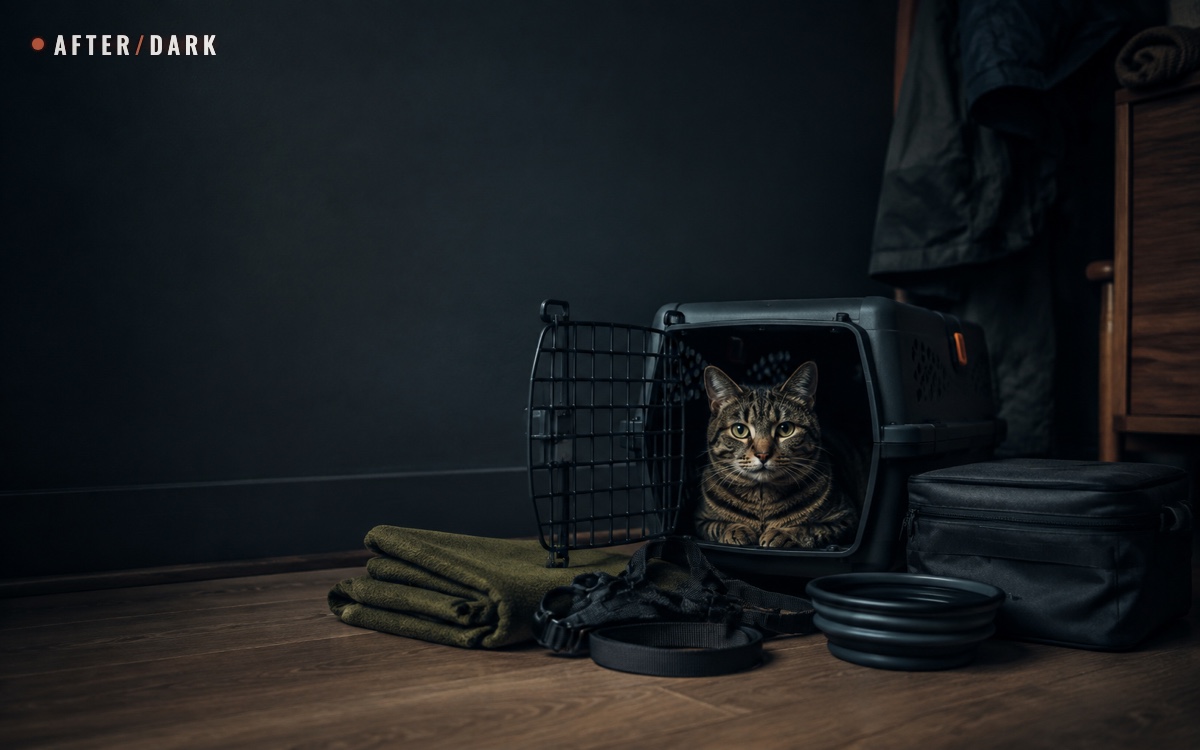
A pet emergency kit is not just a bag of animal supplies. It is a tested system that connects every pet to a secure transport method, an accepting destination, a responsible person, enough portable supplies for the chosen planning horizon, and the records another caretaker would need. Build those connections first; then pack the containers.
This guide covers small companion pets that can travel in an appropriate carrier or with another planned restraint system. It does not provide veterinary care, first aid, feeding changes, or species-specific transport instructions. Confirm those details with the veterinarian responsible for the animal, the carrier manufacturer, transport providers, destinations, and current local authorities.
The home evacuation plan owns household routes, destinations, travel groups, and departure decisions. The pet kit adds the animal-specific transport, supplies, records, and handoff layer. The two should be tested together.
Start With One Readiness Record per Pet
A single line reading “take the pets” hides the decisions most likely to delay departure. Create one readiness record for each animal, even when several pets share food, a caretaker, or a destination.
The record does not need private or technical detail. Its job is to show whether the household can identify, secure, move, supply, and hand off that particular pet.
Pet readiness record: every row must have a usable answer before the kit is considered complete.
| Field | What to record | Completion test |
|---|---|---|
| Pet identifier | Name, species, plain description, and current photo reference | A person who knows the household can match the record to the animal |
| Primary handler | Named person responsible for securing and moving the pet | The person has practised the complete task |
| Backup handler | Named replacement | The backup knows the location and can complete the same task |
| Transport method | Assigned carrier, crate, harness, or other verified system | It suits the pet, route, vehicle, and manufacturer's limits |
| Kit module | Labeled food, water, sanitation, comfort, and record modules | Every module has an exact storage location |
| Primary destination | Confirmed pet-accepting place and contact | Acceptance conditions and last confirmation date are recorded |
| Backup destination | A separate usable option | It does not depend on the same unconfirmed assumption |
| Caretaker | Nearby person with agreed access and instructions | The person has accepted the role and completed a handoff test |
| Review trigger | Date or change that requires an update | The household knows when this record becomes unreliable |
Use status labels such as READY, TEST, REPLACE, and CONFIRM. Blank cells and optimistic phrases such as “someone will carry it” should remain visible as unresolved work.
For a household with more than one pet, add a summary line showing total carriers, total travel space, total supply modules, and the number of handlers available in each ordinary situation. This catches a common mismatch: every pet has an individual plan, but the household cannot execute all of those plans at the same time.
Confirm Destinations Before Expanding the Kit
A complete kit cannot solve a destination that refuses the animal or a route that cannot carry the load. FDA guidance recommends identifying pet-friendly hotels, relatives, friends, or other alternatives because temporary public shelters may not allow animals. Government of Canada guidance likewise recommends listing places where a pet can stay and including the animal in household-plan practice.
Record at least a primary and backup destination. Confirm each one directly rather than treating normal pet access as emergency acceptance.
Destination check: record conditions that could change whether the whole household is accepted.
| Question | Primary destination | Backup destination |
|---|---|---|
| Does it currently accept this species and number of animals? | Confirmed answer and date | Confirmed answer and date |
| Does it require particular records, containers, or advance contact? | Exact requirement and source | Exact requirement and source |
| Can every household travel group reach it? | Primary and alternate route | Primary and alternate route |
| Is there enough transport and indoor space for every carrier? | Verified capacity | Verified capacity |
| Who can confirm access during a disruption? | Name, number, and backup method | Name, number, and backup method |
| What makes this option unavailable? | Closure, capacity, route, contact, or rule dependency | Closure, capacity, route, contact, or rule dependency |
Do not count two hotels on the same booking platform as fully independent if one unavailable phone, account, payment method, or road removes both choices. A friend outside the immediate area, a known animal facility, and a pet-accepting accommodation may provide different dependencies, but every option still needs current verification.
Add the destination addresses and contact details to the printed household Route Sheet. Keep longer pet records in the protected record module, not scattered across several bags.
Assign and Test Secure Transport
NSW Government tells pet owners to plan how every animal will be transported and to make sure all pets can move in one trip. That turns the carrier from a storage item into part of the evacuation system.
For every pet, record:
- the exact carrier, crate, harness, or other verified transport system;
- its normal storage location;
- the path from the pet's usual location to the exit;
- the handler and backup handler;
- the vehicle seat, cargo position, or carried position assigned to it;
- the manufacturer's capacity and closure checks;
- any transport-provider or destination rules that apply;
- the last date the complete movement was practised.
The FDA recommends helping pets become familiar with crates or carriers before an emergency. Familiarity work should follow the veterinarian's and carrier manufacturer's guidance for the individual animal; the evacuation drill simply verifies the household process.
Run a carrier access test
Under calm, ordinary conditions:
- Start the handler where that person is normally likely to be.
- Retrieve the assigned carrier without moving unrelated storage.
- Bring it to the planned securing area using the real route.
- Check that the closure, handle, base, and required attachments are present and operate as intended.
- Place the empty carrier in its assigned transport position.
- Check that other passengers, carriers, and supply modules still fit.
- Return everything to its documented location and record the time and any failure.
Do not surprise or force an animal for the sake of a timing target. The useful result is whether the household can retrieve, position, and prepare the equipment reliably. Any practice involving the animal should remain calm and follow existing professional guidance.
Check the route, not just the container
A carrier that works in one room may fail at a narrow stairwell, heavy door, lift restriction, transit gate, or vehicle opening. Walk the planned route with an equivalent safe load and check:
- door and stair clearance;
- whether one person can manage the carrier as assigned;
- whether the handler still has a free hand for ordinary doors or railings;
- whether wheels, handles, straps, and closures work on the actual surface;
- whether the transport position blocks another passenger or exit;
- whether the alternate route remains possible with the same load.
Write down the constraint. “Carrier A does not clear rear door with Module B in place” is actionable; “car is tight” is not.
Build Five Portable Modules
Separate the kit into small modules so the household can inspect, rotate, and assign them. One enormous unstructured container makes it difficult to find records, notice a leak, or divide the load between handlers.
CDC's pet preparedness list includes food, water, dishes, a manual opener where needed, transport equipment, bedding, identification records, photos, and sanitation supplies. Use those categories as a source-backed starting point, then verify what is appropriate for the particular pet.
Five-module kit: each module has a clear job, owner, and inspection method.
| Module | Typical categories | Pack test |
|---|---|---|
| Food and water | Measured normal food, planned water, bowls, opening tool if the chosen packaging requires one, and the current routine card | Quantity matches the chosen horizon and every container is closed, portable, and dated |
| Transport | Assigned carrier or verified transport system, current identification, and required ordinary attachments | Handler can find, inspect, and position every part |
| Sanitation | Species-appropriate toileting materials, waste bags, paper towels, and sealed cleanup supplies | Contents are separated from food and usable at the destination |
| Comfort | Familiar bedding or towel and one compact familiar item if appropriate | It fits without preventing safe transport or access |
| Records | Pet card, current photos, ownership or registration copies, relevant veterinary and vaccination records, existing microchip registration details if applicable, destination contacts, and caretaker card | Authorized person can identify the pet and reach the right contacts without internet access |
Existing medications, if applicable, may appear as one labeled inventory category. Keep them according to the current label and veterinarian instructions, record the review date, and direct all selection, amount, purpose, and use questions to the veterinarian responsible for the pet.
Label for action, not appearance
Use durable, plain labels that connect each physical module to the readiness record:
PET-01 — FOOD/WATER — REVIEW 2026-10
PET-01 — RECORDS — VERSION 2026-09-04
SHARED-PETS — SANITATION — HANDLER: A / BACKUP: B
Do not place unnecessary private information on the outside. The label should tell a household member what to take and when to inspect it, not reveal the contents to anyone who sees the container.
Shared modules can reduce duplicate weight, but they also create one-item dependencies. If two travel groups may separate, assign each group the minimum it needs and record where the remaining shared stock goes.
Calculate Food and Water From a Recorded Baseline
Official planning horizons are not identical. Government of Canada guidance specifies at least 72 hours of food and water, the FDA lists at least one week, and the CDC lists two weeks. These are published baselines from different authorities, not one universal quantity.
Choose the planning horizon that applies to your location, route, destination, and current authority guidance. Then calculate from what the pet already normally consumes. Do not invent a new routine for the kit.
Quantity worksheet: use documented normal daily amounts and show the selected authority horizon.
| Input | Example notation | Household entry |
|---|---|---|
| Normal food used per day | daily food | Measured from the current routine |
| Normal water used per day | daily water | Recorded using the household's ordinary method |
| Applicable planning horizon | number of days | 3, 7, 14, or another current local requirement |
| Planning margin | clearly labeled extra | Chosen for spillage, delay, or packaging limits |
| Total food | (daily food × days) + margin | Final portable quantity |
| Total water | (daily water × days) + margin | Final portable quantity |
The calculation is a packing method, not individualized feeding guidance. If the household does not know the normal amount, record ordinary use before finalizing the kit or ask the veterinarian responsible for the pet.
Package food in manageable, closed units compatible with its existing storage instructions. Record product, packaging, and opening dates only to the degree needed for rotation. Keep water containers closed and separate from anything that could contaminate them. If the route requires carrying the load, test the actual mass rather than estimating from container size.
Do not expand the horizon indefinitely without checking transport. A supply that cannot leave with the pets belongs in a separate home reserve or destination plan, not in the one-trip evacuation load.
Build a Compact Pet Record Module
Identification and contact information must still work when a phone, cloud account, or household member is unavailable. CDC recommends copies of registration information, a pet description, recent photographs, existing microchip information, contact details, and veterinary records in a waterproof document container. Government of Canada guidance also recommends a pet file with recent photos, emergency contacts, records, and relevant licenses.
Create one paper card per pet with:
- name, species, color, markings, and another plain identifying feature;
- one current close photo and one photo showing the pet with an authorized household member;
- household contacts and an out-of-area contact;
- primary and backup destination details;
- veterinarian and existing service-provider contacts;
- ownership, registration, and existing microchip registration references if applicable;
- carrier identifier and primary and backup handlers;
- date the card was last verified.
Place only the copies required for the plan in the portable module. Link them to the emergency document kit, which should hold the broader inventory, protected digital backup, and location of originals. Avoid distributing full records to every bag when one controlled, assigned copy will do.
Test the module offline. Ask the backup handler to find the correct pet card, match it to the animal and carrier, locate the destination number, and identify where protected records live. Replace blurred photos, unreadable print, obsolete contacts, and pages that require an unavailable app.
Create a Caretaker Handoff Card
The plan needs a branch for the ordinary possibility that household members are away. FDA guidance recommends arranging in advance for a neighbor or nearby friend to care for pets when the owner cannot reach home.
Ask a real person and receive a clear answer. A caretaker arrangement is incomplete until access, authority, contact order, kit location, transport, and destination are understood.
Caretaker handoff card: keep instructions short enough to use without calling first.
| Field | Required entry |
|---|---|
| Pet and location | Which animal, its likely household location, and carrier identifier |
| Access | Agreed lawful access method and where the plan is recorded |
| First action | How to contact the household and which current instructions to follow |
| Equipment | Exact carrier and module locations |
| Destination | Confirmed primary and backup destination contacts |
| Transport | Assigned travel method and capacity limit |
| Records | Location of the pet card and protected-copy instructions |
| Boundary | What the caretaker has agreed to do and whom to contact for anything outside it |
| Backup | Second named person if the first cannot respond |
| Version | Last verification date and change trigger |
Do not bury the card inside a long household manual. Keep one protected copy with the pet record module and give the caretaker only the information needed for the agreed role. Review access after a move, key change, building-policy change, caretaker change, or change in the animal's normal location.
Run a handoff test without simulating distress. The caretaker should be able to locate the written instructions, identify the correct carrier and modules, explain the contact order, and name the destination. Record every question the card failed to answer.
Make the Entire Load Leave in One Trip
NSW Government specifically advises planning to transport all pets in one trip because there may be no time to return. Apply that requirement to the complete household load, not only to the animals.
Lay out the pet carriers, pet modules, household bug-out bags, shared document module, mobility equipment, and ordinary passengers. Assign each item to a person and a transport position.
One-trip load map: every item and animal needs one owner and one physical position.
| Load | Primary handler | Backup | Transport position | Failure check |
|---|---|---|---|---|
| Pet and assigned carrier | Named person | Named backup | Exact seat, cargo space, or carried position | Secure fit, access, and route clearance |
| Food and water module | Named person | Named backup | Exact bag or vehicle position | Weight and leakage |
| Sanitation module | Named person | Named backup | Separate closed position | Access without opening food module |
| Pet record module | Named person | Named backup | Protected but reachable position | Offline retrieval |
| Household bags | Assigned people | Named backups | Remaining carried or vehicle positions | Total capacity and free movement |
| Shared documents | Named authorized person | Named backup | Controlled position | Privacy and retrieval |
Then test the whole load. A pet-only packing trial can pass while the family load fails because the same person has been assigned two carriers and a child, the vehicle has no room for water, or the stairs require a free hand that the load plan does not preserve.
If the load fails, reduce duplication, move nonessential comfort items to the destination plan, divide shared modules, choose a closer destination, change transport, or explicitly record the unresolved limitation. Do not hide the problem by testing half the kit.
Run a Calm Door-to-Destination Drill
A checklist proves that items were written down. A drill proves that people can use them together.
Run the first test under normal daylight and without creating urgency. Follow current building, transport, animal-care, and destination rules throughout. The goal is to find friction, not to produce a dramatic time.
- Start from an ordinary household state, with carriers and modules in their documented storage positions.
- Give each primary handler the normal plan cue.
- Retrieve carriers and secure them for transport using the established routine.
- Collect all pet modules, household bags, records, keys, and mobility equipment.
- Complete the household count and match every pet to its readiness record.
- Move the full load through the planned home exit and to the transport position.
- Follow the route as far as is safe and appropriate for an ordinary practice.
- Contact the destination using the planned method and verify that the recorded process still works.
- Return, restore every item to its assigned location, and record failures before memory fades.
Log facts, not impressions.
Drill log: each failure receives an owner and a retest date.
| Observation | Why it matters | Correction | Owner | Retest date |
|---|---|---|---|---|
| Carrier blocked by stored boxes | Delays retrieval | Clear and mark storage footprint | Named person | Date |
| Food module too heavy for assigned handler | One-trip plan fails | Repack units or reassign load | Named person | Date |
| Backup destination number obsolete | Destination cannot be confirmed | Verify and replace every copy | Named person | Date |
| Pet card available only on phone | Offline handoff fails | Add controlled printed copy | Named person | Date |
| Two carriers assigned to one unavailable person | Responsibility gap | Name and train a backup handler | Named person | Date |
The drill is complete only after corrections are retested. An issue written in a notebook but left in the system is still an issue.
Rotate and Recheck the System
Pet readiness changes when the animal, household, carrier, route, destination, or stored supplies change. Use a scheduled review plus event-based triggers.
At each review:
- compare food and water quantities with the current recorded routine and planning horizon;
- inspect dates, seals, closures, containers, bowls, sanitation supplies, and labels;
- confirm carrier condition and manufacturer instructions;
- replace outdated photos and contact details;
- confirm primary and backup destinations still accept every pet;
- verify handlers and caretakers still have the access and capacity they need;
- open the record module and check that paper copies remain readable;
- confirm existing medications, if applicable, are stored and reviewed under current label and veterinarian instructions;
- update every version date and discard obsolete working copies appropriately;
- schedule a one-trip retest after any material correction.
Useful change triggers include a new pet, change in household membership, move, new vehicle, route closure, destination change, carrier replacement, caretaker change, or a change in the animal's established routine. Do not wait for the calendar review when the plan is already known to be obsolete.
Zombie Scenario: The Carrier by the Exit
Fictional scenario
The first message says the local mobile network is overloaded and the district may close access later that evening. Mara does not begin by searching cupboards. The household Route Sheet already names the pet-accepting destination, alternate route, handlers, and check-in contact.
She moves the cat into its familiar assigned carrier while the backup handler collects the labeled food-and-water and sanitation modules. The pet record pouch stays with the same person who carries the household document module. At the vehicle, each item goes into the position marked during the last drill.
One problem appears: the primary destination does not answer. The backup handler uses the printed card, reaches the independently confirmed second destination, and updates the Route Sheet. The household leaves once, with every person, pet, carrier, and assigned module accounted for. The useful preparation was not a bigger pile of supplies; it was a system that still worked when one contact did not.
Final Pet Emergency Kit Checklist
Use this sign-off only after the records, physical kit, handlers, and destination plan agree.
- Every pet has a separate readiness record and current photo.
- Every pet has a named primary handler and backup handler.
- The assigned transport system fits the animal, route, vehicle, destination, and current rules.
- The carrier and modules have exact, accessible storage locations.
- The primary and backup destinations have confirmed pet acceptance and current contacts.
- Food and water quantities show the recorded daily baseline, applicable horizon, and review date.
- Sanitation and comfort modules are closed, portable, and separated from food.
- The pet record module works without internet access and links to protected household records.
- Existing medications, if applicable, appear only as a current, properly stored inventory category.
- A nearby caretaker and backup have accepted the role and passed a handoff test.
- Every pet, carrier, module, person, and household bag fits into one assigned trip.
- The full drill has been completed and every recorded correction has been retested.
- The next scheduled review and every major change trigger are visible.
A well-built pet emergency kit is not finished when the containers are full. It is finished when another authorized person can understand the plan, every animal can travel by the assigned method, the destination has been confirmed, the complete load fits, and the household has demonstrated the process under calm conditions.
Frequently Asked
How much food and water should a pet emergency kit contain?
Does every pet need a separate carrier?
Will an evacuation center accept pets?
Which pet documents belong in the kit?
What should happen if nobody is home?
Should the kit include medications?
Sources
Related guides

How to Make a Home Evacuation Plan
Turn exits, routes, destinations, transport, household roles, and meeting places into one practical evacuation plan that works without mobile data.

How to Build an Apocalypse Bug-Out Bag
Build a portable evacuation kit around a real destination, route, household, and loaded walk test—not a generic pile of emergency gear.
How to Build a Grab-and-Go Emergency Document Kit
Create a compact, protected document system that remains usable during an evacuation, extended outage, or loss of internet access.