What to Do If You Can’t Get Home During an Emergency
When the journey home stops working, choose a usable place for the next few hours, coordinate with the people who depend on you and arrange onward travel or an overnight stay.

Short answer
Key takeaways
- You can start without an emergency bag or working phone: identify your location, speak to available staff and establish where you may wait.
- Check the destination and the journey separately; an open route does not mean you can enter the building at its end.
- A cancelled service does not automatically make walking home a workable alternative.
- Agree who is collecting children or helping a dependent person, and confirm the handover instead of assuming a message was received.
- Check overnight arrangements before your temporary waiting place closes, then reassess when useful new information arrives.
If an emergency blocks your journey home, first establish where you can spend the next few hours. Follow local protective instructions, contact the people depending on you and check a destination before setting off. Getting everyone to a usable place may mean staying apart overnight.
You might be leaving work, collecting groceries or changing trains when transport stops. Road closures and disrupted public transport can separate a household even when nobody needs to leave their own building. This guide starts at that moment, including when your only supplies are what you brought on an ordinary day.
If you are stranded abroad during a crisis, also check travel documents, permission to remain and the entry or transit requirements for any replacement journey.
Start here if you cannot get home and have no emergency kit
You do not need to solve the whole journey immediately. Establish your location, a permitted place to wait and a source of current information.
- Check what applies where you are. Read posted instructions and listen to staff or official announcements. If there is immediate danger or an instruction to leave, take the directed protective action; do not delay it to complete this checklist.
- Identify the place precisely. Note the building or station name, street, entrance and nearby landmark. “At the terminal, east entrance beside the information desk” is usable information for someone trying to reach you.
- Speak to available staff. At work, ask your manager or building staff; at a station or shopping centre, find the staffed information point. Ask whether you may remain, until when, and where official updates are being given. A lobby being open now does not establish an overnight arrangement.
- Say what you need first. For example: “My route home is closed, my phone is not working, and I need to contact my child's school.” A specific request helps someone identify the next useful action.
- Get the next detail onto paper if possible. Ask for a pen and note the address, contact number or announced update time. If none is available, keep the next step simple enough to repeat back accurately.
With no working phone, ask whether staff can help send a message, let you make a brief call or point you to an active assistance location. If you are outside and unfamiliar with the area, use identifiable nearby staff or responders for directions when accessible. Do not walk from one guessed meeting point to another hoping your family will choose the same one.
If the desk is unstaffed, check posted notices for the next information point or an available help intercom. A nearby open business may be able to help you contact someone or locate official assistance. Ask for that specific help; do not assume it can accommodate you overnight. Keep any move consistent with current protective instructions.
If you have a phone but no connection, another person's network or available Wi-Fi may still work: outages can affect different connections differently. Ask before borrowing a device and send one specific update. The guide to communication without cell service covers the alternatives in more detail.
Choose a place for the next few hours
Treat home as one possible destination. A workplace where you may remain, a confirmed host nearby or an operating assistance location may be more practical while routes are disrupted.
Check entry and travel separately. A friend answering the phone establishes contact; you still need to know whether they can receive you. A route appearing on a map establishes geography; you still need current information about access and conditions.
When the journey home is interrupted: choose the next action from your actual starting situation.
| Your situation | Next action | What makes the option usable |
|---|---|---|
| No kit, car or working phone | Ask available staff for current instructions, contact help and a place to wait. | You know where you are, whether you may stay and where to obtain the next update. |
| Your current building remains suitable | Ask permission to wait while you check onward options. | You know the closing time, permitted area and how to hear new instructions. |
| Home is inaccessible but a nearby alternative is available | Confirm entry and the journey before leaving. | Someone can receive you, or the location is confirmed open for the service you need. |
| A route home appears to be operating | Check the whole trip, including transfers and the final stretch. | Home is available and the journey is permitted and manageable for everyone travelling. |
| Your waiting place is closing or you cannot remain | Tell staff now that you have no confirmed next place. | You obtain an actual alternative or assistance with the unresolved transport or access problem. |
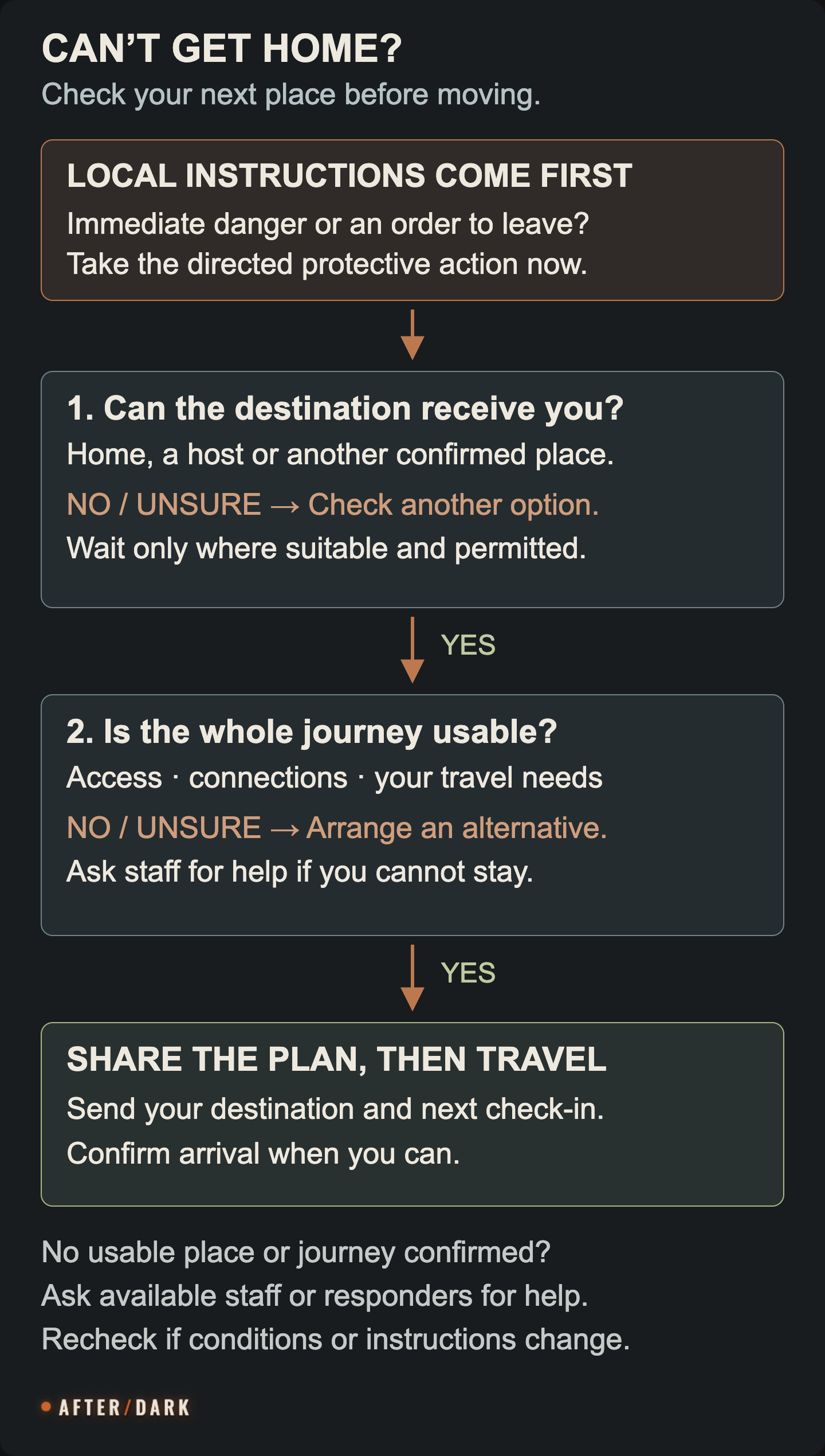
Waiting is an active choice when you know what you are waiting for: the next official service update, confirmation from a host or an arranged pickup. Set the review around that event and your location's closing time. “Maybe something will run later” is not enough to carry you into a locked terminal at night.
If your household already has a home evacuation plan, its alternate destinations may help. Check them from your present starting point; a route designed from your front door may be irrelevant from the other side of the city.
Check the journey before committing to it
Use the transport operator, local emergency information or staff managing the affected site to establish what is actually operating. Look at the time of the update. A screenshot shared earlier may describe a service that has since stopped.
For public transport, establish the boarding point, actual destination and remaining connections. Ask whether replacement transport departs from a different entrance or street. If a service only takes you halfway, identify what you will do at its endpoint before boarding.
For a lift, agree on the vehicle, driver, exact pickup position and destination. Confirm the driver can reach that pickup point under current restrictions. Keep loading areas and emergency access clear; do not chase a moving pickup location through an unfamiliar district.
If you are considering walking
A familiar drive can include roads that make a poor or prohibited pedestrian route. Check the route as a walk: sidewalks, crossings, lighting, closures and the last approach to the destination. Follow pedestrian signs and signals, use sidewalks and cross at designated crossings. Do not substitute a railway, tunnel or closed road for the cancelled service.
Judge the whole journey against your shoes, clothing, weather, available daylight, what you are carrying and the needs of anyone with you. There is no single distance that makes an emergency walk reasonable for everyone. If you cannot complete it comfortably under the actual conditions, look for a closer destination or assistance with transport before leaving a usable waiting place.
Carry or write down directions and the destination address when possible. The offline maps guide explains how to keep navigation available, but a downloaded map does not confirm that a bridge or entrance is open now.
Before moving, decide what would change the plan: a closure, a missed connection, loss of necessary assistance or a destination becoming unavailable. At that point, reassess from a permitted usable location rather than continuing because you have already invested time in the journey.
Send an update people can act on
Tell one household contact or agreed relay person where you are, what you will do next and when to expect contact. Include the practical task you need someone else to take over. A short message is easier to relay accurately than several incomplete fragments.
For example:
I am inside Central Station beside the east information desk. Trains home are suspended. Staff say this waiting area stays open until 20:00. I am checking a place to stay nearby. Please confirm whether you can collect Leo from the school's announced pickup point. I will update you at 18:30, or sooner if I move.
These times illustrate a message, not recommended waiting intervals. Choose times that fit the actual announcement and closing time.
Texting may work when calls cannot get through. Send the update, check its status and look for a reply confirming any task you assigned. A queued message is not a completed arrangement; “I'll ask my sister” is not confirmation that your child has been collected.
If nobody answers and you never agreed on a meeting place
Do not assume everyone will head home or invent a rendezvous they have no way to learn about. If your present place remains usable and you may stay, keep it as your known location while trying an available contact route. Ask an employer, school office or known contact to relay a message through their normal process if appropriate.
If you must move before reaching anyone, choose the next place using the checks above. When a communication route becomes available, send one complete update that supersedes the old location. You can also ask staff whether they have a procedure for leaving a contact message; do not assume a public desk will track your movements.
Once the disruption is over, turn this experience into a household emergency communication plan with meeting places and a relay contact everyone already knows.
Coordinate children and people who need assistance
Work out who is responsible for each person before multiple adults start separate journeys. Agree who is collecting, who is staying available for updates and where the group will go after collection.
Children at school or childcare
Check the institution's current instructions and actual collection location. Reunification may happen at the school or at another site. The usual gate may not be the place families are being directed to now.
If you cannot reach it, contact an adult already authorized to collect your child and confirm they can make the journey. Check the school's release procedure and any identification it requires. Do not promise a child that an unfamiliar person will collect them or assume a new name sent in a message is sufficient authorization.
Ask the collecting adult to confirm collection and the next destination. If no authorized adult can get there, tell the institution through its designated channel and ask what arrangement applies. Keeping school contacts and backup collectors current makes this problem easier to solve before the next disruption.
A person who needs transport or practical support
Ask what the person can do and what help they need in the conditions now. Make the request concrete: an accessible vehicle at a named entrance, a step-free route, help communicating with staff or someone to stay with them while a pickup is arranged.
Confirm those details with the actual operator or host. A vehicle being available does not tell you whether boarding is possible, and an address alone does not establish access to the building. Support networks work best when they include people near the places you regularly use, with more than one possible helper. If the usual person is unavailable, state the unmet need to staff early instead of waiting until the building closes.
Arrange an overnight stay before your waiting place closes
Start checking an overnight option when there is no credible route home within the time your current place remains available. You can still travel later if conditions improve; arranging somewhere to stay gives you an option you can actually use.
At work: ask who can authorize staying, which area is available, how building access works and what facilities remain usable. Workplace emergency planning can include staff stranded without transport, but you need the arrangements for your building today. Do not assume the office kitchen, lifts or toilets will remain available all night.
With a host: confirm they can receive you, the exact address and entrance, who will let you in and whether anyone else is travelling with you. If the host is not yet home, settle how entry will work before departing. An unanswered invitation from months ago is not tonight's arrangement.
At a hotel or other paid accommodation: check actual availability, total cost, accepted payment, identification requirements and arrival access. An online listing does not confirm an operational reception desk. If payment is the obstacle, ask what is accepted before making the trip; the emergency cash and payment guide explains useful backup arrangements.
At an emergency assistance location: use current local announcements or staff information to find out where it is and what it provides. An information or evacuation point may direct people onward rather than offer beds. Check opening status, transport, accessibility and arrangements for anyone accompanying you. Services differ by location; active shelter listings describe the help available at particular sites.
On arrival, confirm your arrival to your contact, find out how updates will be announced and ask about morning departure arrangements. Keep your belongings together so moving again does not become a search for scattered essentials.
Make what you have last through the wait
Take a quick inventory of the things actually with you: water, ready-to-eat food, clothing, phone charge, payment, keys and identification. Then identify the next missing need. If you have no water, ask where drinking water is available; if you cannot buy food, ask the host or assistance staff what options exist. Resolve those practical gaps while help is accessible.
Use a working phone for contact and relevant updates rather than repeatedly refreshing several feeds. Save the destination, directions and contact details for offline use if possible, and ask permission to charge where power is available. Keep the device accessible for incoming instructions. The portable power guide covers batteries and charging plans for a longer disruption.
Keep keys, ID and payment with you when stepping away from your bag. If documents are missing, ask the actual transport or accommodation provider what alternatives it accepts; a photograph is not automatically valid everywhere. Later, the emergency document kit can reduce this single point of failure.
Recheck the plan when something useful changes: a transport update, a confirmed pickup, an approaching closure or your host's availability. At each review, ask what has changed about entry, travel and the people depending on you. Avoid restarting the whole search when none of those facts has changed.
Worked example: the last connection is cancelled
Maya leaves work with a shoulder bag, a little cash and a phone that cannot make calls. Trains stop running and the terminal will close that evening. She has no emergency bag or local hotel booking.
At the staffed desk she learns the announced replacement bus ends before the closed bridge on her route. Boarding would leave her with an unresolved crossing. She asks to wait in the designated area and notes the closing time.
A colleague's phone works. Maya reaches her brother, who is already authorized to collect her child. He confirms the school's current collection point and agrees to message after collection. Her usual backup host is beyond the same bridge, so that address does not solve tonight's problem.
Another colleague nearby confirms that Maya can stay, provides the entrance details and will be there to let her in. Maya checks the short local journey, tells her brother the new destination and leaves before the terminal closes. After arrival, she receives confirmation that her child is with him.
The household spends the night in two places. The useful result is that both arrangements are confirmed, and tomorrow's travel can be decided using tomorrow's service information.
Prepare a small backup for ordinary days
Afterward, fix the things that made this particular journey difficult. Everyday workplace preparation can include walking shoes, contact details and somewhere else to stay. Choose additions you will actually keep accessible:
- A paper contact card with household numbers, a relay contact and agreed addresses.
- Suitable shoes and a layer appropriate to your commute and weather.
- Water and an ordinary ready-to-eat snack you replace as you use it.
- A charged power bank and cable if you carry a phone.
- A workable payment backup and the details needed for your regular transport.
- A nearby host or alternative destination discussed in advance, plus updated school collection contacts where relevant.
Ask about your workplace's arrangements and test one alternate journey from work, not only from home. For a more extensive carry system, use the bug-out bag guide, adapting it to what you can reasonably carry on an ordinary day.
Zombie Scenario: The Pickup Point Changed
Fictional scenario
During a fictional outbreak, a commuter agrees to meet a relative outside a department store. Staff then direct everyone to leave that entrance. The commuter moves to the designated assembly point and sends a replacement pickup message naming the new street and landmark. The relative acknowledges it before driving over. Updating one stale location keeps them from searching opposite sides of a building while the situation changes.
Frequently Asked
Should I go home just to collect my emergency bag?
Can I ask for shelter if I have no ID or money?
What if my pet is alone at home?
What if I am in an unfamiliar city and do not speak the language?
What if I cannot remember anyone's phone number?
Should I retrieve my car or belongings before leaving the area?
Sources
- NZ Civil Defence — Can't Get Home
- NZ Civil Defence — Get Your Work Ready
- UK Government — Phone and Broadband Outages
- Ready PA — Make an Emergency Plan
- NZ Civil Defence — Make a Plan
- CDC — After a School Emergency
- NZ Civil Defence — Steps to Get Ready for Disabled People
- NHTSA — Pedestrian Safety
- American Red Cross — Find an Open Shelter
- NYC Emergency Management — Get Prepared
Related guides
How to Make a Home Evacuation Plan
Turn exits, routes, destinations, transport, household roles, and meeting places into one practical evacuation plan that works without mobile data.
How to Prepare Offline Maps for an Emergency Evacuation
Build a three-layer navigation pack that keeps household routes, destinations, and decision points usable when mobile data is unavailable.

How to Communicate Without Cell Service or Internet
Choose a way to exchange messages during an outage or beyond coverage, including what to do with only a phone or no working devices.