Stranded Abroad During a Crisis: What to Do Next
A cancelled journey abroad creates several problems at once. Work through accommodation, money, documents and departure options in an order you can act on.

Short answer
Key takeaways
- Start with tonight’s accommodation and a working contact route, even if you have no local phone service or prepared travel kit.
- Ask the right organization for each decision: transport, insurance, consular documents and permission to stay are separate tasks.
- Check the whole departure route for every traveller, including transit and any need to pass border control between flights.
- Track your permitted stay alongside passport validity and the next booking; a cancelled flight is not proof of an extension.
- Count accessible money, preserve funds for a feasible departure and record the next action for every unresolved issue.
If you are stranded abroad during a crisis, establish where you can stay, how you can pay and which departure options you can actually use. Follow current local protective instructions first. Then contact the organizations responsible for your bookings, documents and permission to remain, and work through the next unresolved decision.
A flight cancellation, closed border or prolonged disruption can outlast your hotel booking and original budget. This guide helps you organize the wait and a possible return journey, including when you have no working phone, your passport is missing or your family holds different nationalities.
Start with your next place and one working contact route
If authorities instruct you to leave or take shelter, act on that instruction without waiting to finish travel research. When your present location is suitable and you may remain, use it to establish the next steps. Official crisis guidance prioritizes local instructions and contact with travel providers and loved ones.
You do not need an emergency bag to begin:
- Write down where you are. Include the building name, street address and a recognizable entrance. Ask staff to write it in the local language as well if that will help you return or explain a pickup.
- Establish how long you can stay. At a hotel, speak to reception before checkout. At a terminal, ask the staffed information point where waiting is permitted and whether that area closes.
- Identify the immediate obstacle. “My flight is cancelled and my room booking ends today” gives someone a concrete problem to help resolve. Say if you also lack money, documents or a way to contact anyone.
- Make one useful contact. Ask available staff to help you find an official contact, place a short call or send a message. Tell a trusted person your location, who is with you and the specific help you need.
- Record the next action. Note the person or organization, contact method and any deadline. Keep the details on paper if your phone is unavailable.
Without the local language, use short requests and ask for written addresses or directions. A staffed hotel, transport office or visitor-information point may help you locate the appropriate service. If one desk cannot help, ask which nearby office is operating before making another journey.
With a charged phone but no mobile service, ask about available Wi-Fi or a permitted call from another connection. The guide to communication without cell service covers those alternatives. If you are still deciding where to spend the next few hours, the guide for when you cannot get home gives the local waiting and travel checks.
Give each problem to the organization that can act on it
Keep booking references, names as printed on travel documents and a reachable contact method together. When asking for help, describe the disrupted service, your present location and the result you need. Add any upcoming checkout or permitted-stay deadline.
Who to contact when stranded abroad, and what to obtain from the conversation.
| Problem | Start with | Useful result to request |
|---|---|---|
| Cancelled or changed transport | Carrier and the seller responsible for your booking | Confirmed options, booking status, deadlines and any additional cost |
| Extra accommodation or replacement-travel expenses | Insurer or relevant assistance provider | Whether the event and expense are covered, approval requirements and evidence to keep |
| Missing passport or need for consular assistance | Your government's official consular service | Responsible office, case reference and document or assistance procedure |
| Approaching end of permitted stay | Host country's immigration authority | Applicable process, required evidence and what applies while a request is pending |
| Room booking ending | Accommodation provider | Written extension or confirmed checkout arrangement and total price |
| Card or payment access failing | Bank or payment provider through its official contact | A usable payment or access option and its requirements |
Transport and insurance
Ask the carrier or booking agent what happens to all remaining parts of your booking if you accept a refund, change a flight or buy another ticket. Get the proposal in writing before accepting it where possible. Check who must issue the change when an agent sold the ticket. Current fare rules and conditions cover changes, cancellations and refunds; the help available also depends on applicable passenger-rights rules.
For insurance, give the policy number and explain what happened before incurring avoidable extra costs. Ask about the specific accommodation or alternative journey, spending limits, required approval and how to report a claim. Confirm whether cover remains active if the trip extends or the route changes. Policy duration, destinations and exclusions all matter.
Keep cancellation notices, itemized receipts and written responses in one place. Record verbal answers with the date, time and case reference. A promise to review a claim is not money available to pay tonight's bill.
Without insurance, ask the carrier what support applies and establish which costs you must fund yourself. If an employer or university arranged the trip, contact its travel team about assistance, payment and who can authorize replacement bookings.
Consular assistance
Find the contact through your government's official foreign-affairs website or mission directory. Ask which office handles your location and whether you need an appointment before going there. Give citizenship, current location, companions, a reachable number or email and the urgent issue; provide sensitive document details through the official process when requested.
Consular services may help with travel documents, contact with relatives or crisis information. Their powers and eligibility rules differ: the Australian consular charter, for example, separates available assistance from foreign visa and immigration decisions. Ask what help applies to your circumstances instead of assuming an embassy can authorize a border crossing or fund a hotel.
If an official crisis registration service is activated for you, complete it through the government channel and keep your location and contact details current. Registration is a way to provide information; verify any separate process for requesting assistance or a place on organized transport.
Arrange accommodation and count the money you can use
Ask your current accommodation about extending before the existing booking ends. Confirm the nightly total, taxes or deposits, payment method and whether you can shorten the extension if transport becomes available. A flexible arrangement may be more useful than a cheaper booking you cannot change.
If you must move, confirm the new property's operation, availability, entry requirements and arrival time with the provider. Include the cost and feasibility of getting there. When ID is missing, explain that before travelling across the city to check in. Ask what documentation it can accept while your replacement is being arranged.
Separate available funds from hoped-for reimbursements
Count cash and payment balances you can actually access in this location. A bank balance behind an unavailable authentication device, a pending refund and an unapproved insurance claim do not all function as spendable money today.
Use a simple planning calculation in one currency:
Money available for waiting = accessible funds − unpaid essential costs − planned departure costs − contingency.
Divide that result by your realistic daily accommodation, food, local transport and communication costs. This is a budgeting estimate, not a prediction of how long the disruption will last or an instruction to wait until the money runs out.
For an illustrative example, suppose you can use 1,000 currency units, expect 400 for a currently feasible departure and keep 100 for unexpected costs. That leaves 500. At 80 per day, it covers six complete days, with 20 left. If the fare rises or accommodation changes, redo the calculation immediately. Act on a funding gap before reaching the final day.
The emergency cash and payment guide explains backup payment arrangements. Here, the immediate question is which method works for the next actual purchase.
If you cannot pay for tonight
Contact a trusted person and ask the accommodation or carrier whether that person can pay it directly. Confirm any cardholder or identification requirements before they pay. For a transfer, check the receiving method, required ID, available collection location and time to access the funds; sending money does not by itself make it usable at your location.
Tell your consular service if you cannot obtain essentials or access private support. Ask about available assistance and its conditions. Canada's financial-assistance guidance illustrates the distinction between help contacting private sources and exceptional, repayable assistance. Your own government's arrangements must be checked separately.
Explain the shortfall to your accommodation provider while you can still discuss options. Ask for a written arrangement or information about active local assistance. Do not build the next day's plan around an unconfirmed waiver or loan.
Check documents and permission to remain as separate tasks
For each traveller, locate the passport or travel document, any visa or residence permission relevant to the journey, and the record showing the current permitted stay. Note expiry dates and unresolved issues. The date of your cancelled ticket does not establish how long you may remain.
Keep necessary records accessible while protecting personal information. Store copies separately from originals where possible; the emergency document kit explains that organization. Before uploading a passport copy, verify the recipient through its official website or an existing case channel.
If a passport is missing, damaged or expired
Contact the issuing authority or responsible consular office for the appropriate reporting and replacement process. For a loss or theft, ask whether a local police report is needed and how to obtain it. Explain your proposed departure, present location and any limit on your stay.
Ask what evidence, photographs, payment and appointments are required, and what to do if you lack a phone, copies or an accepted payment method. Find out when you can collect the document and which route it can support before committing to travel that depends on it.
An emergency document may have different acceptance rules from an ordinary passport. The UK's application guidance requires checking acceptance for departure, transit and entry, and its documents can be tied to stated travel plans. Ask your issuer about these points for the document it offers. Recheck before changing the itinerary after issuance.
If you later find a passport you reported lost, check with its issuer before relying on it. Finding the physical booklet does not establish its current validity.
If your permitted stay is ending
Contact the host country's immigration authority before the deadline. Extensions or changes of status are matters for the destination's immigration authorities. Explain the cancellation and ask:
- Which process applies to the permission you currently hold?
- What evidence is required, such as an admission record, cancellation notice or replacement itinerary?
- How and when must a request be submitted, and is an appointment needed?
- What applies while a request is pending, and how will you receive the decision?
- If an emergency concession has been announced, does it cover your nationality, status and dates?
Keep the submission receipt and any decision. Do not treat an unanswered email, cancelled flight or social-media claim as proof that your stay has been extended. If the deadline is already close or has passed, tell the authority promptly and request the applicable next step rather than guessing a grace period.
Verify an alternative route before buying it
Write the proposed journey as a chain: current accommodation → departure point → each connection or border → final destination. Then check it for every traveller. Visa requirements depend on nationality and the purpose of travel; one person's successful check does not cover the rest of the group.
- Getting to departure. Confirm the actual airport, terminal, station or border crossing, current access and an operating transport option. Check local instructions and the carrier's reporting time. A flight on sale is not confirmation that you can reach its airport.
- The service itself. Confirm the date, operating carrier, booking status, seats for everyone and how changes will reach you. Check baggage rules and any accessibility arrangements needed for the replacement service.
- Documents at every stage. Ask the relevant authorities about departure, transit and entry requirements for each person's nationality and actual document. Check the destination's requirements with the carrier as well. Include residence documents if home is a country where you are not a citizen.
- Transfers between services. Establish whether you remain airside or must pass border control, collect bags, change airports or check in again. Ask what happens if the incoming service is delayed and whether the next booking is connected or separate.
- Arrival and the next leg. Confirm where you can go after arrival, whether onward travel is operating and how you will pay. If this route only reaches an intermediate country, include the stay and onward journey in the plan.
The distinction between airside and border-crossing transit can change the documents required. The UK provides one clear example; other transit countries set their own rules. Ask about your actual connection rather than assuming “only changing planes” removes the need to check.
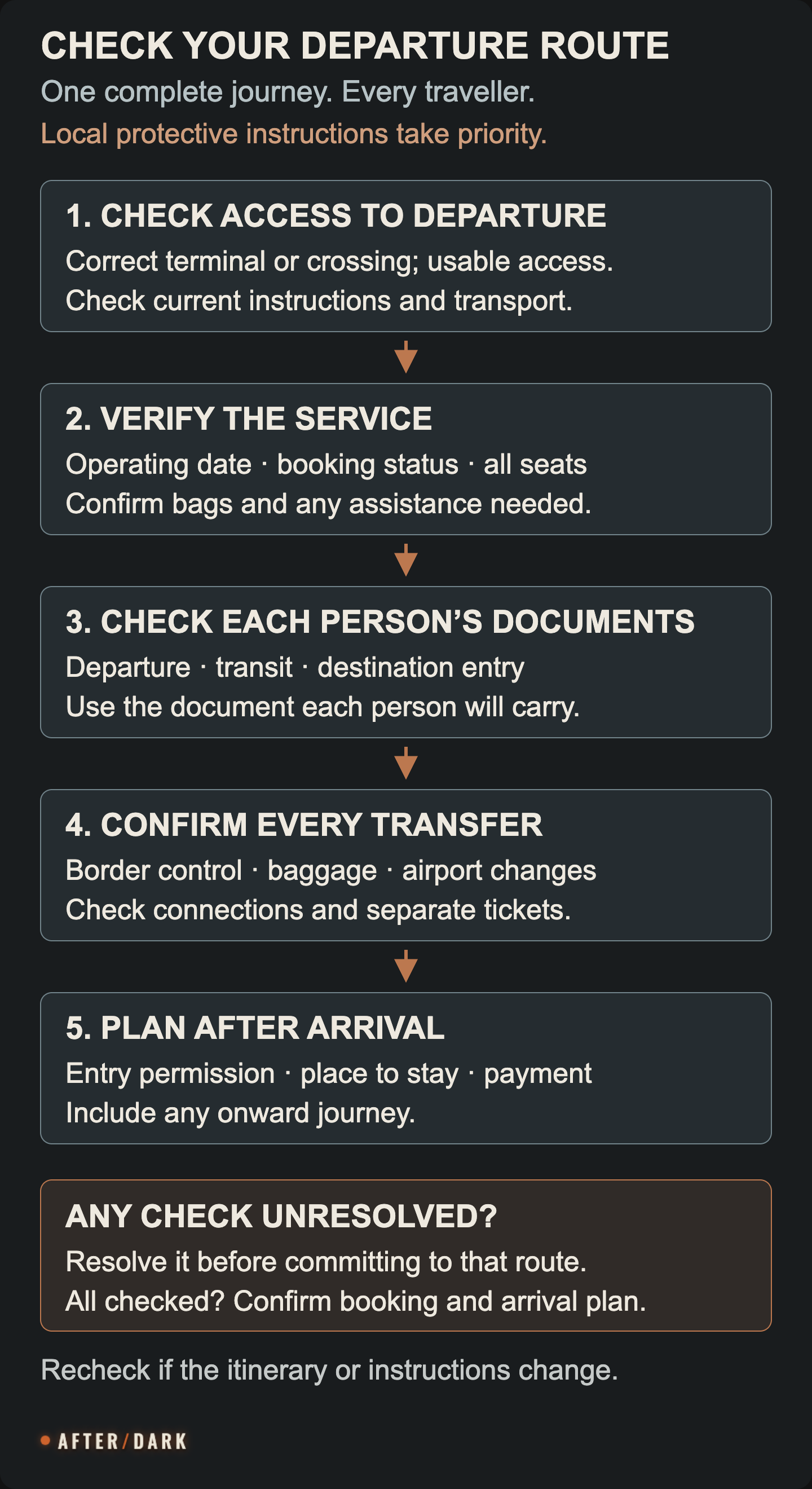
For an overland alternative, use the same checks for the actual crossing and onward transport. Seek current official information on whether it is open to your situation and documents. Do not improvise a trip to an unfamiliar border because it looks close on a map. Keep offline directions and essential route details available once you have a workable plan.
When travelling with children or someone needing assistance
Check everyone as an individual traveller. If a changed route means a child travels with one parent or another adult, ask about the applicable consent and supporting-document requirements before separating. Children's entry and exit requirements vary, and a consent letter may not be sufficient everywhere.
Confirm necessary assistance for the new service and each transfer. Do not assume arrangements attached to the cancelled flight move automatically to another operator. Tell the carrier what boarding, mobility or communication support is needed, and establish where to meet staff. Keep the group's document and assistance checks together so a cheaper flight does not conceal a missing arrangement.
If departure remains unresolved, make tomorrow workable
Give each open problem a next action. For example: the airline is due to respond to a rebooking request; a document appointment is confirmed; accommodation needs an extension by checkout; immigration has asked for evidence. Record those actual times instead of applying a universal waiting interval.
Before settling in for the night, establish:
- Where everyone will stay and how that stay is paid for.
- Where food, drinking water and necessary everyday supplies are available.
- Which official updates to check and how you can receive them.
- The next document, booking or permission-to-stay action.
- Who at home has your current location and when you will contact them again.
Send a concise update with the local time and time zone: location, people with you, current arrangement and next contact. A trusted person can relay it to others using your family communication plan. Ask them to acknowledge any task you need them to perform.
Charge available devices when permitted, keep essential records offline and write down the most important contact details. The portable power guide helps with a longer wait. Reassess promptly if local instructions change, your accommodation becomes unavailable or a checked departure becomes possible.
If your government announces assisted transport, ask about eligibility, confirmation, meeting arrangements, documents and costs through its official channel. Government-assisted departures are not guaranteed. Keep working on feasible commercial options while following the instructions that apply to your location; do not assume registering interest reserves a seat.
Worked example: the replacement flight needs a different check
Consider a family whose return flight is cancelled while they are staying abroad. Their room booking ends the next morning. Both adults can access their documents, but they hold different nationalities. A booking site offers an apparently convenient replacement through another country.
They first confirm a short accommodation extension and establish how much money remains after its cost. One adult contacts the original booking agent while the other checks the proposed connection.
The new itinerary requires collecting baggage and checking in with a different carrier. After checking with the transit country's authorities, they learn that one adult would need entry permission they do not currently hold. They set that option aside before paying. The lower displayed fare had concealed an unusable connection.
The agent then proposes another itinerary. The family verifies the document requirements for each person, transfer arrangements and arrival transport, and confirms the replacement through the agent. They notify the hotel of the new departure, retain the cancellation evidence and send their family contact one updated itinerary.
This example assumes the stated permissions and services have been checked. Its useful habit is assigning parallel tasks without letting a promising fare bypass the document check.
Make the next trip easier to recover
After the disruption, keep the improvements that would have helped: an offline contact sheet, separately stored document copies, a second usable payment method and a small reserve tied to your travel costs. Give a trusted person enough itinerary and policy information to assist without needing access to all your accounts.
For a future trip, check entry and transit requirements for the whole party, note the permitted-stay record on arrival and locate the official consular contact covering the destination. Ask your accommodation and travel provider how urgent changes will reach you if your normal number is unavailable.
Zombie Scenario: The Unconfirmed Booking
Fictional scenario
During a fictional outbreak abroad, a traveller's friend finds a ferry described as still operating. Instead of sending the traveller straight to the port, the friend contacts the operator through its official channel. The sailing exists, but bookings have closed. The traveller keeps the confirmed room while they establish the next available option. A shared search helps because someone checks the missing fact before anyone spends their remaining money on the transfer.
Frequently Asked
What if my country has no embassy where I am?
I live in a different country from my citizenship. Which government should I contact?
Can a photograph of my passport get me onto an international flight?
Can I buy insurance now to cover the disruption that has already happened?
What if an assisted departure takes me only to a neighbouring country?
How can someone at home help without taking over my accounts?
Sources
- UK Foreign, Commonwealth & Development Office — Prepare for and Deal with Crises Abroad
- Australian Department of Foreign Affairs and Trade — Consular Services Charter
- Government of Canada — Large-Scale Emergencies Outside Canada
- Australian Aviation Consumer Ombuds — Travel Tips
- UK Foreign, Commonwealth & Development Office — Foreign Travel Insurance
- Government of Canada — Financial Assistance Abroad
- HM Passport Office — Apply for an Emergency Travel Document Abroad
- HM Passport Office — Cancel a Lost or Stolen Passport
- Government of Canada — Visas, Biometrics and Electronic Travel Authorizations
- Australian Department of Foreign Affairs and Trade — Getting a Foreign Visa
- UK Visas and Immigration — Visa to Pass Through the UK in Transit
- Government of Canada — Consent Letter for Children Travelling Outside Canada
Related guides

What to Do If You Can’t Get Home During an Emergency
When the journey home stops working, choose a usable place for the next few hours, coordinate with the people who depend on you and arrange onward travel or an overnight stay.

How to Build a Grab-and-Go Emergency Document Kit
Create a compact, protected document system that remains usable during an evacuation, extended outage, or loss of internet access.
How to Prepare Emergency Cash and Payment Backups for a Long Outage
Create a modest, usable payment reserve that still works when card terminals, ATMs, banking apps, or one financial provider become unavailable.