What Happens When Supermarkets Stop Getting Deliveries?
A missed truck can become a missing meal. Understand what changes inside the supermarket and how to arrange food when your usual shopping routine stops working.
Short answer
Key takeaways
- Missing deliveries can affect one product, one distributor or a wider area; establish the scope before changing your shopping plan.
- Count food you can actually open, prepare and store, then identify the next meal that lacks something essential.
- Confirm the destination, available food, opening time, payment method and return journey before spending scarce money on travel.
- If you have no food or cannot reach it, ask for specific assistance now rather than waiting for a general restocking announcement.
- Use new deliveries to fill identified gaps and keep track of what has physically arrived.
Imagine this: 7:10 AM. The supermarket doors open on time. The lights are on, the card machines work, but the delivery bay is empty. Yesterday's gaps on the shelves are still there. Your usual groceries are missing, and the staff cannot confirm when the next truck will arrive.
A delivery interruption can begin this quietly. The important questions are what has stopped moving, what food remains accessible, and how you will obtain the next meals if the problem continues. If you have nothing to eat today, start with the section on having no reserve below; understanding the supply chain can wait until you have a practical next step.
What happens when supermarket deliveries stop?
A supermarket is the last visible stage of a much longer system. A simplified route is producer or processor → distribution center or wholesaler → transport → store → shopper. Some products take a different route, including direct deliveries, so one broken link may affect only part of a shop's range.
The FTC's grocery supply-chain report describes how production inputs, labor, transport and changing demand contributed to pandemic disruption. Food can exist somewhere upstream while the product you need fails to reach your local shelf. A functioning factory does not settle whether its goods can be packed, moved and sold where you live.
Retailers also need more than a road and a truck. Orders must reach the supplier, warehouse staff must pick them, vehicles need fuel and drivers, and somebody at the destination must receive the load. Chilled goods add temperature-controlled handling. A store's working lights tell you little about these upstream arrangements.
The UK food-security assessment explains how just-in-time supply relies on goods continuing to move. Keeping limited stock reduces storage costs, but leaves less room for significant delays. This explains the vulnerability without establishing a fixed number of days before every shop becomes empty.
If electricity is also lost across the area, payment, refrigeration and household preparation become separate problems. Our account of a city after seven days without power follows those wider dependencies. Here, the central problem is replenishment, which can fail while the shop itself keeps operating.
Why the shelves empty unevenly
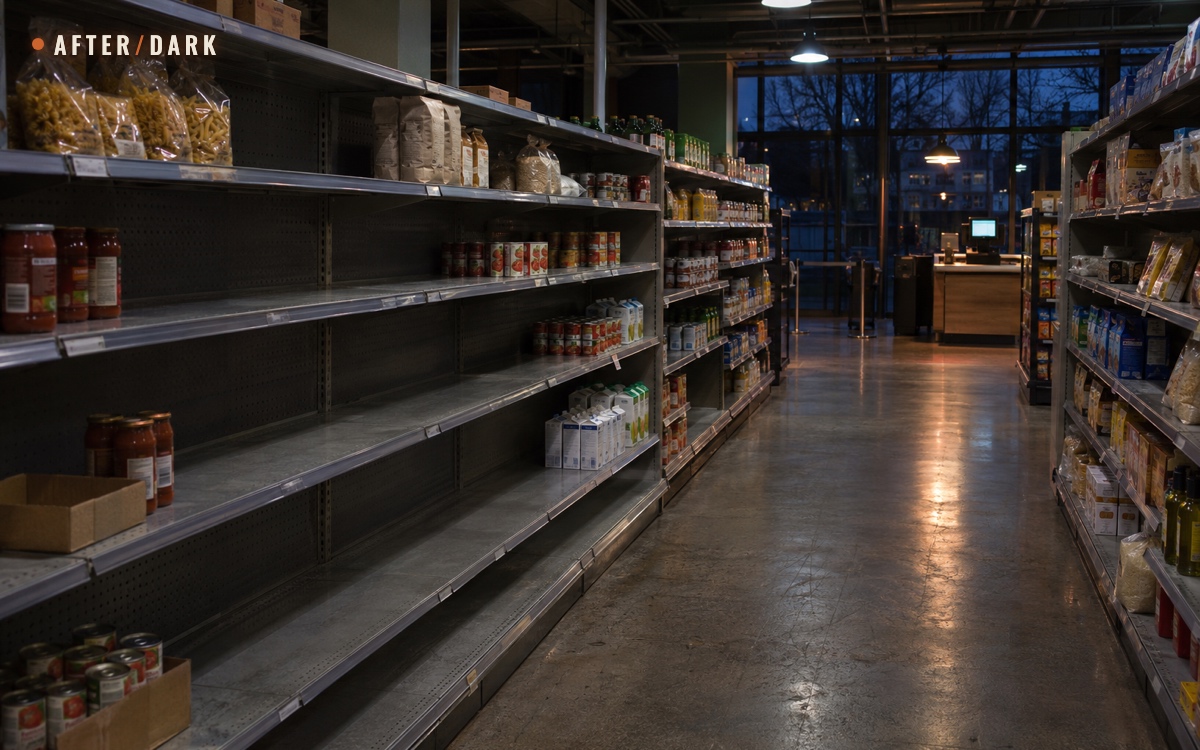
The first visible change may be reduced choice: your usual size or brand disappears while an alternative remains. With repeated missed deliveries, the gaps can spread. Which shelf empties first depends on what was there at the start, what people buy, how often it normally arrives and which suppliers are affected.
Do not treat “fresh food first, canned food later” as a reliable timetable. Perishable products have tighter usable windows, but a sudden rush for long-life products can clear those shelves too. If only one supplier is affected, unrelated products may continue arriving. If transport across the region is disrupted, switching brands may solve much less.
An empty shelf is therefore a clue to investigate. Ask whether the missing item has a substitute, whether a whole category is affected, and whether staff have information about the next receipt. “Expected tomorrow” is an estimate; “received and available now” is a different kind of information.
Different shops can also fare differently. The FTC found that smaller grocery retailers faced greater difficulties obtaining products during the pandemic, while some larger buyers secured preferential supplies. That historical finding does not tell you which nearby branch has food today. It does show why one retailer's situation cannot stand in for the whole area.
What stores can change while supplies are disrupted
Retailers and distributors can adapt, although their options depend on what failed. The response may involve alternative ordering processes, different suppliers, available replacement products or purchase limits. These measures serve different purposes: a limit spreads existing stock among customers; it does not itself create another delivery.
A real example came from UNFI, a North American grocery distributor, after unauthorized activity disrupted its systems in June 2025. Its updates described manual workarounds, the gradual restoration of ordering and receiving, and then the return of core electronic ordering and invoicing systems. By June 26, the company reported deliveries at more normal levels. The sequence of restoration updates shows why recovery can arrive in stages rather than with one truck that fixes everything.
At the shopper's end, rules may change too. Tesco's grocery terms allow quantity limits to support availability. Check the applicable limit before planning a large shop or collecting for several households. A displayed limit alone does not establish how much stock remains behind the scenes.
You may also lose the cheapest version of something even when the category remains available. Compare the replacement's actual price and pack size instead of assuming the old shopping total still applies. The amount you can buy, carry and use is more informative than the apparent fullness of the shelves.
Identify the problem before making the trip
Separate four questions: is the food available, can the seller serve you, can you pay, and can you get it home? Solving the wrong one wastes scarce time and money. Cash does not restock an empty aisle, and a full shop beyond your reach does not solve tonight's meal.
Match the observed problem to the information needed for a useful next action.
| What you encounter | What to verify | Next practical action |
|---|---|---|
| Your usual product is missing | Whether another size, brand or usable food can replace it | Buy a suitable replacement against your meal list |
| Several food categories have gaps | Which branches or other sellers currently have the items you need | Choose one confirmed, reachable destination |
| Groceries are available but checkout is restricted | Accepted payment methods and whether sales are continuing | Use an accepted method or another confirmed seller |
| The app has no delivery slots | In-store availability, collection and help with the last part of the journey | Arrange a real handover before placing a collection order |
| You have no food and cannot afford a purchase | Current food-assistance location, hours and access requirements | Request help for today's meals and explain transport or cooking limits |
| A truck has arrived | What has actually been received, released for sale and limited | Replenish identified gaps rather than assuming the full range is back |
For payment problems, the emergency cash and payment plan covers the available fallbacks. Check the seller's current arrangements before withdrawing cash or traveling on the assumption that cash will be accepted.
Turn the remaining food into a practical shopping decision
1. Find the first missing meal
Look through the food you have and write down what can cover the next meals for everyone eating with you. Include food already opened and anything that needs using sooner, following its storage instructions. If there is almost nothing, move directly to the help and limited-budget steps below.
Count the complete meal rather than every packet as an independent solution. Pasta still needs a way to cook it. A tin needs an opener unless its opening mechanism works for you. Food kept at another address is not available until somebody can bring it over.
Mark the first meal that has a missing essential, then list what would complete it. This gives the shopping trip a purpose. It also prevents several people in the household buying the same familiar staple while the actual gap remains.
2. Choose replacements you can use under today's conditions
Replace the job a food does in the meal rather than chasing the exact brand. If a familiar bread is unavailable, another ready-to-eat accompaniment may work. If you have heat and water, your options differ from those of someone in temporary accommodation with neither.
Before buying an unfamiliar replacement, check:
- Preparation: is it ready to eat, or does the label require cooking, heating or added water?
- Opening: can you open the container with what you have?
- Ingredients: does the exact product meet the household's existing requirements?
- Pack size: can you use the amount once opened, or store the remainder as directed?
- Total cost: what will the purchase and getting it home actually cost?
For example, a large carton of shelf-stable milk may be awkward for one person without refrigeration. A smaller carton used at one sitting may fit the situation better despite a higher price per liter. The FSA's storage guidance explains that some foods require refrigeration after opening; the unopened package's long life does not settle what happens to the remainder.
The same check applies to bargains in unfamiliar formats. A dry ingredient and a ready-to-eat pouch are not interchangeable when you cannot cook. Use the three-day no-cook meal plan for a worked shopping example, or the guide to food storage without refrigeration when a fridge is unavailable.
3. Confirm the purchase and the return journey
Check the shop's current notice or contact staff if possible. Ask about the particular food you need, today's hours, any limits and accepted payment. Stock can change after a check, so identify an acceptable substitute before leaving rather than planning around a single item.
Then account for the journey back. A bus trip, walk or shared lift has a carrying limit. Include bags, stairs and whether you can manage the load without another trip. If someone is collecting for you, agree on the list and spending limit before they leave.
At checkout, compare what you actually obtained with the missing-meal list. Cross off the filled gaps and record the ones left. The successful outcome is food you can use at your destination, not simply a completed shopping trip.
If you have no reserve, little money or no way to travel
Start with today's food, then extend the plan
If you have a small amount to spend, set aside the cost of reaching the seller and returning before choosing the basket. Put food for the next meals ahead of equipment or an ambitious bulk purchase. A lower unit price helps only if you can afford the whole package and use its contents.
Write two short lists: what you need today and what can wait until you have confirmed more money or supplies. If an essential item is unavailable, decide on a usable replacement at the shop; do not spend the remaining budget visiting several branches in pursuit of the original brand.
If you cannot buy enough, ask for assistance while you still have time to arrange access. Be specific: “We have no food for tonight, there are two of us, we cannot cook, and we cannot collect by car.” This tells the person helping you what a useful arrangement must include.
Find an actual food-assistance route
In the United States, the Feeding America locator connects you with a local food bank, which can identify nearby pantries, meal programs and distribution times. In the UK, Trussell describes a referral-and-voucher route to emergency food. These are examples of different access systems, not a single procedure that applies everywhere.
For either service, or the relevant local organization elsewhere, confirm:
- The location and next operating time.
- Whether you need a referral, voucher, appointment or identification.
- Whether the available food can be used with your cooking and storage arrangements.
- How you will receive it if you cannot collect.
Explain any existing food requirements when asking. A parcel still needs to be usable by the people receiving it. Do not assume that every food bank delivers or that emergency distribution is operating simply because an address appears online.
If the first provider is closed, out of food or unable to serve you, ask for the specific next referral or operating meal service rather than leaving with only “try elsewhere.” Make clear whether the need is today; a later appointment may help with ongoing support but does not resolve the missing meal.
Without a car or a working phone
With no car, begin with reachable shops or an agreed collection by someone you know. Ask whether a collection point accepts pedestrians before booking one designed around vehicle access. For someone who cannot leave home, establish who will bring the food through the final part of the journey; “collection available” is incomplete on its own.
With no working phone, ask a reachable trusted person or staff at an open community facility to help make the contact. State what you need and ask them to confirm the destination and access requirements for you. If you are already at the shop, speak to customer service before setting off toward another unverified location.
Have the details written down if possible: address, opening time, contact name and what to bring. Agree where and when the helper will pass on an answer if they cannot get one immediately. This creates a next step that does not depend on repeatedly checking an unavailable app.
Manage the days between deliveries
Once today's food is arranged, keep a simple running record of what remains and what is still missing. After meals and each purchase, update it. Treat an expected delivery as a separate note until you have checked the actual contents.
Choose the next meals with opened packages and shorter storage windows in mind. Avoid opening several large containers when one will meet the immediate need. Keep labels and dates with the food so another household member can use the same plan. Our guide to storing emergency food at home covers the longer-term organization and rotation.
If the disruption also cuts power, reassess refrigerated food using the cold-food outage guidance. Do not continue counting an unpowered fridge as a normal reserve. If refrigeration still works, keep using it normally rather than treating a supply interruption as proof that every service has failed.
Set the next information check around something useful: a store's promised update, a confirmed opening or the next distribution time. Share specific observations with neighbors, including when they were checked. Coordinate purchases without exceeding limits, and avoid making another journey simply because a rumor says a delivery might arrive.
As supply becomes dependable again, replace what you actually used and correct the weak point you discovered. That might be accessible packaging, a second nearby seller or a person who can collect for you. If funds and space allow, build the food and water reserve gradually through ordinary shopping. The reserve becomes more useful when it reflects the meals and practical constraints you have just tested.
Zombie Scenario: The Store Opens, but the Truck Never Comes
Fictional scenario
On the fourth morning of a fictional outbreak, your neighborhood store opens with power and staff, but another delivery has failed to arrive. A message says the warehouse is operating again. Nobody at the shop can say what will reach this branch.
Your apartment still has water and a working stove. Between the two households sharing the kitchen, there is enough food for today but one meal tomorrow is incomplete. You compare the lists, agree on substitutes and send one person on an already-planned shopping trip with a manageable carrying load. The store has a different product that fills the gap, within its purchase limit.
You record what came home and arrange to check the shop's next update. The warehouse announcement may be encouraging, but tomorrow's meal now depends on food in the kitchen rather than a truck you have not seen.
Frequently Asked
Does a confirmed grocery delivery reserve every item in my basket?
If there are no online delivery slots, is the supermarket out of food?
What should I do about money tied up in a cancelled order?
Should I buy a specialist emergency food kit instead?
Can farm shops and local producers bypass the disruption?
Can I collect groceries for a neighbor as well as myself?
How can I tell whether an empty-shelf photo is relevant to my area?
Would starting a vegetable garden help during a delivery disruption?
Sources
- Defra — UK Food Security Report 2024: Food Supply Chain Resilience
- FTC — Feeding America in a Time of Crisis: Grocery Supply Chain Report, March 2024
- FTC — Findings on Grocery Supply Chain Disruptions
- UNFI — Systems Restoration Updates, June 2025
- Tesco — Grocery Product Terms and Conditions
- Tesco — Unavailable Items and Grocery Substitutions
- Feeding America — Find Free Food and Groceries
- Trussell — Get Emergency Food
- Food Standards Agency — How to Chill, Freeze and Defrost Food Safely
Related guides
How to Build a 30-Day Food and Water Supply for an Apocalypse
A practical 30-day pantry for apocalypse preparedness, built from person-days, package labels, a no-cook layer, and stored water you can rotate.
3-Day No-Cook Emergency Meal Plan and Shopping List
Nine meals, daily snacks and a matching shopping list for three days without cooking or refrigeration, with practical US and UK substitutions.

What Happens to a City After 7 Days Without Power?
A city does not stop all at once. Follow the connections between dark buildings, working backups, deliveries and the services people can actually reach.