What Happens to a City After 7 Days Without Power?
A city does not stop all at once. Follow the connections between dark buildings, working backups, deliveries and the services people can actually reach.

Short answer
Key takeaways
- A week-long blackout changes access to services; it does not make every system fail on the same schedule.
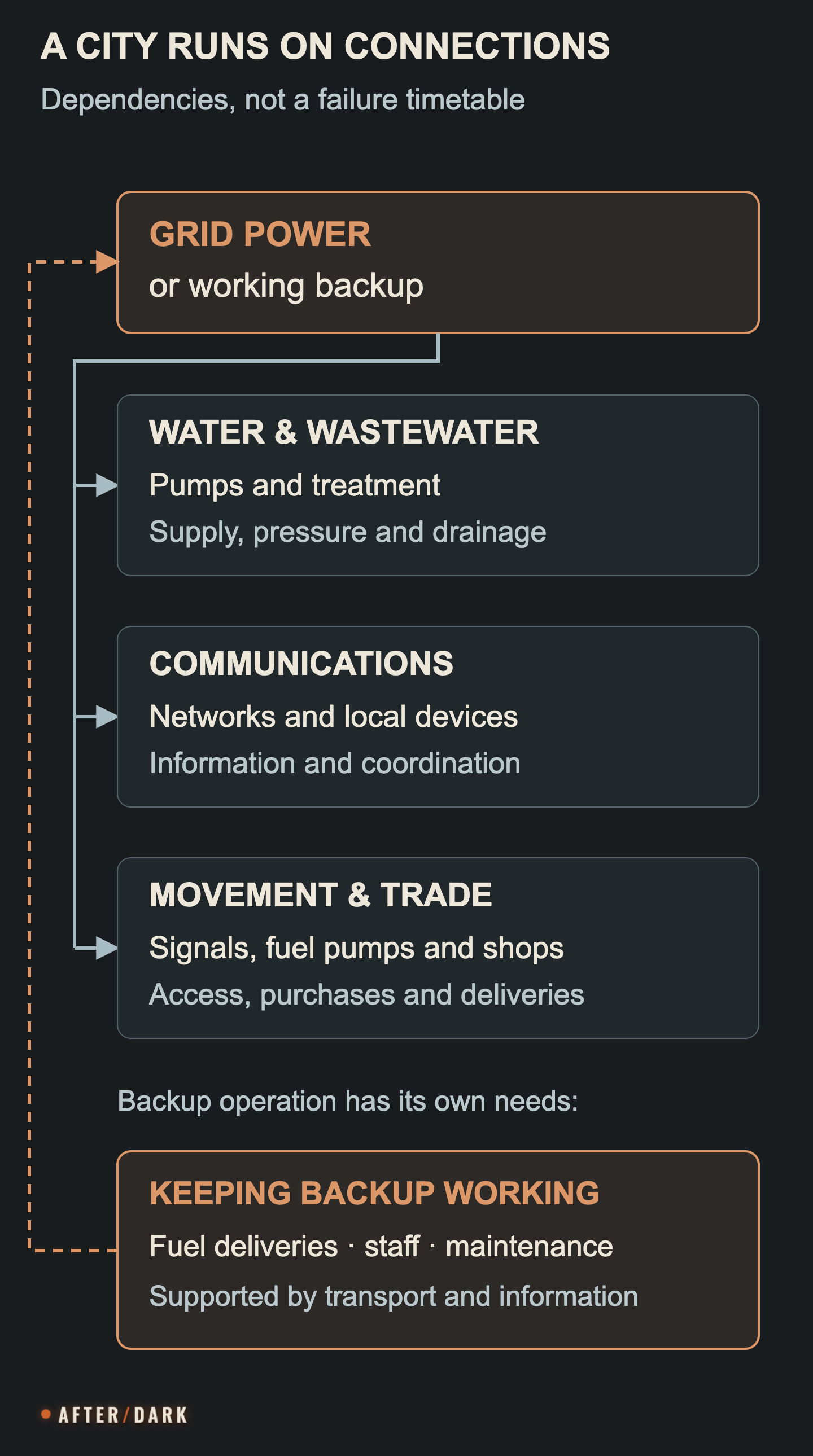
- Backup generation needs continuing fuel, maintenance and staffing, which also depend on transport and communication.
- Water reaching a neighborhood does not guarantee water reaching an apartment on an upper floor.
- A useful destination must offer the service you need, at a time and place you can actually reach.
- Electricity returning is only one part of recovery: water notices, building access and food storage require separate checks.
11:47 PM. The lights go out across the city. Your phone has 12% battery. The refrigerator falls silent. Below your window, a car horn sounds at an intersection where the traffic lights have gone dark. You reach for your charger out of habit. By morning, the blackout will still be here.
Imagine that normal grid supply remains unavailable across much of the city for a week. The buildings are still standing. Surrounding regions can send some assistance, and certain sites have independent backup power. What changes between that first silent minute and the seventh evening?
The answer is more complicated than a countdown to empty shelves. Different systems have different reserves and ways to keep operating. The sequence below is a way to examine those dependencies, not a prediction that every city loses the same service on the same day. Its practical question is simple: what can you still use, and what will it take to keep using it?
The first minutes: ordinary access changes
At first, the blackout is something you notice room by room: lights, appliances, the router. Beyond the front door, it changes movement. A lift may stop serving your floor. A familiar entrance may have an access problem. An intersection needs more attention than it did an hour ago.
Your immediate job is small: account for the people with you, find a usable light, leave refrigerator and freezer doors closed, and check the utility or local authority's information while you have a connection. If you are already somewhere secure, going out merely to inspect the darkness adds a journey without solving a need.
Notice the difference between a problem in your apartment and one affecting the building or street. A neighbor's light could be battery-powered. A working lobby light might be on an emergency circuit. Neither tells you whether the lift, water pump or sockets work. Ask the building operator what is actually available rather than inferring it from one illuminated room.
For a household sequence you can prepare in advance, use the home power outage plan. Here, we will follow what happens beyond that household.
The first night: your phone and the network are separate problems
A charged phone does not guarantee a connection. Equally, a functioning mobile network is of little use to someone whose phone has gone flat. At home, keeping the handset charged will not restore an unpowered router or digital landline: equipment in the home needs its own supply.
Outside your home, network equipment also depends on power. Backup can preserve some service, but its continued operation depends on the equipment and replenishment arrangements. The EPA describes how communications can be lost as backup batteries and generator fuel run out. There is no single countdown that applies to every tower, exchange and connection.
Use a remaining connection to complete something: send a short household status message, save the latest official notice and record an agreed next check-in. Avoid spending the last charge repeatedly refreshing a map that has not changed. If you have a battery radio, use the announced local information channel. If you do not, establish where someone can pass on verified updates in person.
For example, an apartment building could agree to put a dated notice in the lobby after each management update. Include who issued the information and when the next update is expected. An old restoration estimate without a time stamp can send people in the wrong direction. Our guide to communication without cell service or internet covers the alternatives in more detail.
The first day: the city becomes harder to use
Once people begin looking for breakfast, transport and supplies, the outage becomes a problem of access. A shop can have food behind its doors but lack the lighting, staff or payment system needed to sell it. A vehicle can have fuel but no usable route to its destination. These are different constraints and require different answers.
New York City's infrastructure assessment describes how food distribution depends on transport, fuel, refrigeration and transactions. A delivery reaching a district does not complete the job: a retailer must receive it, make usable stock available and serve customers. Residents then need a way to pay and carry purchases home.
Before making a trip, try to establish the specific service, address, opening time and payment method. “The shopping center has power” is not enough if the only operating business is a restaurant you cannot use. Cash is one fallback, with limits explained in the emergency cash and payment plan.
Refrigerated food reaches its limit before the week does
For a home refrigerator kept closed, the FDA gives about four hours. A closed full freezer can hold its temperature for approximately 48 hours; a half-full one for about 24 hours. These estimates do not describe every commercial cold store, and repeated door opening changes the situation.
By the later days, an unpowered domestic refrigerator is no longer a continuing food reserve. Use the relevant time and temperature guidance to decide what to discard; do not taste food to test it. Plan the next meals around food that can be safely stored and prepared under the conditions you actually have. The cold-food outage guide handles that decision separately from the city's delivery problem.
A real blackout did not stop everything in the same way
During Lancaster's December 2015 outage, trains could still run using electricity supplied from outside the affected area, but the station closed after dark because platform lighting was unavailable. Much of the water supply continued, while some buildings had problems with electrically pumped supplies. Shops, communications and payments experienced disruption, and people organized practical help for one another.
The engineering review of Lancaster's experience describes an interrupted restoration and recovery over several days, not seven uninterrupted days without power everywhere. Its useful lesson is the unevenness: a working transport or water system does not guarantee normal access at its final destination.
Water and toilets: the building can be the weak point
Water may continue to flow where gravity, stored capacity or supported pumping keeps the system operating. New York City's system is an example of largely gravity-fed distribution, with high-rise buildings relying on additional arrangements for upper floors. That is why a working tap at street level does not prove that every apartment above it has water.
For a resident, three separate questions matter: does the supply reach the neighborhood, does the building deliver it to your floor, and what does the supplier currently say about its permitted use? Ask building management where an accessible supply is available and whether carrying containers upstairs is the temporary arrangement being proposed. Count the return journey as part of the plan.
Wastewater has its own dependencies. The EPA explains that power failures can affect drinking-water pressure and wastewater pumping. Pressure loss can create a contamination risk; wastewater failures can cause backups or discharges. A citywide power cut does not automatically mean every toilet is unusable, but adding water is not a solution to a blocked or restricted sewer system.
Check the actual water and sewer notices before choosing a workaround. The water outage guide covers supply interruptions; the emergency toilet guide explains the separate sanitation choices. Establishing a usable toilet is part of deciding whether you can remain in a building, not an issue to postpone until drinking water runs out.
Days two and three: keeping backups working becomes a daily job
A generator changes where electricity comes from. It does not remove the need for deliveries, people and upkeep. The EPA's power-resilience guidance treats fuel availability, delivery access, alternative suppliers and staffing as continuing operating requirements. A generator with a resupply plan can remain useful; one without the resources to keep running is a temporary reserve.
Consider a hypothetical water facility supplied by a generator. A fuel delivery needs a functioning supplier, a route, a vehicle and people who can coordinate the handover. If communications fail, arranging that delivery becomes harder. If transport is delayed, the facility may have to adjust its operation. None of this establishes a universal hour when water stops; it shows why one service's continuation depends on several others.
The same reasoning changes how you interpret an announcement. “A charging point is open today” answers a present need. It does not establish that it will open tomorrow, supply meals or offer somewhere to sleep. Record the actual service and its next announced opening rather than treating a powered building as a complete replacement for home.
For your own arrangements, the useful question now is what needs replenishing next? That might be drinking water, ready-to-eat food or phone charge. Name one confirmed way to obtain it and the latest practical time to act. If there is no confirmed arrangement, that unanswered question deserves attention before the remaining supply is exhausted.
Days four to seven: a patchwork city, with longer everyday tasks
By the end of the week, the scenario may contain dark residential blocks beside a working distribution point, limited transport, shops with reduced hours and buildings supported by generators. Outside assistance can make an enormous difference. If neighboring regions are also badly affected, the same arrangements face more competition for equipment, supplies and crews.
What feels different to a resident is how much of the day goes into ordinary tasks. A short shopping trip can become a walk, a queue and a carrying problem. A shared charging outlet needs turns. Reaching someone might require visiting an agreed location. These are possible consequences of limited access, not evidence that every neighborhood has become uninhabitable.
Season and building design also change the week. Losing heating in cold weather or cooling during a hot spell can make the same apartment much less workable than it would be in mild conditions. Even some fuel-based heating needs electrical controls or pumps, as the UK's power-cut guidance explains. Compare conditions where you are with a confirmed alternative, including its opening hours and overnight arrangements. A daytime warming or cooling location may help for several hours without answering where you will stay that night.
How to judge a service that is still operating.
| What appears to work | What still needs confirming | A useful next action |
|---|---|---|
| A water distribution point | Drinking-water provision, opening time, containers and transport | Confirm what is supplied and how you will bring it back |
| A shop with power | Current stock, payment method and opening hours | Choose usable essentials before committing to the journey |
| A mobile signal | Whether your message was delivered and your next charging opportunity | Complete the contact, then preserve charge for the agreed check-in |
| A bus or train service | Your stop, destination, accessibility and any return service | Verify the whole trip, including the final walk |
| A community building | Its announced purpose and whether it accepts people to stay | Ask staff about the specific help you need |
Cooperation reduces duplicated work
Small arrangements can save repeated trips: one person checks a posted notice and reports back, neighbors combine a suitable supply collection, or a building agrees on a place to leave non-private updates. NYC's utility-disruption guidance includes checking on neighbors and arranging practical support. Agree on the task and the person's consent; do not promise assistance that has not been arranged.
For example, three households could discover that each plans to walk to the same information point. One able and willing person could obtain the current opening details and share them. Collecting supplies is a separate agreement because weight, quantities and individual needs differ. Coordination works best when it solves a specific task rather than giving one volunteer unlimited responsibility.
What the week means in your situation
You live on an upper floor
Work out whether the apartment remains usable beyond the supplies already inside it. Can everyone enter and leave through the available route? Can water and meals reach the floor? What has management said about shared services? If help is needed, agree who will provide it and when. A vague expectation that neighbors will carry everything is not a sustainable arrangement.
If a necessary daily task cannot be completed, contact management or the announced local assistance service early about an accessible alternative. For someone who cannot use the stairs, the plan needs organized assistance rather than a recommendation simply to walk down.
You have no car
A large distant supermarket may be less useful than a smaller confirmed source within reach. Plan around what you can carry, daylight, current conditions and the complete journey. If transit runs outward but not back, decide whether you are collecting supplies or relocating; those trips need different arrangements.
When a move is necessary, confirm the destination and ask the local authority about available transport assistance. Our guide to evacuating without a car covers preparing those options. Do not let the lack of a vehicle turn every proposed solution into an impossible drive.
You are visiting and staying in a hotel
Start with reception. Ask whether rooms have water and usable toilets, what the backup actually powers, how entry and exit work, and whether food or charging is available. A bright lobby can coexist with dark rooms and unavailable lifts.
Before accepting a move to another property, confirm the booking, its operating services and transport. Keep the address and agreed arrangements somewhere accessible without a live booking app. Ask staff for written information or directions if your phone is unavailable.
You have no stored supplies and no working phone
Begin with the people you can reach where you are: building staff, a neighbor you know, your host or a staffed reception. Ask for the latest local notice and help identifying an open source of drinking water, a meal and a usable toilet. A supplied drink or meal is an immediate result; learning about an unconfirmed site across the city is not.
Ask whether the announced location provides containers, ready-to-eat food or only bulk supplies. Explain transport or access constraints before setting off. If no one nearby knows, seek the local authority's announced staffed assistance point when the route is usable, or ask someone with a connection to obtain that information for you. Do not assume any school or community building has opened as a shelter.
Agree where you can stay that night and how to hear the next update. If you have no paper, ask for a written address and opening time. The first objective is to connect with an operating service or person who can help complete these tasks, then establish the next meal and water supply. Buying an entire emergency kit is not a prerequisite for asking for assistance.
When the lights return, check what has actually recovered
Restoration is work performed across a network, not one citywide switch. Con Edison, for example, describes prioritizing safety and critical services before restoring larger groups of customers. Other utilities publish their own procedures. A timetable for one area is not a guarantee for your building.
Treat the return of electricity as the start of a short verification round:
- Check your own location. Confirm the utility's status and building notices. Report unresolved access or service problems to the responsible operator.
- Read the water notice. Restored pressure or a running tap does not itself lift an advisory. Boil-water, do-not-drink and do-not-use notices require different actions; follow the notice that actually applies until the issuing authority changes it.
- Keep the cold-food decision separate. Cooling food again does not undo unsafe storage during the outage. Follow the food-safety guidance used earlier.
- Confirm disrupted arrangements. A reopened road does not prove a bus timetable, school, shop or workplace has returned to normal. Check the service before relying on it.
- Replenish what you used. Recharge suitable devices, replace consumed supplies and record the one or two gaps that made daily life hardest.
The useful lesson from a week without power is personal as well as citywide. Perhaps your water stayed on but you could not pay for food. Perhaps supplies were available downstairs but could not reach your apartment. Use that specific finding to improve the next plan instead of buying equipment for a problem you did not have.
Zombie Scenario: The Lit Building Across the Square
Fictional scenario
On the seventh evening, your group sees lights in a building across the square. You have enough food for tonight, but tomorrow's water is unresolved. Someone suggests moving everyone there immediately. Instead, you use the contact already established with its volunteers: the building offers charging during limited hours, has no overnight accommodation, and is awaiting its next water delivery. Your group keeps its existing shelter for now and confirms another water collection arrangement. The lights were evidence of electricity, not an answer to every need.
Frequently Asked
Does the cause of the blackout change what happens?
Would rooftop solar keep a building running?
Could hospitals and emergency services keep operating?
Does having cash solve the shopping problem?
Would widespread looting be inevitable?
Is leaving the city always the best option?
Why might the next block have power while mine does not?
Is a three-day supply enough for a seven-day outage?
Sources
- Royal Academy of Engineering — Living Without Electricity: One City's Experience of Coping With Loss of Power
- Ofcom — Stay Connected in Severe Weather
- U.S. EPA — Water Sector Guide to Telecommunications During Power Outages
- NYC Hazard Mitigation Plan — Built Environment
- FDA — Food and Water Safety During Power Outages and Floods
- U.S. EPA — Power Resilience Guide for Water and Wastewater Utilities (2021)
- NYC Emergency Management — Utility Disruptions
- Con Edison — Our Storm Recovery Plan
- CDC — Drinking Water Advisories: An Overview
- UK Government Be Ready — Power Cuts
Related guides

How to Build a Home Power Outage Plan for a Long Blackout
Turn separate outage supplies into one tested household sequence for lighting, food, communication, water, temperature control, and recovery.

No Running Water at Home: What to Do During a Water Outage
A practical plan for life with dry taps: obtain water, keep essential routines working, organize the next refill, and decide when to stay elsewhere.
How to Communicate Without Cell Service or Internet
Choose a way to exchange messages during an outage or beyond coverage, including what to do with only a phone or no working devices.