How to Keep Your Home Cool Without Electricity During a Long Outage
Build a passive cooling routine around shade, indoor and outdoor conditions, room choice, and a tested day-to-night operating card.
Short answer
Key takeaways
- Block direct sun before it enters the room; removing stored heat later is harder without powered cooling.
- Decide whether to open windows by comparing indoor and shaded outdoor conditions, not by time of day alone.
- Natural ventilation works best when outdoor air is cooler and clean enough to admit; it is less effective in hot, humid climates.
- Choose and test one cool room, but preserve the household route and a confirmed relocation option.
- Use a one-page operating card and a warm-day test so the household does not improvise every morning and evening.
Keeping a home cooler without electricity is a heat-management task. Stop direct sun from adding heat, admit outside air only when it can improve indoor conditions, reduce heat created inside, and concentrate normal activity in the coolest workable room. The system needs measurements and a schedule because the correct window position can change between morning, afternoon, evening, and night.
This guide covers passive operation of an ordinary home during a long outage. It does not provide personal health assessment, set a universally acceptable indoor temperature, or replace current directions from local authorities, building management, or a qualified professional who understands the household. If the home cannot remain usable, the cooling plan should make relocation easier rather than delay it.
Use the Five-Step Passive Cooling Sequence
Passive cooling cannot make every home comfortable in every climate. It can slow avoidable heat gain, preserve a cooler room for longer, and show when the home is no longer responding to the plan.
Use the same sequence each day:
- Block: shade surfaces and windows before direct sun heats the room.
- Compare: read indoor conditions and a representative shaded outdoor temperature.
- Exchange: ventilate only when outside air is cooler, acceptable to bring indoors, and the openings are safe to use.
- Consolidate: move routine household activity away from the hottest rooms without blocking the exit route.
- Reassess: log the trend, check current official information, and apply the next stay-or-relocate decision.
The U.S. Department of Energy identifies shading, windows, doors, insulation, and ventilation as parts of low-energy home cooling. This article turns those building principles into an outage routine. It does not ask the household to install or alter the building while the power is off.
Write the sequence at the top of the operating card:
BLOCK / COMPARE / EXCHANGE / CONSOLIDATE / REASSESS
That line prevents one measure—usually opening every window—from replacing the whole decision process.
Map Where the Home Gains Heat
Do not choose a cool room from a floor plan alone. Observe the home over a warm day and record when direct sun reaches each window, which rooms warm first, and which spaces stay cooler after sunset.
UK Government guidance identifies top-floor flats, homes with openings on only one side, large exposed windows, limited shading, restricted openings, and dense urban settings as factors that can increase overheating. These are screening clues, not a guarantee that one named room will perform best.
Draw a solar-gain map
Sketch the floor outline and add:
- every window and glazed door;
- the time direct sun begins and ends at each opening;
- existing external shade, shutters, awnings, blinds, or curtains;
- rooms above garages, roofs, mechanical spaces, or other warm zones;
- openings that can be used normally and openings restricted by design or rules;
- doors that can separate a hot room without interfering with required airflow or the exit route;
- the primary and backup household exits;
- the two rooms that appear coolest at different times of day.
Sun direction varies with location, season, surrounding buildings, trees, and the shape of the property. Record the exposure the home actually receives instead of copying a compass rule from another country.
Score two candidate cool rooms
A cool room is a managed household zone, not a sealed chamber. It must work for the actual occupants and remain connected to the departure plan.
Cool-room gate: a room must pass every required line before it becomes the primary choice.
| Gate | Pass | Needs work | Reject for now |
|---|---|---|---|
| Solar exposure | Direct sun is limited or can be controlled with existing shading | One exposed window needs an approved covering | Large unshaded glazing dominates the room during the hottest period |
| Measured trend | The room warms later or cools earlier than alternatives | Only one observation exists | The room consistently becomes one of the hottest spaces |
| Ventilation | Approved openings can admit cooler acceptable air when conditions allow | Air exchange is limited but measurable | Required openings cannot be used and the room retains heat |
| Access | Every expected occupant can enter, use, and leave the room | A movable item needs a marked position | Stairs, fixed furniture, or layout exclude an occupant or support item |
| Route | Door swing and path to an exit stay clear | One ordinary item must be relocated | Shading, furniture, or stored supplies block the route |
| Internal heat | No unavoidable heat-producing equipment dominates the space | One device or routine must move | The room depends on equipment that continues adding substantial heat |
| Relocation | The operating module can leave with the household | Load ownership needs reassignment | The setup encourages the household to remain after its written transition conditions |
If the candidate is already the household's shelter-in-place room, reuse its route, capacity, and working-zone plan. Then test it specifically for hot-weather performance. A room suited to information and supply storage may still fail because of afternoon sun or poor air exchange.
Keep a second candidate. One room may be cooler during the day while another releases stored heat faster after sunset. The card can name a daytime room and a nighttime room if the movement is simple and the routes remain clear.
Establish Comparable Indoor and Outdoor Readings
The question is not “Does it feel warm outside?” The useful question is “Will opening this home to the current outside air improve the indoor trend?”
Use at least one indoor thermometer in the candidate room and one representative outdoor reading. The outdoor sensor should be placed and operated according to its instructions, protected from direct sun and conditions the device is not designed to tolerate. A sensor heated by sunlight does not represent the air entering the window.
If the household uses an official nearby weather reading instead of its own outdoor sensor, record that it is remote. A station across town may not match a shaded courtyard, exposed balcony, or dense street. Use the same source consistently enough to learn the difference.
Record:
- time;
- indoor temperature in each candidate room;
- shaded outdoor temperature or source;
- whether direct sun is reaching each window;
- current window and shade positions;
- outdoor air-quality status from the normal official source;
- which household activity or equipment is adding heat;
- the next scheduled comparison.
Temperature log: the trend matters more than one isolated reading.
| Time | Room A | Room B | Shaded outside | Sun exposure | Openings and shades | Decision |
|---|---|---|---|---|---|---|
| Early morning | Reading | Reading | Reading or source | None / partial | Current positions | Close or continue exchange |
| Before direct sun | Reading | Reading | Reading or source | Window or room | Shade status | Block expected gain |
| Afternoon check | Reading | Reading | Reading or source | Window or room | Current positions | Keep closed or change room |
| Evening comparison | Reading | Reading | Reading or source | Reducing | Current positions | Begin exchange only if gates pass |
| Before sleep period | Reading | Reading | Reading or source | None | Current positions | Continue, reduce, or end exchange |
Do not compare an indoor reading taken now with an outdoor reading from hours earlier. Put the time beside every value. If a sensor moves, note the new location; otherwise the log may suggest a temperature change that came from moving the instrument.
Decide Whether to Open or Close Windows
Time of day alone does not make ventilation useful. U.S. Department of Energy building guidance says natural ventilation works best with cooler nights and regular breezes and should not be used when outdoor air quality is poor. Security, weather, noise restrictions, insects, building rules, and the design of the opening also matter.
Use four states.
Window decision table: all three exchange gates—temperature, outdoor air, and usable opening—must pass.
| State | Indoor versus outside | Outdoor air and opening | Action | Next check |
|---|---|---|---|---|
| A: Exchange | Outside is cooler | Air is acceptable and approved openings can be used safely | Open the planned inlet and outlet; keep sun control where useful | Confirm that indoor readings begin improving |
| B: Hold | Outside is equal or hotter | Other gates may pass | Close exterior openings that admit hotter air and keep exposed windows shaded | Compare again at the scheduled time |
| C: No exchange | Outside is cooler | Air quality, weather, security, or building rules fail | Keep affected openings closed; use the better room or relocation branch | Follow the relevant official update |
| D: Unknown | Readings are missing, stale, or not comparable | Opening status may also be uncertain | Maintain shade and the last verified building-safe configuration; obtain a current comparison | Do not convert a guess into a permanent setting |
After changing the openings, check the indoor trend. Air movement can feel noticeable without reducing stored heat, and a breeze does not prove the outdoor air is cooler. If the room reading keeps rising, return to the decision table instead of assuming more open area must help.
Do not defeat window restrictors, screens, locks, alarms, or building rules. Do not use a shared corridor or stairwell as an improvised air path. The household plan must preserve security and the building's required exits while operating the room.
Block Daytime Heat Before It Enters
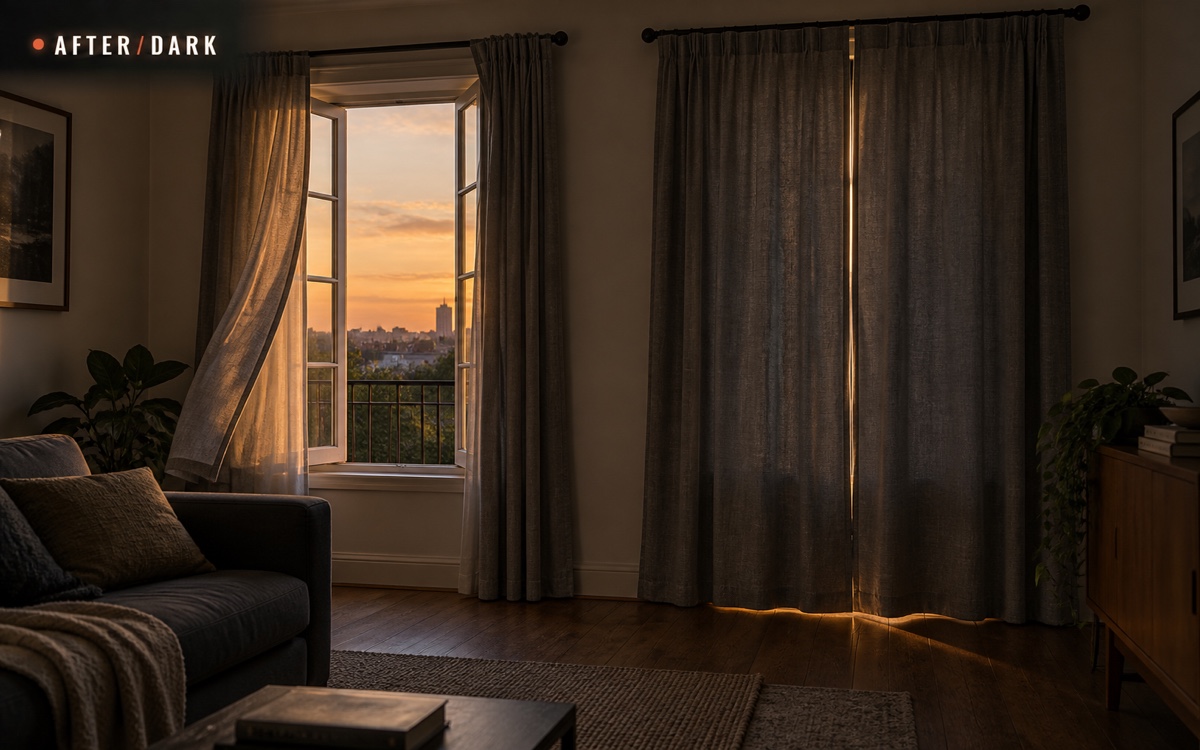
Shading is most useful before direct sun has heated glass, floors, walls, and furniture. UK Government guidance recommends shading or covering windows and identifies external shutters, roller blinds, and awnings as effective options.
Use systems already installed or selected for the exact window and follow their instructions. Complete permanent installation, repair, or exterior work before an outage and use a qualified local professional where the property, access, or product requires one.
Build the daytime routine in this order:
- Check which windows will receive direct sun next.
- Set existing external shading where it can be operated normally and safely.
- Close internal blinds or curtains for exposed glazing without blocking a required exit or vent.
- Close windows when the outdoor comparison shows hotter air would enter.
- Close the door to a hotter unused room only when compatible with the building and its required ventilation.
- Move routine household activity away from the exposed zone.
- Record the indoor trend and the next sun or temperature transition.
Avoid attaching loose reflective sheets, heavy improvised panels, or unfamiliar fixings during the outage. A covering that can fall, obstruct an exit, damage the window, violate property rules, or prevent normal operation is not a finished cooling control.
Keep the floor below the window clear. Shading materials, chairs, supply boxes, and water containers should not turn the window zone or exit route into storage.
Use Cooler Evening Air as a Controlled Reset
When evening or nighttime air is genuinely cooler, ventilation can remove heat from the air and building surfaces. Department of Energy guidance describes night flushing as using cooler nighttime air to cool the home and its thermal mass.
The reset has a beginning, an operating check, and an end.
Begin only when all gates pass
Confirm:
- the outside reading is lower than the candidate-room reading;
- the outdoor air-quality source permits normal ventilation;
- weather and building conditions permit the planned openings;
- the household can secure and supervise the openings as required;
- the inlet and outlet do not compromise a shared route or another household rule.
Open the planned path, not every window automatically. Openings on different sides can support cross-ventilation; lower and higher approved openings may support rising warm air leaving the home. The actual result depends on wind, layout, surrounding buildings, and the size and position of the openings.
Verify that the home responds
Record the indoor reading after a consistent interval chosen for the household log. The interval is an editorial testing choice, not a universal safety deadline. If the temperature trend does not improve, check whether:
- outside air is still cooler;
- the inlet and outlet form a real path rather than opening into isolated rooms;
- internal doors on the planned path are in the correct position;
- direct sun or heat-producing activity is still affecting the room;
- wind has changed;
- humidity or the building's stored heat is limiting the result.
Do not extend the opening period merely because the schedule says “night.” Continue only while the comparison and other gates pass.
End before outside heat returns
Check conditions again in the early morning. Close the openings and reset the shades before outside air becomes hotter or direct sun reaches the exposed glazing. Record the closing time. A successful night flush can be undone when the home remains open into a hotter morning.
Account for Climate and Apartment Limits
The Department of Energy notes that ventilation is not an effective cooling strategy in hot, humid climates. If the night remains hot, the building has only one-sided openings, or outside air adds substantial moisture, shading and internal-heat reduction may slow the rise without producing a meaningful overnight reset.
Use measured response instead of forcing the same method everywhere.
Constraint table: identify what limits passive cooling and which part of the plan must carry more responsibility.
| Constraint | What it changes | Planning response |
|---|---|---|
| Hot nights | Outside air may never become cooler than the room | Keep shade and internal-heat controls active; shorten reassessment intervals; confirm relocation capacity |
| Hot, humid conditions | Ventilation may offer limited cooling | Test actual room response; do not use air movement as proof of lower heat |
| Windows on one side | Cross-ventilation may be weak | Compare rooms, use approved internal paths, and keep expectations realistic |
| Top floor or exposed roof | Heat gain and stored heat may remain high | Prioritize early shading, compare lower available rooms, and plan an earlier transition |
| Large exposed glazing | Solar gain can dominate the room | Use suitable existing external and internal shading before exposure |
| Restricted openings | Air exchange is limited by design or rules | Do not alter restrictors; use another room or relocation branch |
| Poor outdoor air quality | Outside air should not be brought in through natural ventilation | Follow official air information and keep affected openings closed |
| Security or noise limits | Openings cannot remain in the preferred position or time window | Use supervised exchange when permitted and maintain a second location plan |
In an apartment, do not assume the corridor, stair enclosure, roof, basement, or another resident's area is available as a cooler room. Keep common exits empty, follow property-management instructions, and record whether lifts, access controls, or shared doors depend on power.
If a lower shared facility is part of the official building plan, record its access rules and hours. Do not add it to the household cooling plan from observation alone.
Reduce Heat Created Inside the Home
Once direct sun is controlled, remove avoidable internal sources. UK Government guidance recommends turning off unused lights and electrical equipment and considering cooking at cooler times.
During an outage, many devices are already off, but batteries, backup equipment, cooking systems, and sun-heated rooms can still concentrate heat where the household is working.
Use an internal-heat inventory:
- move charging and other nonessential powered tasks out of the cool room when the equipment and household plan permit;
- switch off backup devices when they are not performing their assigned function;
- keep sun-warmed doors closed between hot unused rooms and the managed room when compatible with ventilation requirements;
- schedule necessary household work for the cooler part of the day when possible;
- use the long-outage cooking plan to select an existing method and schedule rather than improvising a new indoor setup;
- keep any equipment in the location and clearance required by its manufacturer and current official guidance.
Do not disable a required alarm, ventilation system, access device, or building control to reduce heat. The cool-room plan manages optional household activity; it does not override installed safety functions.
Build a Small Cool-Room Operating Kit
The room needs a working layer, not the whole emergency reserve. Store it in one marked tote, shelf section, or portable module that can move to the backup room or leave with the household.
Cool-room kit: each item must support a specific operating decision.
| Function | Item or record | Completion test |
|---|---|---|
| Measure | Indoor thermometer and representative shaded outdoor sensor or written official source | Household can compare readings taken at the same time |
| Shade | Controls for existing blinds, curtains, shutters, or awnings | Each control works and does not block the route |
| Operate | Printed day/night card, solar-gain map, temperature log, pencil, and clock reference | Another household member can follow the schedule offline |
| Inform | Battery radio or other low-power official-information method from the household plan | Current local and utility information can be received |
| Light | One efficient battery task light from the existing power budget | Setup can be completed with fixed lighting unavailable |
| Supply | Accessible drinking-water working container from the tested household reserve | It can be dispensed without moving the deep reserve into the room |
| Relocate | Route Sheet, keys, portable records, and assigned departure module | The room can be left without repacking its entire layout |
Connect the information and task-light layer to the phone, light, and radio power budget. The cooling plan should not quietly consume a battery reserve assigned to communication.
Use the emergency water storage system for quantity, container, placement, dispensing, and rotation decisions. This article only assigns one accessible working container to the room; it does not create a second water total.
Write a Day-to-Night Operating Card
Make the card short enough to use while the household is busy. Put detailed room scores and logs behind it.
Operating card: every phase ends with a comparison and a named next decision.
| Phase | Check | Default task | Change condition |
|---|---|---|---|
| Early morning | Indoor versus shaded outside; sun forecast or observed path | Finish useful air exchange, then close and shade before outside heat returns | Outside is no longer cooler or another exchange gate fails |
| Before direct sun | Next exposed windows and rooms | Set approved shading and clear the window zone | Exposure changes or a covering cannot be operated correctly |
| Warmest period | Room trend, official information, internal heat sources | Keep hotter air out, use the better room, reduce optional heat | Another room performs better or relocation conditions approach |
| Evening | Fresh indoor/outdoor comparison and outdoor air status | Begin controlled exchange only if all gates pass | Trend fails to improve or any gate changes |
| Night | Openings, route, security, weather, and room trend | Continue only while the planned path remains usable | Outside warms, air status changes, or supervision cannot continue |
| Review | Utility estimate, building status, household plan, and destination | Decide whether to repeat, change rooms, or relocate | Written transition condition is met |
Assign one primary operator and a backup. Their job is to take readings, update the card, and communicate the current state—not to make private decisions for everyone without the household plan.
Use clear state labels:
DAY HOLD — SHADED / CLOSED / NEXT CHECK 16:00
EVENING EXCHANGE — INLET A / OUTLET B / NEXT CHECK 20:30
NO EXCHANGE — OUTDOOR AIR NOTICE / USE BACKUP ROOM
These examples show format, not universal times. Replace them with the household's verified schedule and conditions.
Test the Plan on a Normal Warm Day
Do not create dangerous conditions or disable cooling, alarms, ventilation, access systems, or other essential equipment to simulate an outage. The test observes how the home responds to ordinary shading, approved openings, room choice, and reduced optional heat while normal safeguards remain available.
Run the test in three passes.
Pass 1: Observe the baseline pattern
On an ordinary warm day, record candidate-room and shaded outdoor readings at the planned checkpoints. Note direct sun, window positions, and normal household activity. Do not change essential routines merely to produce a baseline.
Pass 2: Operate the passive plan
On a reasonably comparable day, set shades before exposure, use the window decision table, reduce optional internal heat, and move routine activity into the chosen room. Record the same checkpoints and any practical failures.
Pass 3: Test the handoff
Ask the backup operator to use the card. The person should be able to:
- identify the primary and backup cool rooms;
- read the two comparison points;
- set the correct shade and opening state;
- explain why a state changed;
- locate official information and the Route Sheet;
- restore each control and record the next check.
The test result is not a promise that the room will perform identically during a longer or hotter disruption. It shows whether the household understands the controls and whether the building responds enough to justify the current plan.
Test log: turn every failure into an owned correction and retest.
| Observation | Meaning | Correction | Owner | Retest |
|---|---|---|---|---|
| Shade set after direct sun reached the floor | Heat blocking began too late | Move the action earlier on the card | Named person | Date |
| Outdoor sensor was in direct sun | Comparison was invalid | Move it to an approved representative shaded location | Named person | Date |
| Open windows did not lower the room trend | Exchange path or outdoor conditions were ineffective | Recheck state, route, and climate limits | Named person | Date |
| Coolest room blocked the exit when occupied | Room fails the route gate | Change layout or choose backup room | Named person | Date |
| Card depended on a phone | Offline operation failed | Add printed sources, map, and log | Named person | Date |
| Household could not name the relocation destination | Cooling plan had no transition | Complete the destination and Route Sheet | Named person | Date |
Connect Cooling to the Relocation Plan
Passive cooling has limits. A home may continue accumulating heat because nights stay hot, openings cannot be used, outdoor air is unsuitable, the building retains substantial heat, or the outage lasts longer than the plan can support.
Do not invent one universal indoor temperature for every occupant. Build the transition from current local directions, building conditions, any existing qualified guidance for the household, and the practical performance of the home.
The operating card should name:
- the current official information source;
- the person who records a direction to leave or a building status change;
- the household's pre-agreed transition conditions;
- a confirmed cooler destination and backup;
- primary and alternate routes;
- transport and pickup responsibilities;
- the portable room module and who carries it;
- the final check that every person and pet has entered the travel group.
Use the existing home evacuation plan rather than creating a cooling-only route. If the destination depends on grid cooling, confirm its current operating status before departure. A remembered public building is not a confirmed destination.
The plan should preserve options. Waiting until the home is difficult to leave, the route is crowded, or the destination is uncertain turns a building-performance problem into a rushed transport decision.
Zombie Scenario: The Apartment That Stored Afternoon Heat
Fictional scenario
By the third afternoon, the apartment is gaining heat faster than the household expected. The windows are open, but the temperature log shows that the outside air is still warmer than both candidate rooms. The breeze feels active while the indoor readings continue rising.
Mina follows the card instead of opening more glass. The household closes the planned openings, keeps the exposed windows shaded, and moves the operating module to the room that has remained cooler. At dusk, a fresh comparison shows the outside air has finally dropped below the indoor reading and the official air source is clear. The approved inlet and outlet are opened, then checked against the log.
The next morning, the room has improved but the utility estimate has moved again. The card's transition condition is now close, so the backup destination is confirmed while the route is still usable. The useful decision was not whether the apartment felt survivable in a fictional collapse. It was whether the measured home, destination, and travel plan still gave the household a reliable next step.
Complete the Passive Cooling Plan
- The household has mapped actual direct-sun periods instead of relying on a generic compass rule.
- A primary and backup cool room pass the sun, trend, ventilation, access, route, and relocation gates.
- Indoor and shaded outdoor readings can be compared at the same time.
- The outdoor reading is not distorted by direct sun or an undocumented sensor move.
- The window decision table includes temperature, outdoor air quality, weather, security, and building rules.
- Existing shade can be operated before exposure without blocking an exit or required opening.
- Evening exchange begins only when all gates pass and ends when conditions change.
- Hot nights, humidity, one-sided openings, top-floor exposure, and restricted windows are recorded where relevant.
- Optional internal heat sources and cooking schedules have assigned controls.
- The room kit uses the existing power, water, communication, and document systems without duplicating totals.
- The day-to-night card has a primary operator, backup, state label, and next check.
- A normal warm-day test and backup-operator handoff have been completed.
- Every failed test item has an owner and retest date.
- Current local information, a confirmed destination, routes, transport, and transition conditions are recorded.
A passive cooling plan does not promise comfort without electricity. It gives the household a disciplined way to slow avoidable heat gain, use cooler outside air when it can genuinely help, concentrate activity in the best-performing room, and recognize when the building has reached the limit of the plan.
Frequently Asked
Should windows be open or closed during a power outage in hot weather?
Which room stays coolest without air conditioning?
Does opening windows at night always cool a home?
How can an apartment be kept cooler without electricity?
What if the windows cannot be opened?
Is there one indoor temperature at which everyone should leave?
Sources
Related guides
How to Stay Warm Without Power During a Long Outage
Keep one room workable during a cold-weather outage with a tested heat-retention layout, a first-15-minute checklist, and firm safety boundaries.
How to Set Up a Shelter-in-Place Room at Home
Turn one ordinary room into a practical household base for a long disruption without blocking the exit, burying the floor in supplies, or assuming one location fits every emergency.
How to Cook Without Electricity During a Long Outage
Build an outage kitchen for an apartment or house with no-cook meals, safe heat options, measured capacity, and clear food-safety limits.