How to Cook Without Electricity During a Long Outage
Build an outage kitchen for an apartment or house with no-cook meals, safe heat options, measured capacity, and clear food-safety limits.
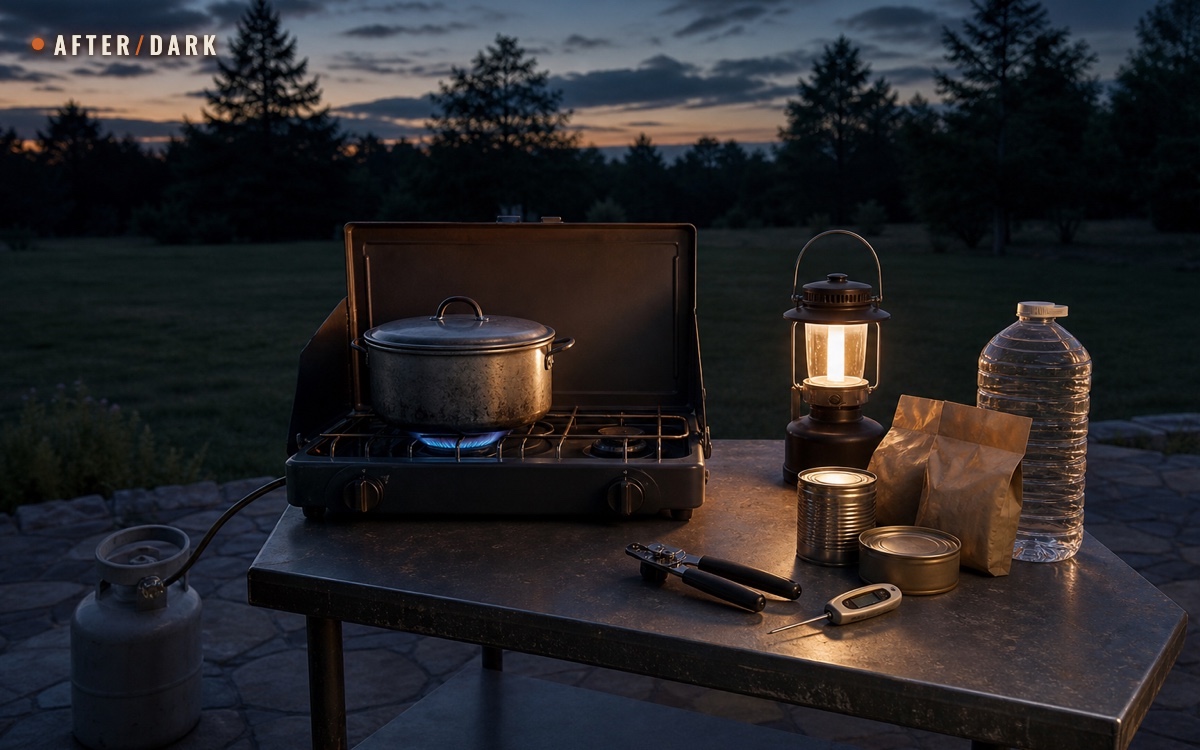
Short answer
Key takeaways
- Keep a no-cook layer that works in every home; heat should improve the plan, not be required for its first meal.
- Portable camping stoves and charcoal belong outdoors in a fully open, permitted location—not in a home, garage, tent, camper, or improvised enclosure.
- Use refrigerator temperature and elapsed time to decide what remains usable; cooking does not rescue food that has already crossed official discard limits.
- Calculate battery energy in kilowatt-hours and fuel capacity in tested burner minutes instead of trusting a headline runtime.
- Test one complete outage day, including food access, cooking water, cleanup, lighting, and the next meal.
To cook without electricity during a long outage, start with shelf-stable no-cook meals. If you have a correctly rated battery system, use only compatible indoor electric appliances within every published limit. Portable camping stoves and charcoal belong outdoors in a fully open location and must follow manufacturer and local rules; never bring them into a home, garage, tent, or other enclosed space. Keep cold-storage doors closed, use food thermometers, prepare small meals, and test the menu, water use, power draw, or fuel consumption before an outage.
This guide builds the cooking system. Use the 30-day food and water inventory to decide what the household stores, and coordinate alarms, power, room use, and departure decisions with the household home-base plan. Current official instructions, equipment manuals, property rules, and local requirements always take priority.
Start With the Safest Available Cooking Layer
The safest method is the one that fits the property, works with verified resources, and does not create a new indoor hazard. Start at the top of this matrix each time conditions change.
Outage Cooking Method Matrix: select the first layer that is both available and permitted.
| Layer | Where it works | What it depends on | Stop condition |
|---|---|---|---|
| No-cook shelf-stable meal | Any usable home or temporary location | Safe food, safe water where required, manual opener, utensils | Package is damaged, requires refrigeration, or cannot be prepared as labeled |
| Indoor electric appliance | A normal indoor cooking surface | Compatible appliance, correctly rated battery or backup circuit, tested cable and capacity | Any rating, connector, ventilation, stability, or battery limit is not satisfied |
| Existing fixed appliance | Only where its manual and current utility or building rules permit outage operation | Model-specific instructions and unchanged utility safety conditions | The manual is unavailable, the control needs modification, or officials restrict use |
| Portable outdoor appliance | Fully open, permitted outdoor location | Manufacturer-approved setup, stable surface, suitable conditions, verified fuel | Location becomes enclosed, access is restricted, conditions become unsuitable, or supervision cannot continue |
| No usable heat method | Apartment or other site without a permitted outdoor location and without compatible electric capacity | Complete no-cook menu | Switch only after a higher layer becomes genuinely available and safe |
Do not treat a window, open door, exhaust fan, carbon-monoxide alarm, or open garage door as permission to operate outdoor equipment inside. CDC says portable camping stoves and charcoal equipment must not be used inside a home, tent, or camper. An alarm is a backup warning layer, not a way to make an unsuitable location acceptable.
The matrix also prevents unnecessary fuel use. A shelf-stable meal that is safe and acceptable without heat remains a valid meal. Save limited heating capacity for food that genuinely needs cooking, for a familiar routine the household values, or for conditions where a hot meal materially simplifies the day.
Protect the Cold-Food Window Before Cooking
The refrigerator and freezer are temporary resources after power fails. Keep both doors closed while deciding what to use. Repeated checking shortens the useful cold window.
CDC states that an unopened refrigerator keeps food safe for up to four hours, a full unopened freezer for 48 hours, and a half-full unopened freezer for 24 hours. These are planning limits under the stated closed-door conditions, not permission to ignore temperature or food condition.
Cold-Food Decision Sequence: record time and temperature before moving food into the cooking plan.
| Decision | Evidence to use | Action in the cooking plan |
|---|---|---|
| When did power fail? | Utility notice, household log, or observed time | Start one written outage clock; do not rely on several memories |
| Were doors kept closed? | Household log and actual use | Shorter or uncertain conditions require a temperature-based decision |
| What does the appliance thermometer show? | Current refrigerator or freezer reading | Follow current USDA guidance for that temperature and food type |
| Does frozen food still contain ice crystals or remain at 40°F (4°C) or below? | Food condition and thermometer | FoodSafety.gov says it may be refrozen |
| Has perishable food exceeded the official limit? | Time and temperature together | Discard it; cooking is not a reset button |
| Is the decision uncertain? | Missing clock, missing thermometer, unknown handling | Follow the conservative current official instruction; never taste food to test safety |
Do not automatically begin cooking everything in the freezer. Frozen food can require more energy, longer heating, and more cleanup than the outage system can support. First identify items that remain within official limits, then compare their cooking requirement with verified capacity. If safe cold storage will not be available after cooking, prepare only what the household will finish within the applicable USDA time limit.
Keep appliance thermometers in place before an outage. A food thermometer serves a different job: it verifies the internal temperature of cooked food. FoodSafety.gov publishes current minimum internal temperatures by food type; use that chart, the product label, and a working thermometer rather than judging by color or elapsed cooking time alone.
Build a Three-Layer Outage Menu
A reliable menu does not make every meal depend on heat. Build it in three layers and assign every stored meal to one of them.
Three-Layer Menu: classify the exact products the household stores.
| Menu layer | Definition | Best use | Required record |
|---|---|---|---|
| No-cook | Shelf-stable and ready to eat as labeled without refrigeration or heating | First meals, apartments without an outdoor site, bad outdoor conditions, resource conservation | Manual-opening need, serving size, water used, opened remainder |
| Heat-and-eat | Shelf-stable product that is safe as packaged but is normally warmed for use | Short heating sessions and familiar meals | Vessel, heating minutes, thermometer or label requirement, complete package use |
| Short-cook | Shelf-stable ingredients that require a brief, measured cooking step | Planned hot meal when power or fuel capacity is verified | Recipe water, active heat time, covered-rest time, resource used |
For this plan, shelf-stable means that the unopened product's label permits storage at room temperature. FDA advises checking storage directions because products other than obvious fresh foods may require refrigeration. Read the exact package. A can or pouch marked “Keep Refrigerated” does not enter the no-cook reserve merely because its container looks durable.
Use foods the household already accepts and can prepare according to their labels. This article does not prescribe a diet or universal recipe list. The planning unit is one complete household meal, not a manufacturer's marketing serving.
For each meal, record:
- exact product and package size;
- number of people it serves in the household's normal use;
- whether it can be eaten without heat;
- safe water required for preparation and cleanup;
- active heating minutes and covered resting minutes;
- appliance, power, or fuel layer required;
- whether opening the package creates a perishable remainder;
- tool required to open, stir, serve, and check it.
Favor package sizes the household can finish when refrigeration is unavailable. A large package can look efficient on the shelf while producing a leftover that the outage kitchen cannot keep safely.
Calculate an Indoor Electric Cooking Budget
A battery power station or other properly installed backup source can run an indoor electric appliance only when the complete system supports it. Confirm the appliance's rated input, the power source's continuous and surge output, the permitted connector, and the manufacturer's operating conditions. Do not improvise wiring, bypass a protection feature, or connect an appliance through an unapproved chain of adapters.
Use nameplate power for a first estimate:
Estimated energy per session (kWh) = watts × minutes ÷ 60 ÷ 1,000
A nominal 800-watt appliance used for 12 minutes has this nameplate estimate:
800 × 12 ÷ 60 ÷ 1,000 = 0.16 kWh
That figure is an editorial calculation, not a promised battery draw. Thermostats cycle, appliances start differently, conversion losses vary, and some power sources reserve capacity before the display reaches zero. Measure one complete normal session with the actual appliance, cable, power source, pot, water amount, and food pattern.
Then calculate tested sessions:
Tested cooking sessions = verified usable cooking energy ÷ measured energy per session
Keep communication, lighting, and other reserved loads out of the cooking budget. If the power source has 0.8 kWh verified for cooking and the actual session consumes 0.2 kWh, the working estimate is four similar sessions—not four days and not four arbitrary meals. A different appliance or longer session needs a new test.
Record the starting charge, ending charge, displayed energy where available, session duration, appliance setting, quantity heated, and any automatic shutdown. Stop the plan if the appliance or power source becomes unstable, damaged, wet, or contrary to its manual. Electrical installation, transfer equipment, and fixed backup systems belong with qualified local professionals.
Use Outdoor Cooking Equipment Only Outdoors
Outdoor means a fully open, permitted location—not a room with a window open, a garage with the door raised, a tent, a camper, a covered passage, or a makeshift enclosure. CPSC says never to use charcoal inside homes, garages, tents, campers, vehicles, or other enclosed areas. CDC applies the same indoor prohibition to portable camping stoves.
An apartment balcony, roof, courtyard, shared walkway, or building garden is not automatically an approved cooking site. Check the lease, building rules, fire code, local restrictions, and equipment manual before adding it to the plan. If no site is clearly allowed, the household's solution is the no-cook layer or compatible indoor electric equipment—not a more inventive location.
For a permitted outdoor setup:
- Use only a manufactured appliance for its stated purpose and fuel.
- Follow its required clearances and surface instructions; choose a stable, level location clear of structures, openings, dry vegetation, stored supplies, and normal walking routes.
- Keep the operating area fully visible and lit without relying on an open flame for illumination.
- Keep children, animals, loose clothing, packaging, and unrelated tasks outside the cooking zone.
- Use a pot that fits the appliance and keep the lid available to reduce heating time.
- Remain with the equipment for the entire operating session.
- Stop when weather, access, supervision, equipment condition, or local instructions no longer match the plan.
Store and handle fuel only in the original approved container and exactly as the manufacturer, property, and local authority require. The article cannot determine a legal storage quantity or location for a particular building. Do not transfer fuel into an unmarked container or make an improvised burner.
Calculate Fuel From Tested Burner Minutes
“One canister lasts a weekend” is not a household calculation. The appliance setting, pot, wind, temperature, meal, and operator all change consumption. Use the manufacturer's stated limits as the boundary and an ordinary outdoor cooking test as the planning evidence.
First calculate daily demand:
Daily burner minutes = sessions per day × active burner minutes per session
If the menu schedules two sessions and each tested session uses 12 active minutes, the plan requires 24 burner minutes per day.
Next record verified usable capacity for the exact fuel unit. Use the manufacturer's runtime information and the number of complete tested sessions achieved under normal, permitted conditions. Do not deliberately run a container empty as an emergency simulation.
Planned cooking days = verified usable burner minutes ÷ daily burner minutes
If a fuel unit provides 96 verified burner minutes for the tested meal pattern and the plan uses 24 per day, it supports four similar cooking days. This is an editorial planning result for that equipment and test—not a general fuel promise.
Keep a log with the fuel product, purchase or inspection date, appliance, session count, active minutes, conditions, meals, and remaining manufacturer-recognized capacity. Recalculate when the menu, pot, appliance, setting, season, location, or household size changes.
Reduce Heat, Water, and Cleanup Demand
Efficiency begins with the menu, not with operating an appliance in a way its manufacturer does not allow.
- Use the no-cook layer for meals that do not benefit enough from heat to justify a session.
- Heat only the amount the household will finish safely.
- Use a correctly fitting lid when the recipe and appliance permit it.
- Choose familiar shelf-stable ingredients with short label-directed cooking times.
- Combine components with similar cooking times instead of running separate sessions.
- Measure recipe water before heating and count it in the stored-water plan.
- Select meals that do not require draining large amounts of safe water when an equally acceptable alternative exists.
- Stage one pot, one serving tool, and each person's eating utensil before starting so the cooking area stays organized.
- Wipe ordinary residue promptly and follow current product and local water-safety instructions for washing.
Do not quietly borrow drinking water from an uncounted “cooking” supply. Add recipe water and expected cleanup water to the meal sheet, then reconcile the total with the household inventory. If authorities issue a water instruction, follow it; this cooking guide does not replace current water-safety guidance.
Avoid large batches when reliable cold storage is unavailable. FDA says food that requires refrigeration should not remain at room temperature for more than two hours, or one hour when the temperature is above 90°F (32°C). The simpler outage rule is to prepare an amount the household will finish during the meal and not create a cooling problem for later.
Assemble the Outage Kitchen
Keep the kit compact enough to inspect and move, but separate food-contact items from fuel and ordinary household chemicals.
Outage Kitchen Inventory: every item needs a function, location, and test.
| Function | Minimum planning item | Passing test |
|---|---|---|
| No-cook access | Manual opener, ordinary utensils, exact shelf-stable meal list | One complete meal opens and serves without household power |
| Temperature decisions | Appliance thermometer and food thermometer | Readable, current, and used correctly according to manufacturer |
| Indoor electric layer | Compatible appliance, rated source, approved cable | Complete meal test stays within every published limit |
| Outdoor layer | Manufactured appliance, correct original fuel, stable permitted site | Equipment and location pass manual, property, and local requirements |
| Cooking vessels | Correctly sized pot or pan with lid and serving tool | Stable on the chosen appliance and large enough for one planned meal |
| Safe water | Counted recipe and cleanup amount | Meal sheet and water inventory show the same total |
| Lighting | Battery lantern or task light | Controls, thermometer, and route remain visible after dark |
| Records | Printed menu, resource log, cold-food clock, current sources | Another household member can follow the plan without a phone |
A working carbon-monoxide alarm remains part of the home-base safety system, but it never changes where outdoor equipment may be used. CDC's indoor prohibition still applies when an alarm is present. Smoke and carbon-monoxide alarms must remain active during a practice; do not disable a safety system to make a method appear workable.
Store the no-cook tools with the pantry layer. Store outdoor equipment according to its manual and property rules, away from food and water. Keep the printed method matrix where the household makes meal decisions rather than buried inside the equipment container.
Build a Seven-Day Cooking Schedule
Seven days is a useful operating worksheet, not a universal outage forecast. Repeat or extend it only after the pantry and resource calculations support the longer period.
Seven-Day Schedule: use product labels and household portions rather than copying these categories as recipes.
| Day | Breakfast layer | Midday layer | Evening layer | Resource check |
|---|---|---|---|---|
| 1 | No-cook | No-cook | Cold-food decision within official limits | Start outage clock; keep doors closed |
| 2 | No-cook | No-cook | Heat-and-eat if capacity is verified | Record first measured session |
| 3 | No-cook | Heat-and-eat | No-cook | Reconcile water and remaining capacity |
| 4 | No-cook | No-cook | Short-cook | Confirm outdoor conditions or electric capacity |
| 5 | No-cook | Heat-and-eat | No-cook | Check package sizes and opened remainders |
| 6 | No-cook | No-cook | Short-cook | Compare actual and planned burner minutes or kWh |
| 7 | No-cook | Heat-and-eat | No-cook | Inventory next seven days before committing resources |
The schedule intentionally does not name a universal meal. Fill each cell with the exact shelf-stable product, portion, water, vessel, and tested method your household uses. A different climate, household, package size, access requirement, or cultural food routine should produce a different sheet.
If an outage begins with safely refrigerated food, add it only through the cold-food decision sequence. Do not let a temporary refrigerator item displace the shelf-stable meals needed after the cold window closes.
Run a 24-Hour Outage-Kitchen Test
Practice on an ordinary day when normal power and services remain available as a safety fallback. Do not disconnect household utilities, disable alarms, spoil refrigerated food, create a false public report, or operate equipment in prohibited conditions.
- Choose three meals from the stored menu. Include at least one no-cook meal and no more heated sessions than the daily resource budget allows.
- Pretend the refrigerator is unavailable. Leave it operating normally but use only the food selected for the test.
- Retrieve the printed plan. Locate the method matrix, package instructions, thermometers, and tools without relying on home internet.
- Prepare the no-cook meal. Record package access, water, utensils, waste, and opened remainder.
- Run one permitted heating session. Use the normal manufacturer procedure in the actual planned location; measure minutes and energy or fuel consumption.
- Prepare in low light. Use the planned task light without reducing safe visibility or moving into a prohibited location.
- Clean and reset. Record safe water used, items that need washing, fuel or charge remaining, and time required to restore the kit.
- Audit the next meal. Confirm that today's choices did not consume a tool, package, water amount, or resource required tomorrow.
24-Hour Test Log: fix the system, not the score.
| Record | Passing result | Revision if it fails |
|---|---|---|
| Method and location | Matches the matrix, manual, property, and local rules | Remove the method or choose a permitted site |
| Complete meal | Exact household portion prepared as labeled | Change product, package size, vessel, or plan |
| Active heat | Minutes recorded from start to stop | Retest before calculating capacity |
| Energy or fuel | Start, finish, and measured consumption recorded | Repair the measuring method or resource estimate |
| Food temperature | Required temperature verified with a working thermometer | Change procedure according to official and product guidance |
| Water | Recipe and cleanup amounts fit the inventory | Change meal or increase the counted safe-water allocation |
| Lighting and access | Controls, route, and tools remain visible and reachable | Move task lighting or reorganize the kit |
| Reset | Next meal can begin with a complete clean setup | Add cleaning capacity, spare utensils, or a simpler meal |
Rerun only the failed layer after correcting it. The goal is a repeatable household routine, not an endurance exercise.
Fix Common Failure Modes
Every meal requires heat
Move enough familiar meals into the no-cook layer to cover an unavailable outdoor site, depleted battery, unsuitable weather, or delayed fuel resupply.
The method does not fit the property
Remove any outdoor method that conflicts with the building, lease, fire code, local restriction, or equipment manual. Do not reinterpret a shared corridor or open garage as an outdoor kitchen.
The battery was sized from capacity alone
Check output compatibility and measure a complete session. Capacity in kWh cannot compensate for insufficient output, an incompatible connection, or a device the manufacturer does not permit.
Fuel is counted as containers, not cooking time
Convert the tested menu into burner minutes and keep each fuel unit tied to its exact appliance and manufacturer conditions.
Refrigerator food drives the whole menu
Use the written outage clock, thermometers, and official limits. The shelf-stable plan must remain intact after the temporary cold-food window ends.
Large packages create leftovers
Choose smaller packages or a meal shared completely by the household. Heating a large amount is not efficient if safe storage is unavailable afterward.
Cooking water is invisible
Put recipe and cleanup water on every meal line and reconcile it with the household water inventory before the test.
Use the no-tap dishwashing routine to measure a complete wash, rinse, dry, and equipment-reset cycle for that meal, including any water replacements.
A carbon-monoxide alarm is treated as permission
Keep the alarm active, but move outdoor equipment outdoors. Detection does not convert an enclosed location into a permitted one.
Maintain the System
After/Dark recommends reviewing the outage kitchen every three months with the pantry inventory and running the complete 24-hour test every six months. These are editorial maintenance intervals; product manuals, package dates, property rules, and local requirements take priority.
At each three-month review:
- rotate stored meals through normal household use;
- confirm labels, package sizes, and refrigeration requirements;
- inspect manual openers, pots, thermometers, cables, lights, and printed records;
- charge and test powered equipment according to its manufacturer;
- confirm that the outdoor location remains permitted and usable;
- reconcile cooking and cleanup water with the current menu;
- replace every outdated copy of the resource calculations.
Repeat the method test after changing the appliance, power source, fuel product, pot, menu, package size, household size, property, or planned outdoor location. A calculation belongs to the tested combination, not to the product category forever.
Zombie Scenario: Dinner on Day Six
Fictional scenario
On day six of a fictional zombie outbreak, the grid is still down and the apartment courtyard has been closed. The household does not move its outdoor appliance into the garage. The method matrix sends dinner to the no-cook layer, preserving the remaining battery for communication and light.
The next evening, the permitted outdoor site reopens. The cook uses the printed short-cook meal line, one measured amount of water, the tested pot, and 11 recorded burner minutes. The meal uses one complete package, so no unreliable cold storage is needed afterward.
The practical result does not depend on the fictional setting: location decides the method, the menu decides the resource, and the test supplies the numbers.
A complete outage kitchen can now answer five questions on paper: What can we eat without heat? Which heated method is permitted here? Is the food still within official limits? How many tested sessions remain? What will the next meal require? If any answer depends on guessing, revise the menu or test before relying on it.
Frequently Asked
Can I use a camping stove indoors during a power outage?
Can I manually light my normal gas cooktop when the power is off?
How long will food stay safe in a refrigerator or freezer without power?
How large a battery do I need for cooking?
Do I need a heated meal every day?
Sources
Related guides
How to Build a 30-Day Food and Water Supply for an Apocalypse
A practical 30-day pantry for apocalypse preparedness, built from person-days, package labels, a no-cook layer, and stored water you can rotate.
How to Prepare Your Home for an Apocalypse
Turn an ordinary house or apartment into a safe, workable base without blocking exits, scattering supplies, or mistaking barricades for preparedness.

What to Do If a Zombie Apocalypse Starts: The First 24 Hours
The outbreak catches you where you are. Work through the first decisions, a missing kit, separated family, and the first night with the resources actually available.