Flood Warning: What to Do When You Receive One
A practical response to a flood warning at home, while traveling, or on the road. Understand the message, organise your next move, and get help when your usual options are unavailable.
Short answer
Key takeaways
- Read the location, action, and timing together; warning labels and colours vary between regions.
- Use preparation time to resolve transport and assistance before access routes are cut off.
- No kit or working phone? Act on the instruction you have and ask available people or staff for practical help.
- A saved route or navigation app cannot authorise crossing floodwater or passing a road closure.
- If leaving is no longer possible, report your exact location and follow emergency shelter instructions.
- A warning ending does not establish that your route, building, or utilities are ready for your return.
A flood warning gives you a task to carry out where you are now. You may be at home with a plan, in a hotel with unfamiliar street names, or already traveling when the message arrives. Start with the required action, then solve the practical details that make it possible.
If you have no kit, car, or working phone: tell a nearby responsible person, available member of staff, or responder that you need the current instruction and help carrying it out. State where you are, who is with you, and what prevents you from moving independently. Take essentials already within reach. A missing bag is not a reason to postpone departure, and an urgent instruction does not require online confirmation before you act.
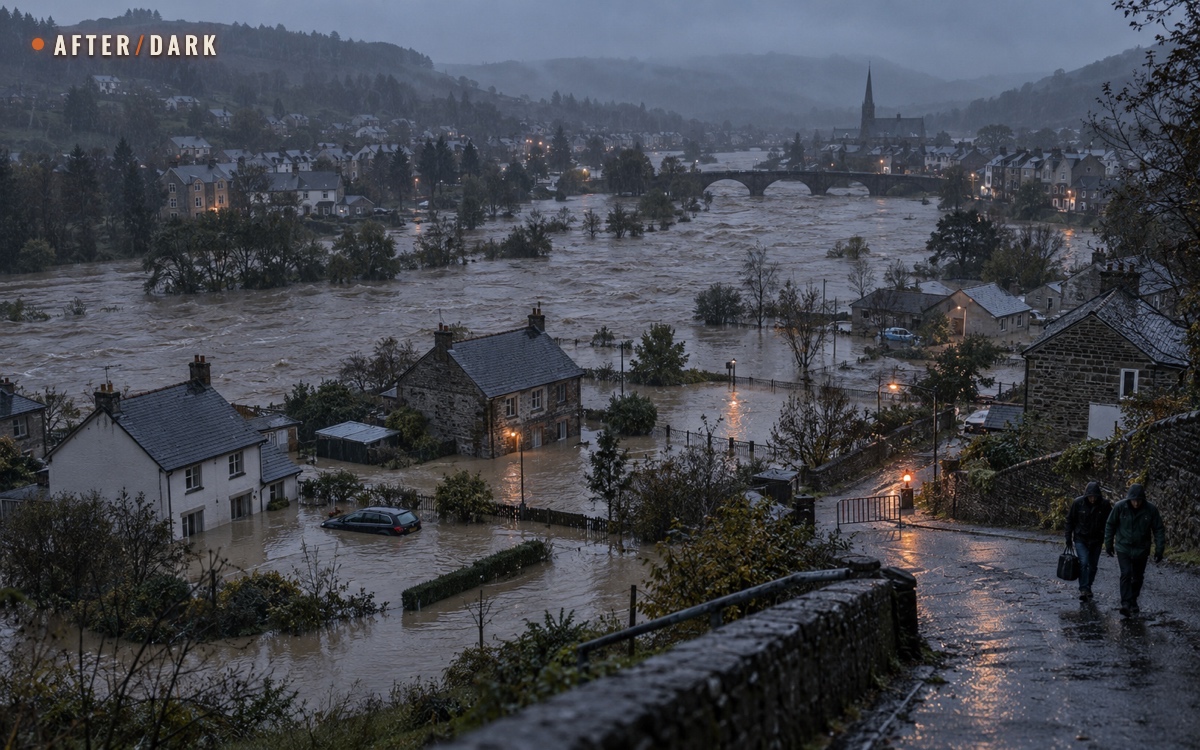
If water is already rising around you, act on the danger. Move away from a low-lying location to higher ground where you can do so without entering floodwater. If trapped, contact local emergency services and seek higher refuge. Do not wait for another alert: water levels and flow can change quickly. The blocked-route section below explains how to communicate your situation without attempting a crossing.
Read the Flood Warning for Your Current Location
Open or listen to the whole message. A forwarded headline may omit the street boundaries, departure time, or instruction that changes what you should do. Look for four things:
- Location. Match the named area to where you physically are. Your home address may be somewhere else. Include any route you need to use, not just your building.
- Action. Find the instruction: prepare, leave, avoid an area, move to higher ground, or shelter in a specified place.
- Timing. Check when the message was issued or updated and whether it gives an immediate instruction or a departure deadline. A forecast peak is not permission to wait until that time.
- Next information source. Identify who issued it and where updates or assistance are available. Keep that source with the instruction.
Warning names, colours, and delivery methods vary by region. Read the action words rather than translating a colour into a rule learned elsewhere. The useful elements are the location, hazard, and protective action.
If the boundary is unclear, ask a local official or available accommodation staff to identify your street, building, or campsite on the current notice. Show the original message if you have it. Do not spend departure time comparing social-media opinions about whether the forecast will prove correct.
Match Your Next Step to the Instruction
A warning does not always require the same movement. Flood messages can direct people to prepare to leave, evacuate, avoid an area, or shelter. Use the action specified for the affected location; do not replace it with a general rule to drive away or go upstairs.
If told to prepare, organise a departure that can actually happen: people, destination, route, transport, and assistance. If told to leave now, put that arrangement into action. If given a departure deadline, begin early enough to meet it; resolve extra assistance immediately rather than treating the deadline as your starting time.
If the instruction is to shelter, identify the specified building or area, move there as directed, and establish how updates will reach you. This is not permission to ignore a later change. Report if the named shelter is inaccessible or your location is being affected by water.
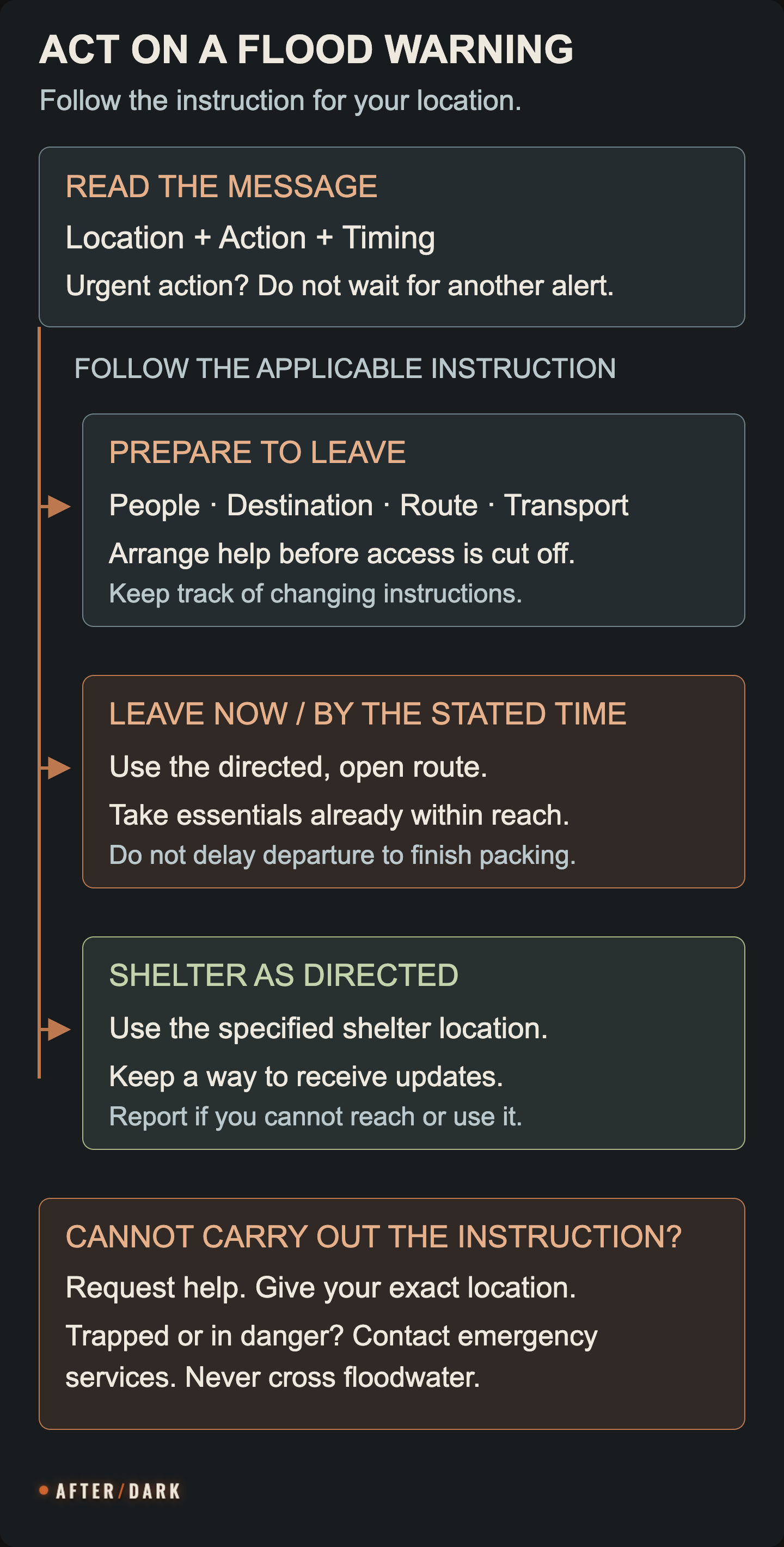
Start with the row that matches your circumstances, then use the relevant section below.
| Your situation | First practical step | What you need to resolve |
|---|---|---|
| At home, with or without a prepared kit | Account for people present and assign departure tasks | Who travels together, where you are going, and what is already accessible |
| In a hotel or rental | Ask staff or the host for the instruction and local address | Exit, route, destination, language help, and transport |
| At a campsite or caravan park | Contact the manager if available and follow the site's flood instructions | A usable way out before access is cut off; people before equipment |
| Already on the road | Have a passenger read the message, or stop somewhere safe to read it | Whether the onward route and destination remain usable |
| No vehicle or help needed to move | Request assistance as soon as the need is apparent | Exact pickup location, people, accessibility requirements, and next contact |
| No phone, internet, or prepared supplies | Ask available staff, neighbours, or responders for the current action | A way to receive instructions and practical help without a device |
Use Preparation Time to Make Departure Possible
Work through the decisions that could hold you up. If an instruction already says to leave immediately, take the essentials at hand and go; the preparation below must not become a prerequisite.
Account for people and animals
Name the people currently with you and who will help anyone needing assistance. Put one person in charge of each child or pet during the move. When several adults are available, divide tasks: one arranges transport and the destination while another gathers accessible essentials.
For family elsewhere, send the current plan and ask them to follow the instruction for their own location. If a child is at school or someone is in a managed facility, contact its designated channel for relocation and collection instructions. Avoid building a reunion plan around a crossing that may close. Our emergency communication plan explains how to use one contact to coordinate separate groups.
Establish a destination and a way to reach it
Use the place named by local authorities, or another destination permitted by their instructions. If staying with friends or family, confirm they can receive you and check that the approach is outside the affected route. If no private accommodation is available, ask where an official reception or evacuation point is open.
Write down the address, main route, transport arrangement, and contact if you can. An existing home evacuation plan supplies a starting point, but today's closures may invalidate one of its destinations. Replace that specific part before relying on it.
Gather what is already usable
Keep the load manageable. Prioritise available identification and essential documents, keys, phone and charger, safe drinking water, ready-to-eat food, suitable clothing, and necessary everyday items for the people and animals traveling with you. Use a bag already nearby. An accessible emergency document kit reduces searching; it is not a reason to return to an exposed room for missing papers.
If time and safe access remain, move important belongings above the expected flood area and follow local instructions for securing the property. Stop property tasks when they interfere with departure. Follow the utility's or authorities' directions for shutoffs; do not touch electrical switches while standing in water or risk entering a flooded room.
If You Are a Tourist or Staying Away From Home
Start with the building or site's responsible person where one is available: reception, the host, a campsite manager, or a tour operator. Ask for the local flood instruction, not merely whether they think the weather will improve.
Use these questions to turn their answer into a usable plan:
- Does this warning cover our building or site, and what must we do now?
- Which exit and route should we use?
- What is the exact destination or pickup point?
- Is transport arranged, or do we need to request it?
- How will you announce a change if our phones stop working?
Ask someone to write down unfamiliar place names or point to the destination on a map. If you do not understand the language, show the message and ask for its action and timing to be explained. Confirm the result back: “We leave from this entrance for this place.” A screenshot or handwritten note can preserve the details, but should not delay an immediate instruction.
At a campsite, do not assume the access road will remain open until water reaches your tent. Low-lying parks can lose access and experience dangerous flooding. Use the departure time and route given by the manager or authorities. Avoid delaying to dismantle a full camp or retrieve equipment. If there is no staff member, use the local emergency notice and the available official information channel; nobody's presence at reception is a condition for acting on an urgent warning.
Once out of the affected area, deal with rebooking, rental arrangements, and onward travel. A flight reservation does not establish that the road to the airport is open. Tell your operator where you have relocated and ask about accommodation if your original room is unavailable.
If You Have No Car or Need Help Leaving
Make the need explicit while departure is still possible. Contact the assistance service named in the warning, the local emergency-management contact, or staff coordinating your building or site. Ask an available neighbour or host to help make the request if you cannot reach the service yourself. For immediate danger or people trapped by flooding, use the local emergency number.
Give practical information rather than only saying that you need a ride:
“We are at [address, building and entrance]. There are [number] people and [animals]. We have no transport. One person needs [specific access assistance]. The instruction says [action or departure time]. What should we do, and where should we wait?”
Describe the actual barrier: stairs, inability to reach the street independently, a vehicle that cannot carry the group, or a pickup point separated from you by a closed road. This helps the person coordinating assistance understand why a generic address for a shelter does not solve your problem.
Before ending the conversation, ask who is arranging the help, where it will arrive, and how to report a change. Record a reference number if one is provided. Do not assume a request guarantees that a vehicle has been assigned. If the expected contact fails or conditions worsen, report the changed situation through the instructed channel.
A friend's offer can be useful only if they can reach you and the destination by an open route. Do not ask them to pass a barrier or enter floodwater. If you can travel on foot, that still requires a usable route consistent with local directions; walking is not a substitute for a road that has flooded.
Follow the Directed Route, Not an Automatic Shortcut
Before starting, make sure the driver and any other adult know the destination and the route being followed. Have a passenger handle messages when possible. If driving alone, stop somewhere safe before reading an update.
Follow closures and directions from responders even when an app still draws a route through them. Do not walk or drive into floodwater or go around a barricade. Water can hide missing road surface and other hazards, so a shallow-looking crossing is not a useful test of whether you can proceed.
If the directed road is closed, stop short of the hazard where it is safe to do so and seek the current alternative from responders or the road authority. If none is available, report that your route is blocked instead of inventing a shortcut through another low area. A second road crossing the same river may share the problem.
Offline maps and a written route card help you identify streets and landmarks when data service fails. They do not contain guaranteed current access information. Use them to understand an official detour and communicate your location, with closures taking priority over the saved line.
Keep the travel group together where possible. If two vehicles become separated, the passenger or driver at a safe stop can send the revised destination. Avoid using an exposed roadside as a meeting place simply because it was familiar before the warning.
If Leaving Is No Longer Possible
A flooded exit changes the task from organising departure to getting emergency help and following shelter instructions. Do not attempt to cross the water to complete the original plan.
If trapped in a building, call local emergency services and state the address, floor or room, number of people, and what has blocked the exit. If your place of shelter starts to flood, move to a higher level without entering floodwater. Avoid enclosed attic or roof spaces where you could become trapped.
Tell the operator about anyone unable to reach the higher level, and follow their directions. If the call disconnects, keep the last instruction and try the available contact method again; do not assume the operator has all the details unless you have communicated them.
If you have no device, ask someone already with you or safely reachable to contact emergency services and relay your precise location. If alone and unable to make contact, call out or signal to people or responders you can see from your refuge without entering the water. Do not leave that refuge to search flooded streets for reception. A vehicle or outdoor location requires instructions appropriate to that setting; tell the operator exactly where you are rather than describing it as a building evacuation.
Keep Updates Available When Phones or Power Fail
Choose one person, if your group has several adults, to keep track of new instructions and repeat them to everyone. Note the source and issue time so that an old screenshot does not quietly become the group's current plan.
With a working phone, save the instruction, destination, and contact details while you have a connection. A short message to one coordinating contact can reduce repeated calls: “We have left [place], are going to [destination], and will check in on arrival.” If your battery is low, use the available charging and power-saving arrangements without postponing movement to finish charging.
Without internet, use an available local broadcast, radio, or instructions delivered by responders and building staff. A battery-powered radio can carry updates during an outage. Tune to the local information service rather than assuming every station is carrying instructions for your area.
Without any device, ask the person managing your current location how changes will be announced and where you should remain to hear them. In an unattended location, ask a safely reachable person for the latest instruction and help contacting the responsible service. The practical fallback is another way to receive and relay information, not a shopping trip for equipment. Our guide to communication without cell service or internet explains the options and their limits in more detail.
After You Reach the Destination
Account for everyone in your travel group and tell your coordinating contact where you have arrived. If someone is missing or went to another location, pass that information to the responsible staff or service instead of starting an unplanned return trip.
At an official reception or evacuation point, explain what you need: somewhere to stay, drinking water, help contacting family, accessible facilities, or arrangements for an animal. Ask what support is actually available there and whether you must move to another location. Evacuation centres provide temporary support; their opening, capacity, and arrangements are local decisions.
For a stay with friends, agree on the next update source, where everyone will sleep, and any immediate shortage. If you left with almost nothing, identify the first missing essential and ask for help obtaining it. Keep receipts and accommodation details if useful for later claims, after immediate needs are settled.
Before resting, answer three questions together: Where are we staying? Who knows we arrived? How will we hear the next instruction? This closes the departure plan without pretending that the whole disruption is over.
Check Permission and Access Before Returning
Wait until the responsible authorities permit return to your area. A warning expiring, water falling, or a neighbour posting a photograph does not confirm that your building and approach road are usable.
Check the permitted route and any access conditions, then confirm the building's status with the responsible authority, manager, or owner. Ask about electricity, drinking water, and sanitation. Permission to enter a neighbourhood does not establish that every home can be occupied.
If the accommodation is still unusable, tell your host or the reception service before the current stay ends and arrange the next place. Keep the same family contact updated. The immediate goal is a workable place to stay with reliable instructions; recovering belongings and restoring the property follow when access is permitted.
Frequently Asked
Why is there a flood warning when it is not raining here?
Does the river height in a warning tell me how deep the water will be at my house?
Can I stay because my apartment or hotel room is on an upper floor?
Will a flood warning automatically arrive on my phone?
Can my pet come to an evacuation centre?
If the tap still works, can I fill drinking-water bottles before leaving?
Sources
- National Weather Service — During a Flood
- NSW State Emergency Service — Understand Warning Levels
- NSW State Emergency Service — During a Flood
- GOV.UK — What to Do Before or During a Flood
- NSW Government — What to Do If You Have to Evacuate
- NSW State Emergency Service — Caravan Parks and Tourism
- Foreign, Commonwealth & Development Office — Extreme Weather and Natural Hazards
- NSW State Emergency Service — Evacuation Centres
- American Red Cross — Staying Safe After a Disaster
- Bureau of Meteorology — Floods: What You Need to Know
- Bureau of Meteorology — Flood Classifications and River Heights
- CDC — Drinking Water Advisories: An Overview
Related guides
How to Make a Home Evacuation Plan
Turn exits, routes, destinations, transport, household roles, and meeting places into one practical evacuation plan that works without mobile data.
How to Prepare Offline Maps for an Emergency Evacuation
Build a three-layer navigation pack that keeps household routes, destinations, and decision points usable when mobile data is unavailable.
How to Communicate Without Cell Service or Internet
Choose a way to exchange messages during an outage or beyond coverage, including what to do with only a phone or no working devices.