Wildfire Evacuation Warning or Order: What to Do
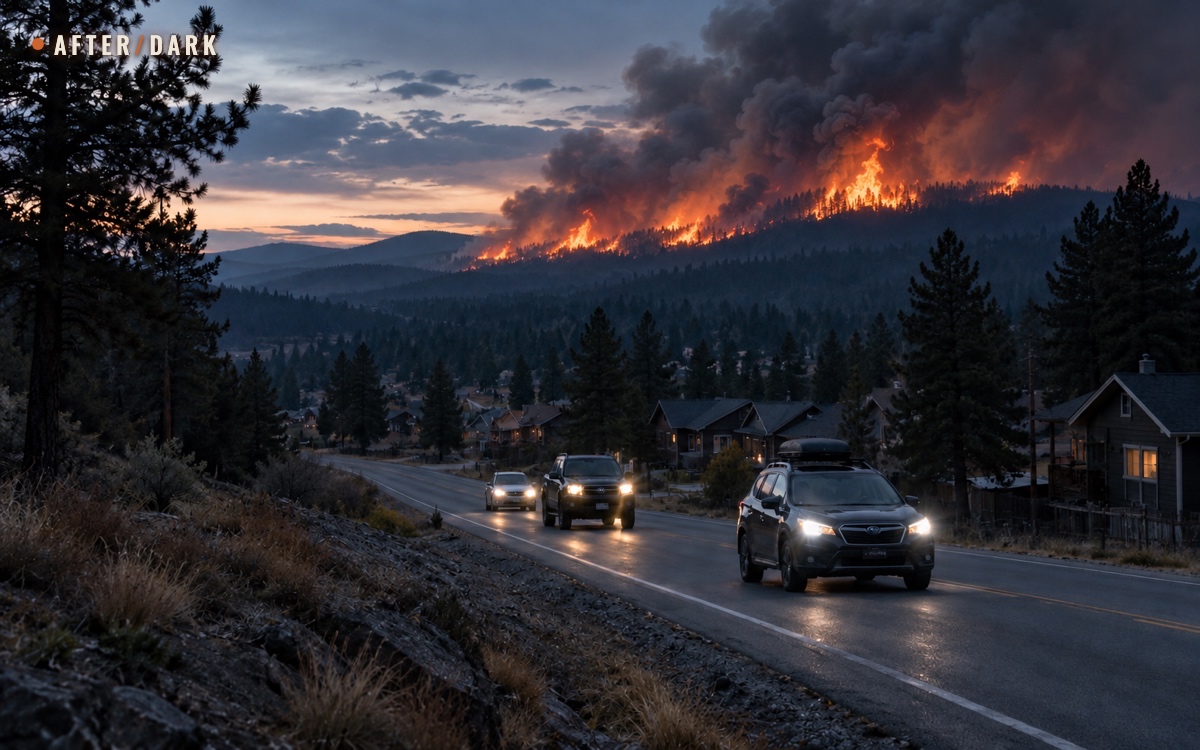
Turn a wildfire evacuation message into a workable next step: arrange departure, get transport help, follow the directed route, and find support after leaving.
Short answer
Key takeaways
- Read the affected location and required action together; warning terminology varies by region.
- Use a warning to resolve transport, assistance, and pet arrangements while departure is still possible.
- A missing bag, passport, or phone does not make an evacuation instruction optional.
- Ask for an explicit pickup arrangement if you cannot leave independently; do not assume someone knows.
- Official road directions and closures take priority over a saved route or navigation shortcut.
- Confirm your next destination and family contact after leaving; a quieter fire is not permission to return.
A wildfire message can reach you at home, at work, or halfway through a holiday. You may have a loaded car and an agreed destination, or only the clothes you are wearing. Start with the instruction for the place you are now, then solve the practical obstacles to carrying it out.
This guide covers an official evacuation warning or order, departure, and the first arrangements after leaving. It also explains what changes when the current local instruction is to take shelter. The useful result is a clear next action for everyone with you, including anyone who needs help to move.
Read the Wildfire Instruction for Your Location
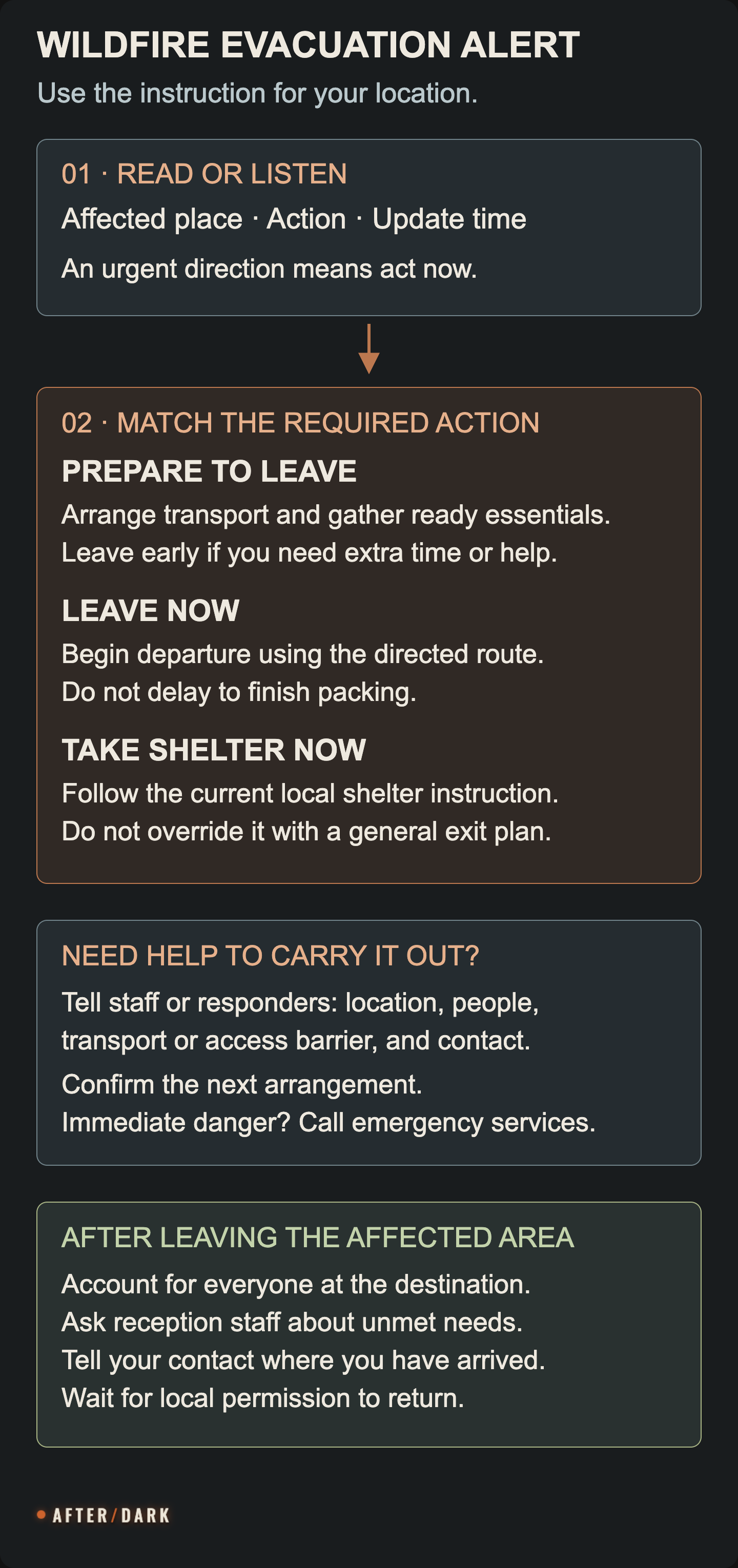
Read or listen for the affected area, the required action, and the time of the update. An instruction to leave now takes priority over looking up a second source or finishing this guide. If a responder is directing your street or campsite, follow that direction without waiting for a matching notification on your own phone.
For a message that gives you time to prepare, identify your address, evacuation zone, hotel, or campsite on the issuing authority's information. Open the full notice when possible: a notification preview may omit the route or destination. A forwarded screenshot can be useful, but its timestamp and location matter; it may describe another neighbourhood or an earlier stage of the incident.
Match the instruction and your available resources to the next action.
| Your situation | First action | Resolve next |
|---|---|---|
| Told to prepare; transport available | Gather the people with you and organise departure | Route, destination, essential items, and anyone who needs extra time |
| Told to leave now | Begin departure using the directed route | Take ready essentials and account for everyone; finish coordination after reaching safety |
| No car or unable to reach the pickup point | Tell the local evacuation assistance contact or responder immediately | Exact location, transport needs, pickup instructions, and how to receive an update |
| No phone, bag, or equipment | Act on the spoken instruction; tell nearby staff or responders what help you need | Confirm the directed exit or assembly point and who will go with you |
| Current message says take shelter or it is too dangerous to leave | Follow that location-specific instruction immediately | Tell emergency services if you are in immediate danger or cannot carry it out |
| Already outside the affected area | Stay out of the restricted area and establish your next destination | Update your contact and follow the authority responsible for return instructions |
What Warning, Alert, and Order Mean
Names vary. Identify the issuing authority and use its definitions; these examples are not interchangeable international levels.
Examples of regional wildfire messages and the action they communicate.
| Region | Terms you may encounter | How to use them |
|---|---|---|
| California, United States | Evacuation Warning; Evacuation Order | A warning identifies a potential threat and calls for preparation, with early departure for people needing extra time. An order means leave immediately. |
| British Columbia, Canada | Evacuation Alert; Evacuation Order | An alert means be ready to leave on short notice. An order means leave immediately. A rapid threat may require a tactical evacuation without a preceding written alert. |
| New South Wales, Australia | Advice; Watch and Act; Emergency Warning | The level communicates urgency. Read the accompanying action, which may direct preparation, evacuation, or immediate shelter. |
In British Columbia, evacuation decisions also account for roads and infrastructure. The fire does not have to be visible from your window for an order to apply. Measuring its apparent distance is not a substitute for acting on the message.
In Australia, an action statement accompanies the warning level. “Leave now” and “Take shelter now” require different actions even when both appear under an Emergency Warning. Follow the current instruction for your location; a general recommendation to leave early does not override a later direction that travel is unsafe.
Use a Warning to Make Departure Possible
A warning gives you work to do now. Start with the arrangement that will take longest: collecting people already with you, securing pets, getting an accessible vehicle, or arranging a ride. The U.S. Fire Administration recommends early departure when additional assistance or time is needed. Do not build a plan that depends on completing all those arrangements after an order arrives.
Use a short sequence:
- Account for the people present. Name who is with you and who is elsewhere. Assign one person to gather ready essentials while another handles transport or pets, if enough adults are available. Someone alone should work through those tasks in departure order.
- Confirm the ride. Check the driver, available seats, accessible boarding if needed, and the actual pickup place. “A neighbour might take us” is still an unresolved arrangement until that neighbour agrees.
- Choose the directed destination or an available place outside the affected area. Check whether relatives or accommodation can receive you, and whether the permitted route reaches them. Keep the official evacuation or reception point as the fallback when your private arrangement fails.
- Make essential items easy to take. Put the bag, keys, shoes, documents already at hand, and pet carriers at the departure point. Keep exits usable rather than filling a doorway with luggage.
- Agree on the next communication. Tell the person outside the area where you intend to go and who is travelling. Decide who will send the arrival update.
The output should be specific: “Three people and one dog, this car, this route, this destination.” If one part remains unresolved, work on that gap. Rechecking the same fire map does not arrange a missing seat.
For preparation between emergencies, our home evacuation plan connects routes, destinations, and household responsibilities. During the current warning, use whatever parts of that plan already exist and match them to today's instructions.
When the Instruction Is to Leave Now
An order changes the priority from getting everything ready to getting people out. CAL FIRE advises prompt departure when told to evacuate. Responders may not have time to visit every door.
At home, with or without a packed bag
Bring the people and pets with you to the departure arrangement. Take the ready bag if there is one. If there is no kit, take essentials immediately available on the way out: keys, phone, wallet or identification, necessary daily items, and drinking water you can readily carry. Put on shoes; take a suitable outer layer if it is at hand. Completing a shopping list or finding a missing document should not become a condition for leaving.
Keep what you carry compatible with the transport. A small bag that stays with you works better for an evacuation bus than several bulky containers that nobody can load. Keep keys and essential contact information accessible rather than burying them under luggage.
If time permits on the way out, close doors and windows in accordance with the local checklist. Leave utility operations to the specific directions for your area. Property tasks should not hold up departure. A preassembled emergency document kit can shorten this stage, but the absence of one does not change the instruction to go.
Before the vehicle moves or the group leaves with staff, name everyone who is physically present. If someone is missing, tell the responsible responder or staff member who they are and where they were last known to be. Do not silently assume they are in another car.
When household members are elsewhere
Act on the instruction for each person's current location. A child at school, a partner at work, and someone at home may be following different local arrangements. Use the school or workplace's official procedure to find its evacuation or reunification point; an improvised trip back to the usual building may lead to the wrong place.
Send a short message that separates intention from arrival: “Leaving the house with Sam now. Going to the announced reception centre. Will confirm when there.” Once you arrive, send the confirmation. An emergency communication plan can make those roles familiar, but a brief factual update is useful even without a previous agreement.
If you are already outside an ordered area, do not return to collect possessions. Tell responders about a person who needs assistance inside it. Keep any reunion outside the restricted area and consistent with the instructions each person receives.
If You Are a Tourist, Guest, or Camper
Your first task is to turn an unfamiliar place name into an identifiable location. Use the accommodation address, campsite number, entrance name, or a nearby sign. Give that exact wording to staff or responders rather than guessing a local neighbourhood name.
In a hotel or holiday rental
Show or read the message to reception, the on-site manager, or the host if they are reachable. Ask for four concrete pieces of information:
- Does the instruction cover this address?
- Which exit and route are guests being directed to use?
- Where is the assembly or onward transport point?
- What should guests without a car do?
State the size of your party and any boarding or communication assistance you need. If you do not understand the language, show the location and the message, ask for the destination to be written down if possible, and repeat or point to it to confirm. Keep your group together while receiving instructions.
An absent host or unanswered booking-platform chat should not delay compliance with an evacuation order. Use the local authority's instruction and the no-transport steps below. Deal with checkout, replacement accommodation, and travel bookings after reaching a place outside the affected area. Let the accommodation operator know that your party has left when you can, so they are not trying to account for you at the property.
At a managed campsite or park
Follow ranger, campground, and emergency personnel directions. National Park Service guidance tells visitors to obey closures and emergency instructions; a familiar trail or access road may no longer be available.
With camping equipment and transport: take the people and ready essentials first. Tell staff if hitching a trailer, loading equipment, or moving a large vehicle would delay you. Ask about the directed alternative rather than treating every item at the campsite as something that must leave with you.
With only a day bag or phone: use the named site and your party size to obtain exit and pickup instructions. A phone can help you show the notice or contact the operator; it is not a reason to separate from the group to find a better signal.
With no equipment or working phone: tell the ranger, campground host, or responder giving the instruction that you have no transport or way to receive updates. Ask them to identify the departure point and repeat the direction back. Join the organised movement as directed, keeping companions together. This sequence uses conversation and the local evacuation arrangements; it does not require a map, shelter, or emergency kit to appear in your hands.
If you are isolated away from staff and cannot identify an available exit, report your location and the obstruction through any available emergency contact or passing responder. Do not use this evacuation checklist to invent a route through active fire or closed terrain.
If You Have No Car or Need Help Leaving
Request assistance when the problem becomes apparent, including during a warning. Use the transport or assistance contact in the local notice. Where no contact is listed, ask the local emergency-management office, accommodation staff, or responder for the evacuation transport arrangement. In California, 211 is an information route for local shelter and transportation assistance; that number is a regional example, not a worldwide service or a promise of a vehicle.
Make the request usable:
- Give your exact location. Include the address or site, building entrance, and room or unit if relevant.
- Say that you cannot evacuate independently. Explain the practical obstacle: no vehicle, no driver, inaccessible boarding, a locked exit, or inability to reach the stated pickup point.
- Describe the group. Give the number of people, pets, and any wheelchair, mobility aid, or other boarding requirement the transport must accommodate.
- Ask for the next arrangement. Where should you be, how will you recognise the vehicle or staff, and how will a changed instruction reach you?
- Confirm what has actually been agreed. A message sent or a phone ringing is not yet an arranged pickup. If nobody confirms, keep trying the listed assistance route or tell a responder in person. Escalate to the local emergency number if there is immediate danger or you are trapped.
For example: “Two adults at Riverside Cabins, unit 6, north entrance. We have no car. One person uses a wheelchair and cannot board steps. Where should we wait for evacuation transport, and how will you contact us?” This is an example of the information to give, not a real pickup location.
If a neighbour or fellow guest can take you, agree on the actual vehicle, seats, destination, and departure. Tell the coordinator if this replaces an assistance request already made. Do not ask someone outside the closed area to drive back into it to collect you.
No phone and no arranged ride
Speak directly to the responder delivering the message or the staff coordinating departure. Say plainly: “I cannot leave on my own, and I have no phone.” Ask for the location of the official assembly point and how to get there. Repeat the instruction so a similar-sounding street or entrance does not send you elsewhere.
If no official is immediately present, ask a nearby neighbour or fellow guest to relay your need and location or help you reach the established departure arrangement, where that is safe. Do not start walking an unfamiliar road simply because it appears to lead away from smoke. If the announced pickup point cannot be reached, report that obstacle rather than assuming someone will discover it later.
Keep Instructions Available When Power or Service Fails
Use the communication channel that is actually working. With a phone, save the destination, zone, and contact details while connected. Keep enough battery for an update or callback. If another person is handling navigation, there is little value in everyone repeatedly loading the same map.
With no internet, a vehicle or battery radio may still carry local instructions. In New South Wales, official guidance recommends local ABC radio when power or mobile networks are affected. Use the equivalent emergency broadcaster for the place you are in. A saved map can show roads, but cannot tell you which have just closed.
With no working device at all, ask staff, a nearby responder, or someone receiving the broadcast to repeat the instruction for your location. Confirm the destination and whether the direction has changed. Agree which person in your group will receive updates so an instruction heard by one person reaches the rest.
For an ongoing outage after departure, our guide to communicating without cell service or internet explains the equipment and counterpart each alternative requires. During evacuation, use an existing connection rather than trying to assemble an unfamiliar system.
Follow the Directed Route, Including Any Changes
Use the route given for your area and follow traffic officers, barriers, and current road instructions. A route practised last month is useful preparation, but today's closure takes priority. NSW Rural Fire Service warns travellers that fire can cross roads and that smoke or closures can change a journey.
If you are driving, have a passenger handle messages and navigation when possible. Keep the vehicle moving with directed traffic and leave access for responders. A slow queue does not make a forest track or closed road an authorised alternative. Do not enter a route blocked by fire, dense smoke, or an official closure; obtain updated directions from traffic personnel or emergency services instead of testing whether you can get through.
For unfamiliar areas, compare the destination in the notice with the route you are being directed to take. Ordinary navigation apps may suggest a shorter connection that does not reflect an active closure. Destination BC specifically cautions visitors about delayed emergency information in third-party maps. An offline map prepared in advance helps you recognise road names and junctions; live instructions establish which connection you may use now.
If your vehicle fails, the road becomes impassable, or you cannot carry out the direction, give emergency services or a nearby traffic officer your road, location, group size, and obstruction. If the current warning says it is too late to leave, follow its immediate shelter instruction. A general article cannot identify a safe escape across that terrain.
For a later trip, the vehicle evacuation guide covers readiness, loading, and transport fallbacks. Those preparations help before an incident; an active departure is not the time to reorganise the whole car.
At the Evacuation or Reception Point
Check in with the staff responsible for arrivals. State who is with you, who remains unaccounted for, and what you need next: accommodation, transport, basic supplies, communication assistance, or help contacting another household member. Explain if you arrived with nothing. Staff can work with an explicit need more easily than with an assumption that you are already self-sufficient.
A reception point may coordinate services rather than provide beds in the same building. In British Columbia, designated reception centres can register evacuees and arrange referrals for essentials and accommodation. Follow the location named by the local authority; a place used in a previous emergency may not be operating this time.
Before leaving the reception point for another location, establish:
- The destination's name and address, and whether someone has confirmed space for you.
- How you will get there, including the pickup point for any onward transport.
- Whether the arrangement includes everyone in your party and any animal accommodation.
- Which service or official channel will provide the next update.
If you have already reached relatives or other accommodation outside the affected area, tell your agreed contact that you have arrived and follow any local registration instruction. A short message such as “All three of us are at Alex's house; staying tonight” resolves a different question from the earlier message that you were leaving.
Tourists should then notify their host or tour operator and arrange onward travel around the current restrictions. Resolve reservations after establishing a place to stay. Keep the official return instruction separate from a host's estimate of when the property might reopen.
Wait for Permission to Return to Your Area
Continue following the authority that issued the evacuation directions. A lower alert level, reopened main highway, or another household's permission to return may not apply to your address. Read the area covered by the return notice as carefully as the area in the original warning.
Before setting off, confirm the permitted access route and whether your accommodation is available. If restrictions remain, continue with the reception centre or your temporary host to arrange the next stay. Keep your contact informed if your party moves again, so they know where to reach you while the evacuation continues.
Frequently Asked
Is a Red Flag Warning an evacuation order?
Does a public safety power shutoff mean I must evacuate?
Should I turn off the gas before evacuating?
Can I get shelter if I left without identification or money?
Will my pet be allowed to stay with me at an evacuation shelter?
Can I return when the fire is contained or the smoke has cleared?
Sources
- California Office of Emergency Services — Evacuation Warnings vs. Evacuation Orders
- BC Wildfire Service — How do evacuation orders and alerts work?
- NSW Government — Know the warnings
- U.S. Fire Administration — Wildfire Evacuation
- CAL FIRE — Go Evacuation Guide
- National Park Service — Wildland fire safety for park visitors
- California State Assembly, Committee on Emergency Management — Wildfire Resources
- NSW Government — Bushfire warnings and what to do
- NSW Rural Fire Service — Bush Fire Safety for Travellers
- Destination BC — Wildfire Update for BC's Tourism Industry, August 17, 2026
- PreparedBC — Emergency evacuee guidance for the public
- American Red Cross — Find an Open Shelter
- National Weather Service — Understanding Wildfire Warnings, Watches and Behavior
Related guides
How to Make a Home Evacuation Plan
Turn exits, routes, destinations, transport, household roles, and meeting places into one practical evacuation plan that works without mobile data.
How to Prepare Your Car for an Emergency Evacuation
Turn an ordinary car into a checked evacuation option with defined readiness gates, separate load layers, fixed cargo positions, and a rehearsed departure routine.

How to Build an Emergency Communication Plan
Create a household contact system that still works when phones, power, internet, or normal meeting routines become unreliable.