What to Do If Your Car Breaks Down in a Remote Area
A practical plan for a disabled car far from town, including no signal, no emergency kit, an overnight wait and getting every passenger home.
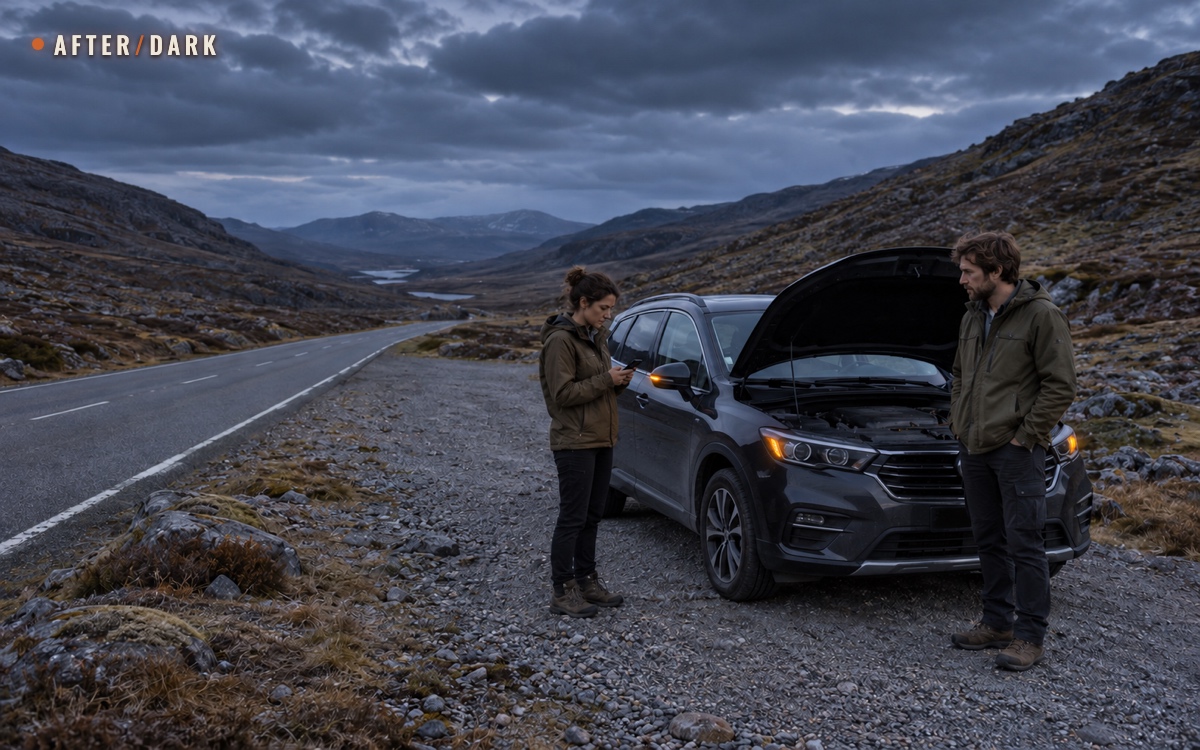
Short answer
Key takeaways
- Choose the waiting position by traffic and local conditions; staying near the car does not always mean sitting inside it.
- Give a usable location, vehicle description, passenger count and specific request for help.
- Track whether the request was received and whether assistance was actually arranged.
- Without a kit or working phone, use the vehicle and your existing belongings to support a visible, sheltered wait.
- Confirm transport for every passenger and pet as well as recovery of the car.
A remote car breakdown interrupts more than the journey. It may also remove your heating or cooling, phone charging and easiest way to reach water or shelter. The useful first task is to organize the people, location and request for help while you still have daylight and whatever resources remain.
This guide starts after the car stops. For checks and packing before departure, use the separate vehicle preparation plan. Here, the starting point may be an ordinary car with no special equipment at all.
If you have no emergency kit and no working phone
You still have a location, a vehicle, your clothing and possibly other people. Begin with those resources.
Check whether passing traffic can reach you and whether the car itself is safe to remain near. If you can reach protected ground away from traffic, keep the group together there. If you cannot exit safely, remain belted inside and use the hazard lights if they work. The roadside section below explains this decision in more detail. A working built-in SOS system may also provide emergency contact without a personal phone, as explained in the communication section.
Once the car is safely clear of traffic, use it as your base. Keep the keys with an adult, identify which side provides shade or wind protection, and check the seats and luggage for belongings you actually brought. A spare jacket or shopping bag of food can be useful; the plan does not require either to exist. In a hot location, use available shade beside the vehicle instead of treating a closed cabin as shelter. A vehicle provides both a recognizable location and a more visible search target than someone walking across open country, as remote-travel guidance explains.
Make the breakdown noticeable from safe ground using the visibility steps below. When another traveller stops safely, ask for a specific relay: your location, vehicle description, number of people and request for assistance. Have them repeat it back. If they cannot contact anyone until farther along the road, help is still unconfirmed when they leave.
Choose the next task from the resources and contact status you actually have.
| Your situation | First useful task | What counts as progress |
|---|---|---|
| No working phone or emergency equipment | Establish a protected, visible waiting position beside the safely stopped car | The group is together and ready to give a passing helper a clear request |
| Vehicle lights and charging outlets do not work | Use a protected waiting position and any independent light or visible marker available | The plan no longer depends on the car supplying power |
| Phone works, ordinary service does not | Record location; check available emergency-call or supported satellite options | An actual connection, not merely a location dot or signal icon |
| A call or message gets through | Give location and passenger needs; ask what happens next | Someone acknowledges the request and identifies who is arranging help |
| Equipped with a working communicator and supplies | Confirm assistance, then organize resources for the wait | A shared waiting plan and a usable return-contact method |
| Assistance is delayed or its status is unknown | Reassess shelter, remaining supplies and the last confirmed communication | An updated request or a deliberate continuation of the visible waiting plan |
If the vehicle has no electrical power
If the hazard lights, cabin lights and charging outlets are unavailable, organize the wait without them. Use a separate phone, torch or power bank only if you actually have one. Reserve its remaining charge for contact and necessary light; a cable plugged into a dead vehicle outlet will not recharge anything.
From a position safely clear of traffic, make the stopped car noticeable with the resources at hand. Display a bright spare item at a window, or use an independent light to signal a nearby helper. These are ways to improve visibility without vehicle power. Keep clothing you need for warmth on your body. With no spare item or light, keep the group near the visible vehicle in a protected position; do not enter the road to compensate for missing warning lamps.
Tell any person relaying your request that the car has no working lights and may be difficult to see after dark. Include any separate phone's remaining charge so the recipient knows whether a later callback is realistic.
Make the roadside position safe first
If the vehicle is still moving, use the remaining control to reach an exit, pull-off or other suitable place clear of traffic where possible. Switch on the hazard lights. Once stopped, secure the car using its normal parking procedure. Attend to passengers before inspecting the fault.
The key distinction is the road around you:
- Fast traffic or an exposed traffic lane: leave through the side away from traffic only if there is a safe way to reach protected ground. A barrier may help, but check the ground beyond it. If exiting is unsafe, keep seat belts fastened and seek urgent assistance.
- A quiet road with a firm pull-off: organize the wait near the vehicle, away from the travelled surface. Keep bags and people out of the road and preserve access for a recovery vehicle.
- Immediate danger at the car: move the group to the nearest safer position and seek emergency help. Staying with a vehicle is not an instruction to remain beside fire, smoke or another immediate threat.
These distinctions follow the exit-or-stay checks used in breakdown guidance. Local driving direction, road rules and emergency instructions determine the details; “always exit on the left” would be wrong in a worldwide guide.
Near high-speed traffic, avoid waiting where a collision could push your car into you. Motorway guidance also treats inability to exit safely as an urgent assistance problem. If someone cannot get out without help, tell the operator that early. Do not turn an exposed shoulder into a repair workspace.
Establish a location another person can find
A useful location describes both where you are and how a responder can recognize the stop. Gather what is already available:
- Road and direction: the road name or number, direction of travel and side of the road.
- Last confirmed point: a junction, signed entrance, bridge or settlement you actually passed. Distinguish a remembered landmark from a guess.
- Current position: coordinates or an offline map marker, if a working device provides them. Preserve minus signs, hemisphere letters and the displayed coordinate format when copying.
- Visible description: pull-off, nearby sign, road surface, vehicle colour, make and registration.
Read nearby signs from a safe position. Do not walk along an exposed road just to find a better landmark. If your device shows a broad uncertainty circle or places you on an adjacent road, report that uncertainty rather than correcting the position by guesswork.
A saved offline map and route record can help identify the last junction. With a dead phone and no paper map, work from the last reliable observation and describe it plainly. “About twenty minutes after the signed junction, travelling toward the coast” is approximate, but more useful than an invented distance.
Keep the location with the request. If a call drops after one sentence, the listener should already know where to start looking.
Get the request through and confirm the response
Use roadside assistance or the relevant recovery provider for a routine breakdown in a suitable waiting position. Use the local emergency channel when people are in immediate danger or you cannot maintain a safe waiting situation. Describe the actual problem; being remote does not make every mechanical fault the same kind of emergency.
With an ordinary phone connection
Give the essentials before the story of the journey. This is a message pattern to fill with real details:
We have a disabled vehicle at [road, direction, landmark or coordinates]. It is a [colour, make, registration]. There are [number of adults and children], with [pets or transport/access needs]. We are waiting [position relative to the car]. The main concern is [traffic, exposure, water, access or other concrete problem]. Please arrange [roadside recovery or emergency assistance]. Reply with who is handling it, the next update and how to contact us.
Ask the recipient to confirm the location. Then establish three things: who has accepted the request, what they are arranging, and when you should expect the next update. Record a job reference if provided. Tell one trusted contact what has been agreed so that several people do not independently arrange conflicting collections.
For a voice call, stay available for the operator's questions. For a message, distinguish an unsent or queued item from a reply accepting the task. Emergency texting is not available everywhere; use the locally supported channel.
With the vehicle's built-in SOS or eCall system
If the car has a working built-in emergency-call system and the situation requires emergency services, use its documented SOS activation procedure. It can provide a contact route without a working personal phone. Once connected, explain the danger and the occupants' needs, answer the operator's questions and follow their instructions.
Check what the button does on that vehicle. For example, eCall can be activated manually, while some cars route SOS through a manufacturer's service centre. Use the handbook to identify the function; do not place a test emergency call. For a routine breakdown in a suitable waiting position, use a separately identified roadside-assistance service rather than treating SOS as a general tow-booking button.
Standard eCall communicates through public mobile networks, so it is not a satellite fallback for every remote location. Compatible coverage, functioning equipment and power still matter. After an electrical failure, do not assume the system remains available: follow its status indication and any voice response. If it cannot connect, use another available contact method or the visible waiting and relay plan.
With no ordinary cell service
If the situation is urgent, try the local emergency call function even when your own carrier is unavailable. Then check the capabilities you actually have. A supported phone satellite service, active satellite messenger or satellite phone may provide another route. Follow the device's connection instructions from a suitable position near the car, and continue the exchange until the recipient's response is clear.
For example, Apple's satellite emergency workflow requires supported hardware, software and regional availability, an appropriate view of the sky, and an exchange of information. Ordinary roadside assistance is a separate option where offered. An app downloaded at home does not by itself give an ordinary phone satellite transmission.
Use a prepared radio only through an arrangement you understand and a reachable listener; a broadcast receiver cannot send your request. The guide to communication without cell service explains the different connections and their prerequisites.
When nobody has acknowledged the request
Keep the status explicit: help has not yet been confirmed. A relative knowing your destination is different from that person knowing this breakdown location. If there was a missed-arrival arrangement, identify who will notice and what route they were given; do not assume a search has started.
Continue the visible waiting and relay plan below. Retain usable battery for further attempts and incoming contact. If you establish a connection later, send the complete current situation, including how long you have been stopped and anything that has changed. If a confirmed provider misses its update, contact it again with the reference and new constraints rather than simply restarting the original request with another company.
Make the vehicle easy to identify and ask for a relay
Keep the vehicle visible from the road and remain close enough that a helper finding it can find you. A safer patch of shade nearby can be a waiting place; a separate camp hidden far away makes the location harder to interpret.
On a securely stopped vehicle, a raised hood can identify a breakdown. Backcountry-road guidance recommends this visible signal. Open it only where approaching the front of the car is safe and there is no sign of an engine fire. Use the supplied hood support correctly; leave it closed if you cannot do that securely. Keep required warning lights operating where traffic needs to see you.
If a vehicle approaches, make yourself visible from protected ground. Do not step into its path or force it to stop. Once a driver has stopped safely, ask for one concrete action: call the relevant service now, relay the location when coverage returns, or bring the request to a staffed ranger or service point.
If you have paper, write the details for the helper. Otherwise, say them slowly. Include which way you approached the location so that the helper can describe the route. If they can call while there, use the opportunity to hear the response yourself.
Organize a wait that may continue overnight
Begin with a small inventory, not a shopping list. Count people, actual drinking water, ready-to-eat food, clothing, lights and usable power. Put shared essentials where they can be reached without unpacking everything into the weather. Keep keys, phone and any location record together and accessible.
If water or other essential supplies are absent, make that part of the help request immediately. Do not plan around a spring symbol or an assumed shop farther along the route. Avoid unnecessary trips away from the car and tiring work that does not improve the waiting situation. The outdoor emergency planning principles of conserving resources and maintaining a findable position apply here as well.
In heat and direct sun
Find the available shade and ventilation while staying clear of traffic. The vehicle's shadow moves as the sun moves; recheck where the group is sitting. Use an existing sunshade or suitable covering if you have one, but keep exits accessible and the occupants visible to one another.
Do not equate “stay with the car” with remaining inside a hot closed cabin. Parked-vehicle guidance warns that cracked windows do not prevent dangerous heating. If there is no workable shaded waiting position or you cannot protect the passengers from the conditions, report that change as an urgent problem.
In cold, wind or rain
Where the parking position is suitable, the cabin offers protection from wind and rain. Bring available dry layers, coats and blankets within reach before darkness. Keep wet outer items separate from the dry things you intend to use for the night. With no spare equipment, use your existing clothing and the vehicle's weather protection; do not assume the failed car can supply heating.
If the engine can run, heater use still depends on the fault and the exhaust conditions. Cold-weather vehicle guidance warns against prolonged engine running in an enclosed space or with blocked exhaust. Follow the vehicle's instructions and any responder directions rather than planning continuous idling as an overnight solution.
Before darkness
Identify the waiting place, accessible exits, available light and the next communication step while you can still see. Keep any torch within reach rather than under luggage. Save phone power by stopping entertainment and unnecessary screen use; use an existing compatible power bank if available. Preserve the return-contact method agreed with the operator rather than switching everything off without telling them.
Agree who holds the working phone and how the others will notice an arrival. There is no need for everyone to remain occupied with the same task. One person can manage updates while another organizes clothing and keeps children close. If you are alone, arrange those things before settling down so that a call or approaching vehicle does not send you searching through the boot in darkness.
Include every passenger in the waiting and pickup plan
With children, assign an adult to supervision while someone else handles the call or luggage. Choose a waiting place with a clear boundary away from traffic. Never leave a child alone in the car while looking for reception or assistance. Explain the next small step—waiting for a reply, putting on a layer or preparing for collection—so the group understands what is happening.
With someone who cannot easily exit or walk, describe the constraint to the operator at the start. The useful details are practical: number of people, whether assistance is needed to leave the vehicle, mobility equipment carried and transport space required. Do not assume a nearby barrier or a tow-truck cab is accessible to everyone.
With a pet, use the lead or carrier you have before opening doors near traffic. If that equipment is missing, plan how to keep the animal controlled before moving the group; do not open every door to unload luggage at once. A hot vehicle is not a suitable unattended holding space for an animal, as park pet guidance makes clear. Tell the recovery provider about the pet and confirm where it can travel. A portable pet kit helps on future trips, but the immediate request must describe the resources you have now.
Decide whether there is a real reason to leave the vehicle
The default on an isolated road is to keep the vehicle as your findable base. Backcountry guidance recommends remaining with a disabled car; a delayed response does not make an unknown walking route reliable.
Separate a short move to nearby protection from abandoning the location to seek help. Moving off an exposed shoulder or into immediately adjacent shade can improve the waiting position while keeping you near the car. Walking toward a town guessed from a map is a different decision involving route certainty, distance, conditions and the capabilities of the whole group.
Do not use an arbitrary timer such as “after two hours, walk.” First ask what has changed: has the waiting place become dangerous, has a responder given relocation instructions, or is there a genuinely known and safely reachable staffed place? A building in the distance does not establish access, occupancy or a safe route. Do not cross unfamiliar terrain to shorten the apparent distance or send one person off on an unplanned search for signal.
If you are directed to relocate, tell the service and your contact where the group is going. When leaving the vehicle and you have writing materials, leave a dated note with the time, destination, direction and number of people. Updating an agreed rendezvous matters: someone may otherwise arrive at the right car and find nobody there.
Confirm recovery and transport before ending the wait
“A truck is coming” leaves several practical questions unanswered. While you have a connection, confirm:
- Access: the provider has the correct road, side, surface and any known gate or access restriction.
- Vehicle: the operator knows the make, model, power type and whether it can move; the recovery method must suit the vehicle.
- People: there are arrangements for every occupant, any child restraints, mobility equipment and pets.
- Destination: you know where the vehicle and the passengers will be taken, including what happens if a repair shop is closed.
- Next contact: you have a reference, expected update and a way to report a worsening situation.
These are planning questions, not assumptions about what a membership includes. Record the answers before the connection drops. If the car and passengers will leave separately, confirm both arrangements and tell your trusted contact the new meeting place.
At collection, keep essential belongings with the people who need them rather than leaving them buried in the car. Let the operator direct the loading process and keep the group clear of that work. Once everyone has reached the agreed destination, close the loop with anyone who was expecting an update or arranging help. Then use the experience to improve the car's preparation for the next journey.
Zombie Scenario: A Tow Is Not a Ride for Everyone
Fictional scenario
During a fictional zombie evacuation, a family car stops on a quiet detour well away from the crowded main route. A brief radio contact reaches a friend who can arrange vehicle recovery. The family initially reports only the registration and location.
Before the exchange ends, they add the missing detail: two adults, two children and a dog need transport too. The friend checks passenger capacity and arranges a separate suitable pickup instead of assuming everyone can ride with the recovery driver. The family confirms one collection point for both vehicles and keeps the children's restraints and the dog's carrier ready.
The useful lesson is the incomplete handoff: moving a disabled car and getting its occupants to a workable destination are two jobs that must both be assigned.
Frequently Asked
Can an emergency call work when my phone shows no ordinary service?
What if I have no warning triangle or reflective vest?
Can I find my coordinates without mobile reception?
What changes if the broken-down car is a rental?
Will my breakdown membership cover a remote or unpaved road?
Should I try to repair the car while I wait?
Sources
- Queensland Government — Breakdown Safety on Motorways and Freeways
- National Highways — Driving on Motorways: What to Do If You Break Down
- National Park Service — Death Valley Backcountry Roads
- National Park Service — Be Safe on Big Bend's Backcountry Roads
- Western Australia Police — Outback Travel, Bushwalking and Prospecting
- National Park Service — Outdoor Emergency Plan
- Apple — Use Emergency SOS via Satellite on Your iPhone
- Australian Communications and Media Authority — Emergency Calls
- NHTSA — Summer Driving Tips
- NHTSA — Winter Weather Driving Tips
- National Park Service — Pets at the White House and President's Park
- Hertz — What Happens If the Vehicle Breaks Down?
- Finnish Transport and Communications Agency — ADAS: eCall System
- Austria's Federal Ministry for Innovation, Mobility and Infrastructure — eCall
Related guides
How to Prepare Your Car for an Emergency Evacuation
Turn an ordinary car into a checked evacuation option with defined readiness gates, separate load layers, fixed cargo positions, and a rehearsed departure routine.
How to Communicate Without Cell Service or Internet
Choose a way to exchange messages during an outage or beyond coverage, including what to do with only a phone or no working devices.
How to Prepare Offline Maps for an Emergency Evacuation
Build a three-layer navigation pack that keeps household routes, destinations, and decision points usable when mobile data is unavailable.