Earthquake Alert: What to Do When You Receive One
Use the first seconds to protect yourself, then follow local instructions. A practical guide for residents and travelers, including when phones and familiar plans are unavailable.

Short answer
Key takeaways
- An early warning concerns shaking that may arrive within seconds; use that time for the protective action, not packing or checking the news.
- Your location determines the immediate response. A resident away from home and a visitor in the same building follow its earthquake procedure.
- A phone, emergency bag, or vehicle is not required to begin protecting yourself.
- After shaking, distinguish an instruction to evacuate from permission to return; a quiet interval settles neither question.
- Residents need a workable family reunion plan; visitors also need local directions, language support, and confirmation of where they can stay.
An earthquake alert can interrupt a normal evening at home, a train journey, or your first night in an unfamiliar hotel. You may have seconds to act. The useful sequence is to protect yourself where you are, then establish what the local instructions require once the shaking stops.
This guide follows that sequence for residents and tourists. It includes people without a prepared bag, working internet, or a phone of their own.
If the Earthquake Alert Is Sounding Now
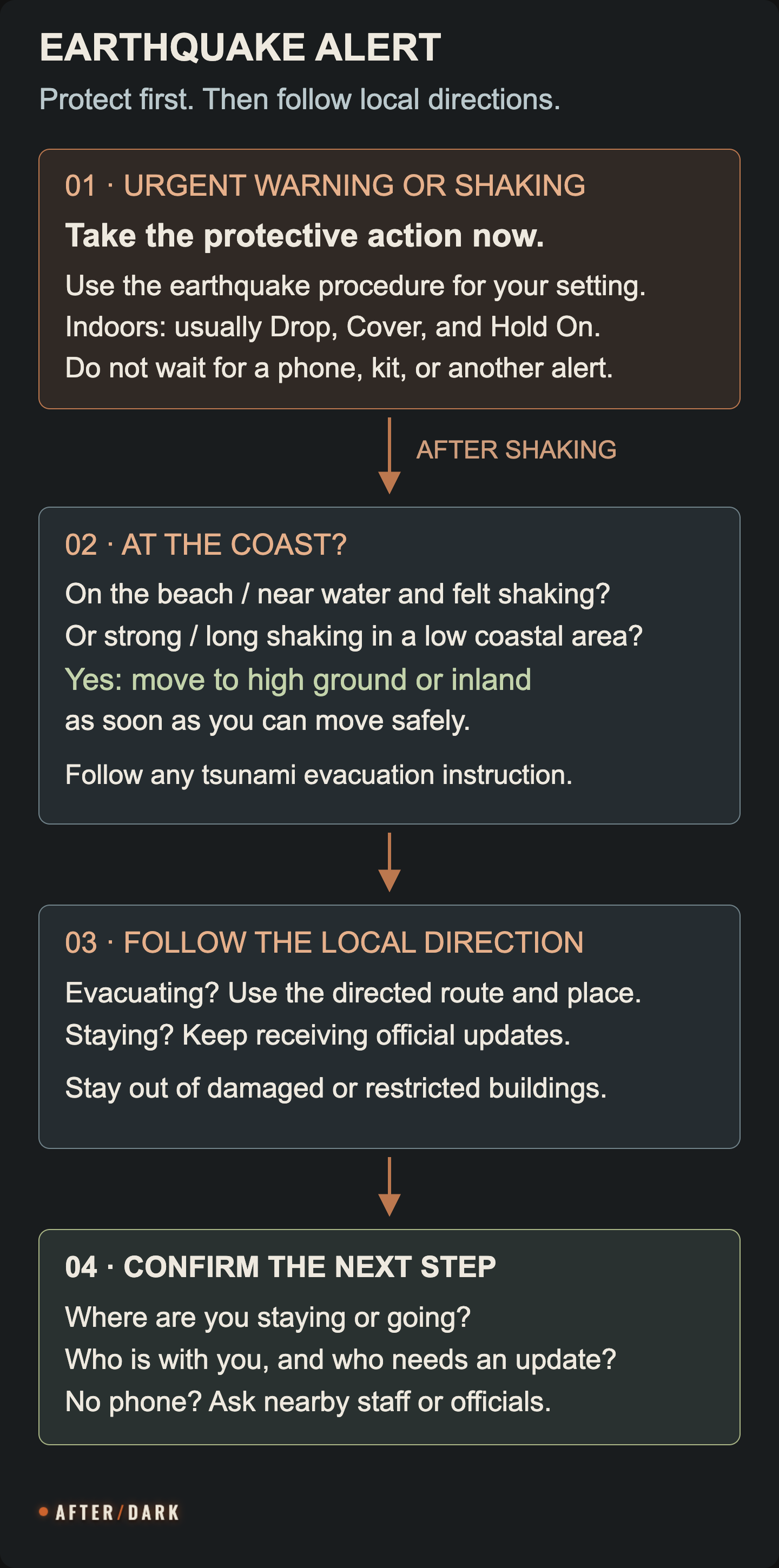
An urgent warning to take cover is the action cue. Stop what you are doing and begin the protective response for your setting. Do the same if you feel shaking before receiving any message. California's early-warning instructions say to act without waiting to feel the earthquake.
For someone indoors who can get down, the usual response is:
- Drop onto your hands and knees before shaking knocks you over.
- Cover your head and neck. Get under a sturdy table or desk if one is nearby.
- Hold on to the shelter until the shaking stops; move with it if it shifts.
No table or equipment? Get low beside an interior wall away from windows and furniture that could fall, and protect your head and neck with your arms. You can start with nothing in your hands. A bag, helmet, or phone is not a prerequisite.
Call out a short instruction to people beside you as you act. Save explanations, screenshots, and messages to distant relatives for afterward. If a rehearsed local earthquake procedure applies to the building, follow it; the regional distinction below explains why an alert does not mean the same evacuation order everywhere.
Match the action to your surroundings
These are protective actions for imminent or ongoing shaking, not instructions to travel to an assembly point. The seated and mobility adaptations follow Canada's illustrated response guidance.
Immediate earthquake response: choose the situation you are actually in.
| Your situation | Action to take |
|---|---|
| Inside a room, including a hotel or office | Take cover close by. Keep away from glass and unsecured tall furniture; stay inside during shaking. |
| Indoors with no table, kit, or working phone | Get low near an interior wall and cover your head and neck with your arms. Do not cross the room to collect equipment. |
| Already in bed | Stay there and protect your head with a pillow. |
| Unable to get onto the floor safely | Remain seated and protect your head and neck. In a wheelchair, lock the wheels and bend forward if able. |
| Outdoors | Stay outdoors. Move clear of buildings, walls, trees, and overhead wires if you can; get low and protect your head. |
| Driving | Pull over smoothly where clear of overhead hazards, bridges, and overpasses. Set the parking brake and stay inside until shaking stops. |
| On a bus or train | Hold a handrail or strap securely and follow the crew's instructions. |
The indoor and driving guidance advises against running outside during shaking or using elevators. Do not treat a doorway as a substitute for nearby sturdy cover. On transport and in public buildings, JMA's warning guidance emphasizes holding on, following attendants, and avoiding a rush to the exits.
Understand What the Warning Is Telling You
Earthquake early warning detects an earthquake after it has begun, then sends a message ahead of potentially damaging shaking. It is not a forecast for tomorrow. The ShakeAlert explanation also distinguishes early warnings from ordinary earthquake notifications, which commonly arrive after an event.
The message's purpose matters:
- An urgent early warning calls for the immediate protective response.
- A lower-level notice may tell you to be aware and prepare for possible stronger shaking. For example, Android distinguishes “Be Aware” and “Take Action” alerts. These are that service's terms, not a worldwide scale.
- A report of a past earthquake supplies event information. Its arrival alone does not establish that new shaking is approaching your location.
Read the applicable action rather than trying to interpret the alarm's volume or the largest number on the screen. A countdown is an estimate, not spare time for an errand. Once you recognize an urgent instruction, act; detailed checking comes later.
Why the local building procedure matters
Instructions can differ before shaking arrives. Canada's guidance generally directs people to protect themselves immediately. Some buildings in Mexico have plans that assign evacuation to occupants near an exit and sheltering to others. For example, UNAM's Institute of Biology protocol distinguishes ground-floor occupants near an exit from people on higher floors. That is a procedure for those premises, not a floor-number rule for every building in Mexico.
Follow the earthquake plan for your actual location and directions from the responsible staff. Do not invent a race down several flights because you remember a longer warning time somewhere else. Ask about the building's procedure before an emergency, especially when visiting a country with a different alert system.
After Shaking: Establish the Next Safe Place
When shaking stops, check the people with you and listen for the next instruction. Aftershocks can occur; take the protective action again if shaking resumes. If the building appears damaged or you hear unusual shifting noises, leave by a safe route rather than waiting there for a general announcement. Stay out until authorities permit entry. Official post-earthquake guidance also identifies fallen power lines and damaged structures as hazards.
If the building is being evacuated, follow its directed route and use stairs rather than an elevator. Report an inaccessible or blocked route to staff or responders instead of improvising a climb or assuming everyone can use the stairs. Once outside, continue to the designated assembly location; leave entrances and emergency access clear.
If there is no evacuation instruction or immediate reason to leave, obtain the local update before starting a journey. The alarm ending does not tell you whether a road, hotel, or workplace is open. Equally, every small earthquake does not automatically mean relocating for the night.
Before moving again, establish where you are being directed, how to reach it, and who is with you. A message saying a district is affected is not a route. If you have saved maps, use them to follow the current directions; our offline evacuation-map guide explains how to prepare those copies.
Alone in a private home or rented apartment
A private apartment or self-catering rental may have no reception desk, building announcement, or host who answers immediately. Once shaking stops, use this sequence:
- Decide whether your present location requires departure. Apply the damage, unusual-noise, evacuation, and coastal conditions described here. A landlord's reply is not a prerequisite for leaving an immediate hazard. If there is no immediate reason or instruction to leave, begin receiving local updates rather than setting off to find the owner.
- If leaving, establish a nearby place to stop. Use the building's designated assembly point if it is accessible and appropriate to the current instructions. If none is known, choose an open space clear of facades, glass, overhead wires, and traffic while you obtain directions. Do not wait directly below the building entrance. On the coast, the tsunami branch below takes priority over remaining at a low-lying assembly point.
- If remaining, make the next action possible. Keep the route to your exit clear and identify nearby cover for another tremor. Use an available radio, television, or official phone update. Avoid turning this interval into a tour of the building to judge its structural condition.
- Make your location known when a channel is available. Tell one trusted person your street address, apartment or floor, and whether you are staying or have moved. Contact the host or building manager for access and accommodation arrangements. If you need urgent assistance or cannot use the exit, contact the local emergency service and describe the exact location and problem.
With no working connection, listen for public announcements. If a neighbor is within speaking distance from your current safe position, ask whether they have an official instruction or can relay a message. If you need help because the exit is unusable, call to anyone within hearing and give your floor or apartment number. Do not delay a necessary departure along a usable route to restore your phone or find someone to accompany you.
If you are on the coast
An earthquake warning and a tsunami warning are different messages. On a beach or near the water, felt shaking is a reason to move off the shore to high ground or inland as soon as you can move safely. In a low-lying coastal or tsunami hazard area, a strong or long earthquake is a natural tsunami warning: protect yourself during shaking, then leave without waiting for a separate official message.
Use the local tsunami route where available. Our tsunami-alert response guide covers the onward destination, updates, and permission to return. Do not go to the waterfront to check whether a wave is coming.
If You Live in the Area
Your advantage may be knowing local places and people. It does not mean everyone is at home, that the family plan exists, or that the usual route remains usable. Start from where each person actually is.
At home with other household members
After the immediate response, account for the people who were with you. Establish whether you are remaining, following a building evacuation, or moving under a wider local instruction. Give everyone one destination and keep the group together during that move.
If evacuation is required, take essentials already within safe reach without turning departure into a packing exercise. The next task is reaching the directed place. Tell staff or responders about someone who cannot use the route; include the person's location and the assistance needed.
If your home cannot be used, confirm an actual alternative: a reception centre authorities have opened, accommodation that has confirmed availability, or a host outside the restricted area. Distinguish a place to assemble from a place where you can stay overnight. Record the destination and how the household will receive its next update.
At work, out shopping, or separated from family
Follow the procedure at your current location first. Afterward, use your household's agreed contact and meeting arrangement. The communication-plan guidance from Indiana DHS recommends a meeting place, paper contact details, and an out-of-area contact who can relay updates.
Send a short, usable message when a channel is available. For example:
Alex — 18:40 — at the office assembly area with coworkers — staying here under staff instructions — next update when our onward destination is confirmed.
This gives relatives a location and a next step without implying that a meeting point is already open. Use our family emergency communication plan to establish the contact order and fallback destinations in advance.
For a child at school or someone at a care facility, obtain that institution's current reunion or collection instructions before choosing a destination. Its evacuation may have changed the usual pickup point. Report an urgent need for assistance through the local emergency channel rather than relying on a family group chat.
No agreed plan? Once protected from the immediate hazard, try one trusted contact and identify your exact location. If you cannot reach anyone, follow the current local arrangements for your site. Ask responsible staff how to leave a contact message or reach an available assistance point. A guessed cross-town search is not a substitute for knowing where the other person has gone.
If You Are Visiting or Traveling
A visitor has the same immediate need for protection but may lack the language, local contacts, and knowledge of the building. Solve those gaps through the people responsible for the place you are in.
In a hotel or unfamiliar building
After taking cover, listen for staff instructions. In Japan, the official hotel guidance says to check exits after the tremor and follow the accommodation's directions. It does not tell guests to rush outdoors automatically.
Once it is safe to speak with staff, ask for a specific next step:
- “Should we stay here or go to the assembly point?”
- “Please show me the route and the exact destination.”
- “Can I remain here tonight? If not, where are guests being directed?”
Have staff point to the destination on a map or written notice. Say or point back to it so both of you mean the same place. A photo can preserve the instructions if your phone works; otherwise ask for a marked paper map or a written place name. Keep passports and belongings already with you together, but arrange retrieval of anything left in a closed room through the accommodation when access is authorized.
Out sightseeing, at a station, or away from your accommodation
After the initial protective action, use the attraction's staff, transport crew, station announcements, or officials at your current location. Establish whether you should remain, move to a designated place, or wait for transport information. A route shown in a navigation app is not confirmation that a train is running or a street is open.
Do not make returning to the hotel the automatic next step. First establish whether it is accessible and receiving guests. If transport has stopped or the accommodation cannot be reached, ask where visitors are being directed locally. For example, Tokyo's official visitor resources include disaster maps and information on temporary accommodation facilities. Availability still needs checking for the current event.
When traveling with companions, count who is present and report anyone missing from the group to the responsible staff. If separated, use the meeting place agreed for that outing only if local instructions and access still allow it. Share your actual destination when it changes; “back at the hotel” is useful only after you have reached it.
If you do not understand the message
During the urgent phase, take the protective action rather than standing exposed while a translation loads. Afterward, show the message to staff and ask them to identify the required action and affected location. Ask for a direction you can repeat back, not just a general reassurance.
For advance preparation in Japan, the tourism agency's visitor information tools include multilingual alerts, response flowcharts, and communication cards. Find the equivalent official service for your destination before travel. A downloaded map, local-language accommodation address, and paper contact number remain useful when roaming fails.
Official Earthquake Alerts and Updates by Country
Use the early warning for the immediate protective action. Afterward, the agency reporting the earthquake and the authority directing your next move may be different. A map of the epicentre or shaking intensity does not identify an open shelter, usable route, or permission to re-enter a building.
Earthquake warning systems and sources of follow-up instructions in four countries.
| Where you are | Early-warning system to recognize | Where to obtain the next instruction |
|---|---|---|
| Japan | JMA's Earthquake Early Warning, also called Kinkyu Jishin Sokuho, is distributed through channels including television and radio. | JMA's multilingual information provides earthquake and tsunami information. Use your city or town's disaster announcements for evacuation destinations and shelters. |
| Mexico | SASMEX / Alerta Sísmica is coordinated by CIRES. It selects locations to warn based on the detected earthquake; receiving a warning is not guaranteed everywhere. | Look for national updates from Coordinación Nacional de Protección Civil (CNPC), and directions from the Protección Civil authority for your state or municipality. Check that a destination or restriction applies to your locality. |
| United States | In California, Oregon, and Washington, ShakeAlert-powered warnings reach phones through government alerts, operating-system features, and compatible apps. ShakeAlert itself is not an app to download. | Follow state and local emergency-management alerts for evacuation, closures, and reception locations. The official state-agency directory helps you find the responsible organization. |
| Canada | NRCan's earthquake early-warning system sends public alerts through the National Public Alerting System. Its coverage focuses on western British Columbia, eastern Ontario, and southern Quebec. | Follow your municipality and provincial or territorial emergency authority for local directions. Use the government's emergency-management directory to identify the organization for your location. |
Before travel, save both the earthquake-information source and the local emergency authority for the place where you will stay. These links help identify sources when you have connectivity; checking a website is not a step to complete before responding to an urgent warning. Without internet, use available broadcasts and announcements as described next.
Get Updates When Your Phone or Internet Is Unavailable
A dead phone changes how you obtain information, not whether you can respond. You may hear the warning through a public announcement or another person's device. Once the immediate protective action is complete:
- Use a source already available nearby. Listen to building or transport announcements, speak to the responsible staff, or use a working local radio or television if one is available.
- Obtain the actual instruction. Ask who issued it, which place it applies to, and what to do next. A forwarded screenshot without its time or location can be misleading.
- Request one practical communication task. If someone has a working connection, ask them to relay your name, location, status, and destination to a known contact. Have them confirm whether it was sent and whether a reply arrived.
- Leave with a clear next step. Know where you are staying or moving and where the next official update will come from. If you have no contact number or meeting agreement, ask the local assistance point about its available contact or reunification arrangements.
The post-earthquake communication advice favors brief texts over nonessential calls when networks are strained. Texting still requires a usable service. If you already have alternative equipment, our guide to communication without cell service explains what both ends of the connection need.
Check the Alert Setup Before the Next One
Use an ordinary day to learn the warning sound, the action at your usual locations, and the earthquake procedure at your accommodation. Rehearse where you would take cover without running, creating a false alarm, or obstructing other people.
Check the service for your location and phone using the responsible authority's guidance and current device documentation. Learn how to enable the applicable alerts before you need them, and use an announced official test or drill to practice your response.
Finish by making the plan usable away from home: keep the local address and one contact number on paper, agree on a meeting place and an alternative, and ask how the building supports anyone who cannot use its normal evacuation route. The useful test is whether each person can name their first action and their next source of instructions without searching online.
Frequently Asked
Why did I receive an earthquake alert but feel no shaking?
Why did another person's phone receive an alert when mine did not?
What if the warning arrives after shaking has started?
What if I am already inside an elevator?
Should I turn off the gas before taking cover?
Does the magnitude on the alert tell me how hard my building will shake?
Sources
- Cal OES — California Earthquake Early Warning System Fact Sheet
- Natural Resources Canada — Canadian Earthquake Early Warning
- CDC — Safety Guidelines: During an Earthquake
- Japan Meteorological Agency — Earthquake Early Warning: Dos and Don'ts
- USGS — Earthquake Early Warning Overview
- Google — Android Earthquake Alerts Expansion and Alert Types
- UNAM Institute of Biology and Botanical Garden — Earthquake Response Protocol
- CDC — Safety Guidelines: After an Earthquake
- National Weather Service — During a Tsunami
- Indiana Department of Homeland Security — Emergency Communication Plans
- Japan Tourism Agency — Earthquake Response at a Hotel or Accommodation
- GO TOKYO — Useful Disaster and Emergency Information
- Japan Tourism Agency — Disaster Information and Tools for Visitors
- USGS — Be ShakeAlert Safe
- Natural Resources Canada — Earthquake Early Warning Frequently Asked Questions
- Google Android Help — Earthquake Alerts and Supported Locations
- Japan Meteorological Agency — Responding to Earthquake Early Warnings
- Japan Tourism Agency — Earthquake Response in Elevators
- USGS — Did You Feel It? Scientific Background: Magnitude and Intensity
- Japan Meteorological Agency — Multilingual Information on Disaster Mitigation
- UNAM — Earthquake Alerts and Mexico's 2026 National Drill
- USAGov — State Emergency Management Agencies
- Government of Canada — Emergency Management Organizations
Related guides

What to Do When You Receive a Tsunami Alert
Turn a tsunami alert into a clear next step: understand the instruction, find the local evacuation route, and stay informed until officials allow a return.

How to Build an Emergency Communication Plan
Create a household contact system that still works when phones, power, internet, or normal meeting routines become unreliable.

How to Communicate Without Cell Service or Internet
Choose a way to exchange messages during an outage or beyond coverage, including what to do with only a phone or no working devices.